
BURGUNDY. – A historic French region whose name perpetuates the memory of the Burgundians (a Germanic people who entered France around the 5th century) and of the feudal state they established there, definitively incorporated into the French monarchy in 1497.
Since 1790, the three departments of Yonne, Côte-d'Or, and Saône-et-Loire have been included in Burgundy, covering an area of 24,075 sq. km., stretching from Champagne to the Jura and from the Vosges to the Rhône.
The landscape is quite varied, alternating between highland zones (from the Langres Plateau to the Chalonnais, resting on the crystalline heights of the Morvan) carved by valleys (combes) tributary to the Seine and the Saône, with plains partly reclaimed for cultivation, partly still occupied by marshes (Bresse) or covered with forests (litteaux). Overall, it is an agricultural region, particularly suited to vine cultivation (the Burgundy vineyards climb the slopes of the hills, or *côtes*, which from Dijon to Lyon close off to the west the trough through which the Saône flows) and to cereals (wheat and maize), which also support livestock farming (barn and poultry stock). However, the importance Burgundy held in history derives above all from its geographical position, a transit zone between Mediterranean France (Rhône basin) and northern France (Paris basin) and between eastern France (Lorraine) and western France (Loire basin), as evidenced by the development of communication routes and navigable canals crossing the region.
Between 1921 and 1946, Burgundy’s population experienced the usual decline seen across France; in 1946 it amounted (in the three departments mentioned above) to 1,108,365 inhabitants (46 per sq. km.). There are no large urban centers; the most important, which is also the historic center of the region, is Dijon (100,664 inhabitants), essentially an agricultural market and transportation hub. The other two departmental capitals are Auxerre (Yonne, 24,000 inhabitants) and Mâcon (Saône-et-Loire, 21,000 inhabitants).
HISTORY OF THE DUCHY OF BURGUNDY. – Burgundy was a poorly defined territory in the Middle Ages due to the frequent shifting of political borders; even present-day Savoy and the Aosta Valley were part of II. Christianity penetrated from Lyon and Vienne, where it flourished in the 2nd century. It took its name from the Burgundians, who settled there in the 5th century and established a kingdom that the Franks incorporated into their realm in 534. Under the Merovingian kings, it had its own administration, sometimes with hereditary princes. Charles the Bald created the Duchy of Burgundy and conferred it upon his brother-in-law Richard the Justiciar (877–921), who freed it from the Normans. Subsequently, although the duchy became part of the Empire in 1038 with only weak ties to it, it remained in the hands of individuals related to the Frankish royal family and thus closely tied to it, until in 1032, with Robert of the Capetian family, a true dynasty began that transmitted the duchy by inheritance until 1361.
Of particular interest for Church history are the two great monasteries of Cluny and Cîteaux (q.v.) and certain figures among its dukes, who distinguished themselves in the Crusades. Odo Borel (1079–1102), who protected the recently founded Cistercian monks in Burgundy while opposing those of Cluny—earning him excommunication—died in Cilicia during the Crusade; his successors, Hugh II the Peaceful (1102–43) and Adon II (1143–82), were also embroiled in disputes between Cluniacs and Cistercians. Hugh III (1182–93) died as a crusader in Tyre, and his son Odo III (1193–1218) supported King Philip Augustus in the struggle against the Albigensians. Hugh IV (1218–72), along with St. Louis IX (q.v.), fell as a firstborn of the Arabs at Mansurah and from Baldwin I of Constantinople received the purely honorary title of King of Thessalonica. His brother and successor, Robert II (1272–1305), supported Philip the Fair against Boniface VIII. When the Capetian ducal line became extinct in 1361 with Philip of Rouvre, who died without heirs, the duchy easily passed into the hands of John II of France, who in 1363 granted it as an appanage to his son Philip the Bold. From this point onward, it became part of the French monarchy (q.V. PHILIP THE BOLD).

ART. – Twice in its history, Burgundy’s art rose to European importance: first during the height of the Cluniac and Cistercian Orders, respectively in the Romanesque and late Romanesque periods, and second during the duchy of Philip the Bold (1363–1404) and his successors, when the political union with Flanders following Philip’s marriage to Margaret of Flanders (1384) sparked intense cultural exchange and made Dijon the artistic center of France.
In Burgundy’s Romanesque and late Romanesque art, architecture and sculpture were of preeminent importance: compared to other regions of France, architecture followed entirely distinct paths, drawing especially from classical art in its basilicas with vaulted ceilings and masonry systems reminiscent of Roman arches. Preceding the definitive construction of the abbey church of Cluny were two earlier phases of the same monument and other lesser churches, such as Saint-Bénigne in Dijon and Saint-Philibert in Tournus. A true Burgundian school, however, only emerges in the final construction of the Cluny church (vaulted with five naves, of a size little inferior to the ancient Basilica of St. Peter, with five bell towers; begun in 1089; the choir was consecrated by Urban II in 1095; completed in 1125, it was largely destroyed during the French Revolution).

(according to R. Dignabari)
This school developed and asserted itself in buildings derived from the Cluniac model, such as the churches of Paray-le-Monial, Beaune, Autun (early 12th century), La Charité-sur-Loire, and Langres (second half of the 12th century). Another type, perhaps with Eastern influences, appears at Vézelay in the church of the Madeleine, at Ancy-le-Duc, and at Avallon. While the churches of the Cistercian reform centers, Clairvaux and Cîteaux, are not preserved, their type is reflected in those of Fontenay and Pontigny, as well as in some Italian abbey churches (Casarano, Fossanova, etc.).
In sculpture, classical influences are quite weak compared to the passionate vitality of its original slender forms. The earliest current remains rather heavy; for example, the capitals of the choir of Cluny and Ancy-le-Duc, the portals of Charlieu (1094), and Mâcon. Later, sculpture became exceptional in its dynamism and, subsequently, stylized, as seen in the portals and capitals of Autun and Vézelay (c. 1120–30, under the influence of the destroyed portal of the Cluny church’s third phase), at Paray-le-Monial (second half of the 12th century), and at Avallon. Cîteaux was also a center of flourishing miniature painting, especially under Abbot Stephen Harding; many of the codices are now in the Dijon library and are famous, particularly the so-called "Harding Bible" of 1109.
Importance of a preponderant kind in the second period of the art of Burgundy, that is, at the end of the fourteenth and the beginning of the fifteenth century, was held by painting and sculpture. Court painters to Philip the Bold were Jean d’Arbois (1373-75), Jean de Beaumetz (d. 1397), Jean Malouel (d. 1415), Henri Bellechose (d. c. 1440), most of whose works are to be found in the Louvre; more famous than all the rest was Melchior Broederlam (q.v.), who, like almost all the others, was a Fleming.
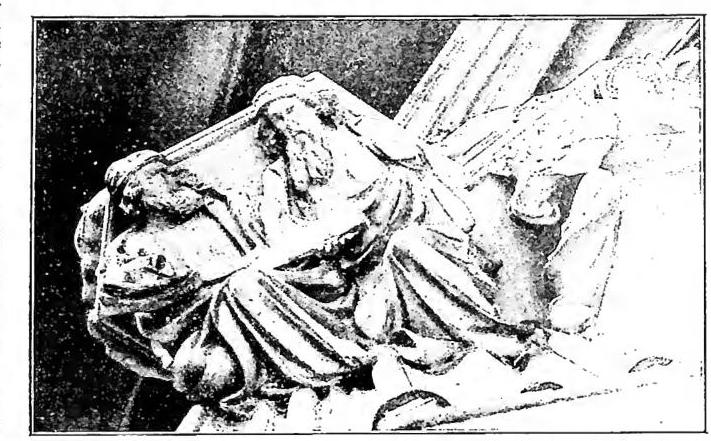
Of the old structure of the Charterhouse of Champmol, founded by Philip, there survives (besides the altarpiece by Jacques de Baerze and Broederlam in the museum at Dijon) the portal with the sculptures of Jean de Marville and Claus Sluter (1390-97). Sluter (q.v.), who was present in Dijon in 1385, became in 1398 successor to Jean de Marville (d. 1404) as “valet de chambre”; he was a sculptor of the highest importance for the so-called “courteous-international style”: he executed the celebrated Well of Moses (Champmol, ordered in 1395) and began the tombs of Philip the Bold and John the Fearless, now in the museum at Dijon, the first completed in 1411 by Claus de Werve (d. 1439) and the other in 1469 by Jean de Huerta and Antoine le Moiturier. From Cîteaux comes another of these famous Burgundian tombs, that of Philip the Bold (d. 1494), now in the Louvre. For the later periods it is enough to mention the late-Gothic church of Brou (beginning of the sixteenth century) and the elements derived from Italian Renaissance which appear in the churches of S. Michele at Dijon, of N.-D. at Bourg, and in the portal of Tonnerre. The same development from late Gothic to Renaissance can be seen in secular architecture, especially in the fine châteaux of Ancy-le-Franc, Tanlay, St-Fargeau, Sully, etc.
See Pl. CXIII.