
SANDRO BOTTICELLI (ALESSANDRO di MARIANO FILIPEPI). — Painter, born in Florence in 1445, died there on 17 May 1510. The same Filippo Lippi, Botticelli’s master according to the sources, must be accepted—despite the profound difference in temperament—as an important element in the formation of Botticelli’s style. In Lippi’s works from the period after 1460—the famous Madonna and Child with Saint John at the Uffizi, some of the frescoes at Prato, including The Feast of Herod—the young Botticelli found certain rhythmic cadences and a new relationship, no longer geometrically perspectival, between volume and space. Indeed, his earliest activity consisted of a series of exercises translating these into a more linear language and a more slender and refined typology than the aforementioned Madonna by Lippi, while in the rectangular Adoration of the Magi in London he strove to animate Lippi’s static compositional schemes from Prato with freer linear developments. Another series of Madonnas (at the Louvre, the Accademia in Florence, London, Strasbourg, the Uffizi, Duveen, Naples) and some portraits (Hearst, Pitti) show Botticelli engaged in a more serious engagement with formal problems under the influence of Verrocchio in the period before 1470. This leads to his first dated work, Fortitude (Uffizi, 1470), in which the clear illustrative references to Verrocchio are combined, in terms of style, with a linear vigour derived from Pollaiuolo. A lively work, full of ferment and potential, but—despite the enthusiasm of Ruskin and many later critics—still fundamentally prosaic.
As Botticelli now distances himself from Lippi—though echoes of the latter’s motifs occasionally persist—and from Verrocchio, he deepens his own experience of Pollaiuolo’s art. Pollaiuolo offered an example of a style in which line assumed the function of organizing and articulating the entire plastic form through an uninterrupted and unresolved tension, decisively surpassing the Florentine tradition of plastic-spatial equilibrium. Soon, however, under Botticelli’s brush, the taut, springing line of Pollaiuolo relaxed into the quiet flow of a melodic thread, opening into a broader lyrical expanse. Thus, alongside still immature works, there arose the first Botticellian masterpieces: the Chigi Madonna in Boston, the portrait of a gentleman with the medal of Cosimo the Elder, the two stories of Judith and Holofernes at the Uffizi, and the Saint Sebastian in Berlin (1474). These are the first clear, albeit tentative, notes of that linear melody which the artist would later orchestrate on a grander scale in his mythological works of maturity.
In the Saint Sebastian, the Pollaiuolesque exemplar (probably the Saint Sebastian in London) is viewed, in a humanistic spirit, through the lens of Polyclitan ponderation, so that the image projects into the suggestive distance of poetic memory, and the dramatic torment of unresolved tension is resolved in the harmonious conclusion of the vibrant motion of the line into a more serene vision. From this period comes the Adoration of the Magi at the Uffizi, pleasant and famous, but perhaps somewhat descriptive. In 1475, Botticelli painted Pallas on the banner carried by Giuliano de’ Medici at the joust celebrated in Poliziano’s verses; an echo of this survives in a wood-inlay translation on a door of the Palazzo Ducale in Urbino.
The period of formation is now closed, and that of maturity begins with a series of portraits (at the Filangieri in Naples, the Victoria and Albert Museum in London, and others less certain), including the commercial portrait of Giuliano (probably 1478), known in four versions (the autograph ones likely being the Kahn version and that in a private Italian collection published by Bettini, pl. 46), and with the Primavera, executed shortly after 1477 to illustrate two famous stanzas by Poliziano. Here, no longer is there the interplay of volumes set within perspectival space; instead, the line, with its continuous melodic flow, organizes the composition: so that the picture is not grasped at a glance but is read from right to left, and the compositional unity arises from the temporal succession of images, as in poetry and music. This line is not, however, mere arabesque; it does not deny form but serves as the decorative resolution of the movement of volumes. Thus, the vision fixes on the ideal limit of time in which action passes into the presentation of images: hence arises that impression of indefinite duration of the act, by which reality is transfigured into dream, and history into myth.
Another masterpiece from 1480 is the fresco of Saint Augustine in the church of Ognissanti. Unusually monumental and of heroic tone (as is also the slightly later Saint Thomas in the Allegg collection in Zurich), in which, however, the line, concluding in a melodic cadence, tempers the heroic power of the rotating planes. After painting a passionate Annunciation in San Martino (1481), Botticelli was summoned to Rome to begin, alongside Cosimo Rosselli, Ghirlandaio, and Perugino, the decoration of the walls of the Sistine Chapel. With assistants, he painted several portraits of Popes and three scenes from the lives of Christ and Moses; these frescoes are generally judged by critics to be inferior in quality to his panel paintings and are to be appreciated analogously. Yet in one of the three, Moses and the Daughters of Jethro, the painter achieves compositional unity by inserting the diagonal movement of the landscape into the angular and contrasting rhythm of the figures, whose tension relaxes into the pastoral song of Jethro’s daughters at the centre of the foreground. And a new dramatic spirit breathes through it, to which the influence of Signorelli may not be unrelated; an echo of which is also seen in another Roman work, the Adoration of the Magi in the Mellon collection, level in its linear rhythm, an anxiety that expands and calms into an idyllic note within the vast, almost Umbrian landscape.
In the summer of 1482, Botticelli was back in Florence, occupied with works now lost for the Magnificent, and in the painting—executed with considerable help from pupils—of the panels depicting the story of Nastagio degli Onesti (1483). The Madonna and Child with Two Saints John in Berlin dates to 1485, and close to it is the Magnificat tondo at the Uffizi. Amidst many retouchings, the expression of suspended souls in a moment of quiet adoration is clearly discernible: the slow curving of the contours in the figures harmonizes with the circular frame, and in the background the serpentine line of the river and hills reprises, until it fades into distant indefinites, the subdued music of the line in the group. The Madonna of the Book at the Poldi-Pezzoli recreates, in more concentrated solitude and with a subtler vibration of the soul, the theme of the Magnificat.
From this time also date two mythological paintings, Pallas at the Uffizi and Venus and Mars in London, and three portraits of the beautiful Simonetta (the autograph one probably being that in the Noak collection). It was in this meridian era of Sandro’s imagination that The Birth of Venus arose, one of his highest and most typical masterpieces. The spatial amplitude suggested by the quiet spreading of the verdant mass of water and marked by the slender tongues of land long penetrating the sea has no rigour of perspectival construction, thanks to the continuous unfolding of the line. Space is identified with the plane of the images’ placement, while the rhythm of the line’s development is identified with the rhythm of the rotation of the volumes. Thus, action imperceptibly passes into absorbed contemplation, and the images remain suspended, in melancholic perplexity, on the timeless horizon of myth.
Perfectly consonant with the spirit of The Birth of Venus are the frescoes for the Tornabuoni-Albizi wedding at the Louvre (1486), while a certain sign of fatigue, of “botticellismo,” appears in the Madonna of the Pomegranate (Uffizi).
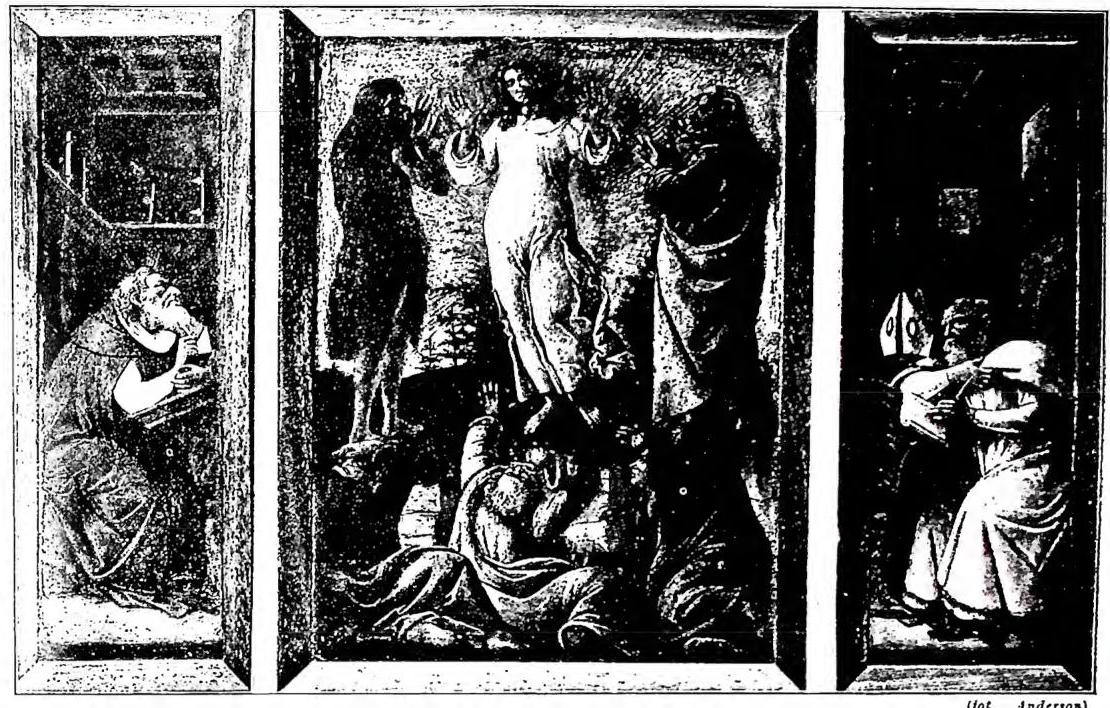
From this point onward, with the *Pala of St Barnabas* (with that predella of bare, starched, desolate backgrounds), the *Annunciation* (1488) and the *Coronation* (1488–90), all in the Uffizi, the *Derelitta Pallavicini* and other works, a new sense of pathos begins to permeate B.’s oeuvre. The drawings for the *Divine Comedy*, probably executed between c. 1488 and c. 1495, attest to this as well. Until the rhythm of the lines becomes tormented and broken in the *Calumny* (Uffizi), a work all too typical of this moment (c. 1495), where an excess of eloquence seems to disturb the serenity of vision, as though the ethical drama of the subject were too immediately present to the artist’s spirit for him to detach himself from it and contemplate it as a pure image of fantasy.
The artist’s spirit was certainly much troubled in those years, and therefore the traditional hypothesis that he was shaken by the dramatic events that agitated Florentine civic life from the death of Lorenzo (1492) to the martyrdom of Savonarola (1498) is acceptable—especially since his brother Simone, with whom he lived, is known to have been a fervent follower of the friar. Yet this turmoil often achieves full artistic catharsis in many works of this final period: from the small panel of St Augustine in the Uffizi to the stories of Virginia (Bergamo) and Lucretia (Boston) of 1499, the two *Lamentations* in Munich and at the Poldi-Pezzoli, up to the apocalyptic *Crucifixion* in Cambridge, U.S.A. (1501) and above all the splendid *Nativity* in London (1501).
Against a background of luminous chromatic clarity, there unfolds a sequence of the most piercing notes in the lacerating tension of darting, slashing lines: an acutely lyrical force shakes the stupefied atmosphere of a miraculous, crystal-clear morning like the sound of a trumpet blast.
From the mytho-idyllic visions of the *Primavera* and the *Birth of Venus* to the lacerating drama of these last works (to which may be added, around 1505, the *Miracles of St Zenobius* in Dresden, New York and London), it may seem that the trajectory of B.’s art strains beyond every logical limit. Yet the unity of his language—absorbing through allusion every value of volume and space—ensures the unity of artistic vision throughout all phases. Thus, if the serene fancies of his youth were not without a subtle melancholy, a poetry of exile, as has been said, the tormented visions of his later years do not lack that fabulating spirit which projects every image into the astral distances of myth. The artist’s inspiration always ignites where motion passes into pose, at the point where life becomes contemplative memory. Here, in the infinite varieties of tone, lies the lyrical core of his lofty poetry. — See Pl. CXVIII.