
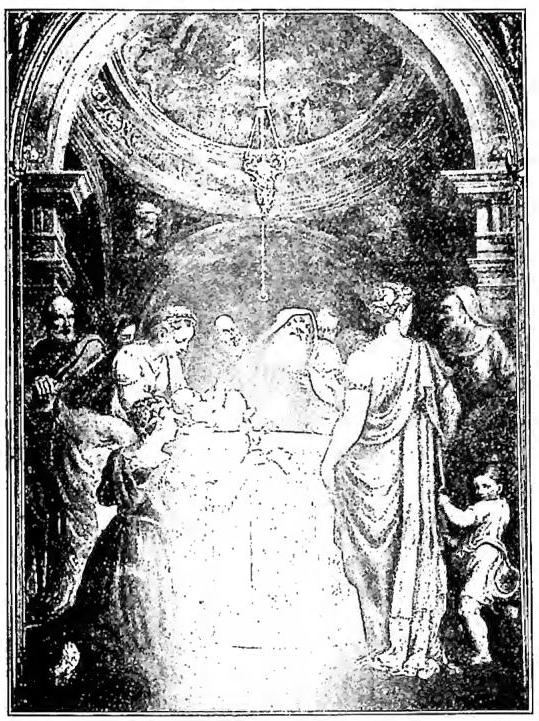
His first work is the *St Christopher* in Santa Maria del Castello, at Viadana. Worth noting are a *Madonna and Saints* at the Brera and the *Madonna between Sts Roch and Sebastian* (1518) in San Sebastiano, Cremona. His son Giulio (c. 1502–72) surpassed local tradition, looking especially to Pordenone, Romanino, and Titian; later hinting at the Mannerist taste of his language in the frescoes of Santa Margherita (1547) and the Cremona cathedral (1566–68). The influence of Pordenone is evident in the *Adoration of the Child* at the Brera. Avronio (d. c. 1591), another son of Galeazzo, showed in his works disparate influences, especially those of Parmigianino, Giulio Romano, and Pordenone. From the harshly decorative Mannerism of his early period (*Annunciation* in Sant’Agostino, Cremona; *Fall of St Paul*, Milan, etc.) he moved toward a naturalistic luminism, precociously Caravaggesque (*Beheading of the Baptist* in San Paolo, Milan).
This reform in a naturalistic direction reached its peak, with a taste for still life and genre scenes, in the art of Vincenzo (1536–91), Galeazzo’s last son; works by him are found in Milan (Civic Museum) and at Kirchheim castle. Bernardino (c. 1522–96) was subject to various influences (Parmigianino, Giulio Romano, Correggio); he produced numerous works, both paintings and frescoes, in Cremona (church of Sant’Agata), Piacenza, Milan, etc. Notable is the *St Cecilia and St Catherine* in San Sigismondo, Cremona.