
I. Birth and Early Years
A man of energetic and lively personality, rich and complex, fascinating both as a man and as a leader, C., whom contemporary chroniclers—an unusual fact in history—called "the Great," hastened the natural ripening of the times, closing the barbarian age and opening the feudal civilization. Between the decline and fall of the Empire in the West and the rise of the Holy Roman Empire in its most singular representatives—Otto I and perhaps Barbarossa or even Frederick II—his is the greatest character; he stands out powerfully against the background of the Frankish people, Christianized but still primitive, and impetuously brings them to dominate the European stage, shaping its face—which would remain for the long Middle Ages—after the first emergence of autonomies following Rome’s disintegration.His work is linked to that of his father and grandfather (and viewed in this light, it is their careful and sagacious perfection), his place is in the great current of Christ’s and the Roman Church’s neophytes, though he adapts to it with the freedom of an exuberant temperament; his action is by no means a continuous sequence of miracles or successes. Yet where the habit of compromise still prevailed, he substituted a straight and sure line, clear and coherent action that did not halt until its goal was achieved. By expanding the boundaries of Pipin’s not insignificant kingdom, he clearly pursued the realization of a Christian empire that would become the grand legacy of the Middle Ages and its highest achievement, until the formula—harmonized in the Lateran mosaic, *"Beate Petre donas vitam Leoni papae et victoriam Carolo regi donas"* (Blessed Peter, you grant life to Pope Leo and victory to King Charles)—of perfect balance and unity between the supreme powers waned in the face of the rising individual conscience. And perhaps C.’s greatness lies more in his defeats, which he accepted as warnings and used as lessons, in his tenacity and patience that initially joined in him with swift moves and immediate perception of reality. Though he was an heir to tradition, he was also, in contrast to
enemies and friends alike, as a force of nature: not only for his physical qualities, but also for his moral ones, and for his personal worth, but also for the scant attention given to biographical data and information about his personal life, so much so that the silence, even from the closest sources, regarding his life before his accession to the throne may even appear as a device to exalt his personality beyond customary limits. From nature he has the gift of shifting from violence and restless fervor to serenity and great calm, from recollection and expectation to a superior equilibrium, which is the quality that most astonishes and elevates a man, even one steeped in passions; while there is nothing he does not understand or escape him—and even in theological matters he wishes to leave his mark—just as he, uneducated and nearly illiterate, becomes the driving force behind a cultural movement that will remain linked to his name.
He was perhaps born in 742 (if it is true, as Eginardo writes, that C. died at the age of seventy-two according to a late obituary from the monastery of Lorsch), on April 2, from the stock of the ancient mayors of the palace who had, first in fact and then in name, supplanted the Merovingian dynasty, continuing with renewed energy their work of unifying France. As uncertain as the date is the place of his birth: so much so that it has been inferred, even to explain the absence of any details about his youth and the careful silence of the sources, that he was born before his parents’ marriage, and his illegitimacy might perhaps explain the deep hostility of his brother toward him.
He was born at the end of the first year of his father’s rule, Pipino the Short, since Carlo Martello, victor at Poitiers and founder of the power of the dynasty, had died in 741. As a nine-year-old, he witnessed the fulfillment of his father’s plan, with the deposition of the last of the *rois fainéants*, Childeric III; while, with the Lombard invasion of the Exarchate and the Duchy of Rome and the pope Stephen II’s journey beyond the Alps in search of Frankish aid against Astolfo, the drama of Italy, the Church, and Rome was unfolding, a drama that the unaware child would one day be called upon to resolve. Certainly, among the rare recollections of the future emperor’s youth is the meeting, to which his father brought him, between Pipino and Stephen II, with his younger brother Carlomanno. At Ponthion and Quierzy the foundations were laid for agreements whose distant origin was to be the *Respublica Romana Francorum* and the renewal of the Empire in the West, and in the meantime the *Promissio Carisiaca* (based on the claim, expressed in the forged *Constitutum Constantini*, of ecclesiastical circles to dominion over vast ex-imperial possessions) and the conferral upon the king of the Franks of the Roman patriciate. On August 28 of that year, 754, C. was present at the ceremony in Saint-Denis in which the Pope crowned Pipino and Berta (or Bertrada), and was consecrated king by Stephen II, together with his brother Carlomanno. In return, Pipino marched against the restless Astolfo, in the first and then the second war, since the agreements made with the Lombard had not been kept. Then, between 760 and 763, C. appears in some monastic donations, accompanies his father on the expedition to Aquitaine, and receives certain counties.
The death, in the flower of his age, of Pipino, on September 24, 768, brought the two brothers to power. The Frankish kingdom was divided by testament: to C. went Austrasia and Neustria north of the Oise, and to Carlomanno Neustria south of the Oise, Burgundy, Gothia, Alemannia, and Thuringia. The contested Aquitaine was also divided. The future capital, Paris, lay within Carlomanno’s domains. The Lombard kingdom of Italy bordered on his; Bavaria, semi-independent under Tassilo, cousin of the Frankish kings and son-in-law (like Arechi of Benevento) of the Lombard Desiderius, bordered on C.’s possessions. On the same day, October 9, the two brothers, each in a locality within his own kingdom (C. at Noyon), were consecrated kings. There was no concord or goodwill between them: this was shown by the revolt that broke out shortly afterward in Aquitaine, which C. was forced to suppress on his own, while appeals to his brother proved futile. In an attempt, perhaps, at a turning point that might bring peace, a policy was now devised, above the activities of the two kings, by the queen mother, Bertrada: reversing the cautious, if far-sighted, policy of Carlo Martello and Pipino—an alliance with the Church against the Lombards and intervention in Italy—she became the instigator of marriages between C. and a daughter of Desiderius, Desiderata, and between the sister of the Frankish kings, Gisela, and a son of Desiderius, perhaps Adelchis, the eldest. For this, an unheard-of act for a woman of that time, Bertrada traveled to Pavia and then to Rome to persuade the Pope of her move, and returned to France via Pavia, bringing back with her the bride for her son C. A policy of peace and détente was taking shape, one that went well beyond a family understanding: in reality, the antagonistic thrust of the Franks was replaced by a three-way Franco-Lombard-Bavarian agreement, of which Desiderius was the beneficiary, assuming a central position and freedom of movement in Italy, while the Pope found himself squeezed in an inescapable vise, in worse conditions—owing to the manifest weakness of Byzantium and the progressive decline of Greek influence in Rome—than in the time of Gregory the Great. It was perhaps also the means (which must have mattered most to Bertrada) of strengthening relations between C. and Carlomanno, who was pro-Lombard and pro-Bavarian and inclined toward a policy of peace.
Before meeting Bertrada, the new pope Stephen III wrote the least dignified letter in his not inconsiderable collection, using every means to prevent the young king from taking his bride from the “most nefarious” Lombard people. Even the canonical pretext of a previous marriage of the king was invoked (though this was a non-legal bond, even if it had not been without consequences: certainly not the last, despite C.’s four wives); but Bertrada’s will prevailed, and Desiderata became queen of the Franks around Christmas of 770.
II. Conquests in Italy
Few months pass: and by the end of 771 the young daughter of Desiderius is sent back to her father, and the understanding pursued by Bertrada is broken. The fact is that on December 4 Carlomanno had died, and C., disregarding his brother’s sons, had himself acclaimed king also in the other part of the realm, while the widow of the deceased, Gerberga, with her orphans, took the road to the court of Pavia, thus abruptly severing relations. These events are closely connected, but in turn they have their explanation in something that may have had the power to bring C. back to the path marked out by Pipino. Having secured his rear with the new marital policy, Desiderius had resumed his push toward the lands considered the patrimony of St. Peter, perhaps pursuing the vain dream of a Lombard Italy, whose foundations had been laid with the duchies of Spoleto and Benevento. To detach from the Pope’s side the leaders of the anti-Lombard party, Christopher, primicerius of the notaries, and his son Sergius, secundicerius, and under the pretext of settling the long-standing dispute over the rights of St. Peter, Desiderius had gone to Rome: tumults had broken out between his band of *fideles* and the two notables,appointered by only slender Frankish contingents (of their presence there, perhaps dating back to the beginning of the reign of Carloman, little is known) the Lombards had prevailed. The Pope, making the best of a bad situation, had abandoned his friends to Desiderius and his intermediary or representative, the cubicularius Paul Afiarta, and had even written to the Frankish court, reviling the memory of the former and praising the conduct of the latter. But, virtually a prisoner, what he affirmed about the restitutions carried out had little value. These had neither occurred nor were they about to occur: the Roman Church was well aware of this. Similar and other news, reaching France, must have aroused discontent there and a reaction against Bertrada’s policy. The death then of Carloman, and the reunification of the two parts of the kingdom, gave Charlemagne a free hand
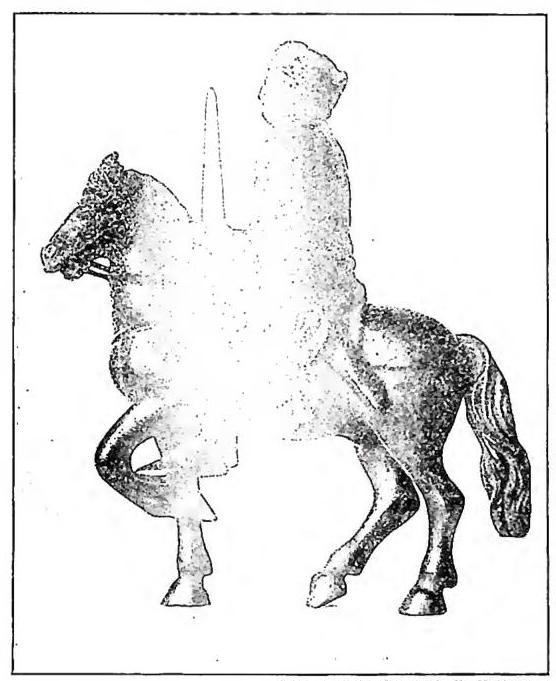
Charlemagne = Equestrian bronze statue of Charlemagne, Paris, Carnavalet Museum.
to change his game: and a clear sign of this is the repudiation of his Lombard wife. From peace at any cost, the situation rapidly moved toward war, also due to the influence exerted by the wound opened in Desiderius’s soul.
To Stephen III, a pope of quite different caliber, succeeded Adrian I, of noble Roman stock and above factional strife. There was an exchange of embassies between Rome and Pavia, but to no avail: on one side, Adrian no longer trusted the promises of the Lombard king, while on the other, Desiderius was now drawn by a program of vengeance against the offender of his daughter and demanded from the Pope recognition of the orphans of Carloman, his wards, who could have renewed the situation to the advantage of the Lombards. Perhaps there was a prudent refusal by Adrian I. Certainly, Desiderius invaded the lands of the Exarchate, holding them as a pledge to secure the Pope’s solidarity. The treacherous killing of the envoy, Afiarta, pushed relations between the Lombards and Rome to the breaking point: the Pentapolis was also accused and Roman Tuscany invaded. At this juncture, Adrian repeated the move of Gregory III and Stephen II, invoking the aid of the Franks. But this would not arrive in time (Desiderius, with renewed fury, had resumed his march on Rome with an army, bringing with him the widow and the two sons of Carloman), had not the threat of anathema once again (as between Gregory II and Liutprand) stopped the king and forced him to retreat as far as Pavia. The relations, however, did not improve: each of the contenders was now committed and could not withdraw. Whoever yielded could only lose. Even regarding the rights of St. Peter. In vain, Charlemagne made the gesture of a monetary payment almost as ransom for the contested and conquered territories. To the negative response, the Frankish intervention took shape, rendered inevitable by considerations of prestige for the sovereign and his dynasty.
Dividing his army and entrusting part of it to his uncle Bernard, Charlemagne, after an assembly of the magnates at Geneva, descended through the Mont Cenis Pass: the encircling maneuver closed in the Dora Riparia valley behind the defensive line arranged at the Chiusa by Desiderius and his son. The rout was complete: the surviving Lombards shut themselves up with Desiderius in Pavia and with Adelchis and Gerberga in Verona. It was September 773. Soon Verona surrendered. The siege of the capital lasted until June, yet this did not limit Charlemagne’s activity in the peninsula. After the surrender came the submissions of the dukes. King Desiderius, Queen Ansa, and their daughters were confined to monasteries: nothing more was heard of them. Of the royal family, only Adelchis, who had escaped the surrenders of Verona and Pavia, remained a proud adversary of the Franks, and as an exile on the Bosporus, he would fan the flames of hatred at the Byzantine court against them. Charlemagne assumed the double dignity of King of the Franks and of the Lombards: the personal union of the two crowns left the Lombard institutions intact; outwardly, everything seemed to continue along the same track, as if no revolution had taken place. In reality, drawn into the Frankish orbit so thoroughly as to leave no room for hope or illusion (only in Friuli did a revolt flare up, only to be swiftly crushed), the Lombards in 774 had nothing left but their name.
Charlemagne had not waited for the fall of Pavia to go to Rome: in the spring, while the Lombard kingdom was already crumbling, accompanied by his magnates, he set out on the journey, met thirty miles from the city by representatives of the clergy and militia, who then lined up outside the walls in his honor. Adrian I awaited him before St. Peter’s, embraced him, and led him by the hand into the basilica, while the clergy sang “Benedictus qui venit in nomine Domini.” It was the Byzantine ceremonial applied to the Frankish monarch. The festivities lasted several days: on the fourth, Pope Adrian demanded of Charlemagne confirmation of the agreements made between Pepin and Stephen II, and the donations envisaged in the *Promissio Carisiaca* (there is debate over the extent, since it is impossible to credit the biographer of Adrian in the *Liber Pontificalis*). It was, in any case, an entry into those relations of collaboration that the conferral and acceptance of the patriciate rendered natural: with the limitation, however, that now he was also the patrician king of the Lombards and thus bound to reconcile the temporal and Italian interests of the papacy and the crown.
Perhaps Charlemagne had not come down to Italy with a precise intention or plan regarding further action. The victory at the Chiusa revealed to him the inner weakness of the Lombard monarchy: its dissolution, while the siege of Pavia still lasted, gave him, in concrete terms, the opportunity for the personal union and fusion of the vanquished and the victors; the Roman journey must have awakened his deepest sentiments, in contact with the ancient ideal of universal dominion. The Italian campaign, after the test case of the Aquitanian revolt, revealed to him immense possibilities of action, the decisive act by which he emerged from the careful and sagacious preparations of the mayors of the palace to pursue a policy of Frankish predominance. That this policy would later expand and rise to become an expression of empire already universal in itself was due to the fascination and influence of Rome.
From 774 to 800, when the name of Empire rose again, passed the most intense years of Charlemagne’s activity, those in which, with a now clear orientation but never abandoning prudence and balance, he gave unitary form, as in the ancient Empire, to Western Europe; the years also of continuous relations with the popes, Adrian I and Leo III; of religious expansion, for the Christian idea (and war as its instrument) became the
The king’s activity had a religious substratum, but he was also conscious of the political value of the idea that inspired him.
III. Conquests outside Italy
These are the years in which the triple thrust becomes evident: toward Saxony, toward Bavaria, and along the middle Danube. The struggles against the Saxons, the warlike tribes still pagan in Westphalia, last, one might say, throughout the reign of CHARLEMAGNE: it is a series of revolts, with the rise of a true national hero, WIDUKIND, who forces the Frankish king to continuous campaigns, sudden returns, and who leaves him no security in his rear; and he reacts violently with massacres (4,500 dead at Verden), the destruction of idols, and mass forced baptisms. Yet there is gradualness, there is, amid undoubted ferocity, prudence; and there is, as in the Italian enterprise, a pursuit of the goal to its achievement, with the tenacity that scatters the ranks of others. The Bavarian question is simpler: it is all in reducing Bavaria from a semi-independent state to a region of the Empire; and it is a family matter, which brings us back to relations with his brother-colleague, CARLOMAN. The duke of Bavaria, TASSILO III, who had not moved to prevent the fate of the Lombard people, realized belatedly his mistake: the sources ascribe to his wife, the Lombard LIUTBERGA, daughter of DESIDERIUS, the weaving of plots with the Byzantine court (where ADELCHIS was) and Beneventan court (where the other sister, ADELBERGA, was). Even at Ratisbon, as at Benevento, the weakening of the central Lombard state and the supposed acquiescence of the Franks increased ambitions: from duchy it passed to principality, and for Bavaria dreams of independence arose, while Carinthia was annexed. With the sharp decisiveness that was his characteristic and strength, CHARLEMAGNE, in 782, as soon as the Italian kingdom was consolidated, cut short Tassilo’s ambitions. At the assembly of Worms, Tassilo swore an oath of vassalage and left hostages. But he resumed his plotting: discovered again in 787, fearing CHARLEMAGNE’s vengeance, he sought the support of the Church, before which Bavaria, a Catholic kingdom and always faithful, could not fail to find favor. But the king did not stop at the prayers of his “frater suus” ADRIAN; he forced him rather to take a position against the rebel, that is, against one who withholds the loyalty due to his lord; and in 787, after a new expedition, Tassilo yielded and renewed his oath. To begin again, perhaps his heart could not bear to see his state reduced to the rank of one of the many duchies of the Frankish kingdom. This time CHARLEMAGNE no longer pardoned: condemned to death, Tassilo ended his days in a monastery, and Bavaria, as such, ceased to be an individual entity in history. Bavaria was a necessary bridgehead for the third enterprise: that against the Avars, whose movements in the middle Danube region foreshadowed a new leap toward the West. To stop them in time, amid the continuation of the Saxon campaigns, was the concern of the Frankish court: at first peaceful means were tried, so that at the assembly of Worms envoys of the Khan were seen, and one can imagine Franks at his court. But when some collusion with the court of Ratisbon became clear and every agreement proved impossible, in 791 campaigns against the Avars were opened, long and bloody, which, after varying fortunes, ended with the forcing of the barbarian Ring, with immense booty and the slaughter of the vanquished, in 799. This time it was valiant lieutenants of CHARLEMAGNE who led the armies: the Bavarian duke GEROLD and the duke of Friuli, HENRY, both fallen in battle. Saxons, Bavarians, Avars: these were three points resumed from the program of PIPPIN the Short, with the strengthened relations with the Church and the settlement of the Lombard question. But what had been anticipatory hints were now achievements that seemed prodigious to contemporaries, and the breadth of horizons now allowed the outline of the immune construction of the Carolingian Empire.Elsewhere, for Benevento and Spain, which were the points of junction and friction with the only two terrestrial powers that CHARLEMAGNE felt equal to or in any case formidable — the Byzantine Empire and Islam — he showed quite different prudence. Only on his fourth descent into Italy did CHARLEMAGNE show that he was aware of the Beneventan prince’s pretensions to independence and the danger he represented, allied to his enemies, ADELCHIS and TASSILO, and certainly not hostile to the Byzantine court itself: but then, in 786, and subsequently, he took good care not to push matters very far and was content with the reconfirmation of the Beneventan duchy in the same state of dependence in which it had been toward the Lombard crown. Even when the sudden death of AROCHIS and his eldest son ROMUALD placed in his hands, with the second son GRIMOALD as hostage, the new duke, he did not refrain from sending him back, at the insistence of his mother and people: and yet he was aware that GRIMOALD, even if he should at first prove loyal by opposing the Byzantine invasion led by the logothete JOHN and by ADELCHIS, could not but follow the path of instinct and be among the natural enemies of Frankish power in Italy. In Spain, in the clash with the Muslims (and here too one must recall PIPPIN: the capture of Narbonne), he acted, especially after the ambush at Roncevaux, with extreme caution, motivated less by the dream of conquering the peninsula than by the will to place a bulwark between Muslims and Christians of southern France: and this was the Hispanic March. One may ask why CHARLEMAGNE did not pursue his Beneventan or Spanish attempts further, and why he was not the unifier of the peninsula, indeed of both peninsulas, Italian and Iberian, thus anticipating history by centuries. Behind Benevento stood the Byzantine Empire, which stretched its thousand tentacles into southern Italy; behind the Muslims of Córdoba stood, even though he considered them rebels, the power of the caliphate of Baghdad, ruled by those Abbasids whose splendor always aroused CHARLEMAGNE’s admiration. By way of marriages (of a daughter with the young CONSTANTINE or of himself with the empress IRINE, the blinding one) or, as would later be granted him, by a clear delimitation of spheres of influence, CHARLEMAGNE sought for years an understanding with the Eastern Empire; just as, by an innate taste for knowing and drawing near, he wished to exchange embassies and gifts with the Caliph, that unattainable HĀRŪN AL-RASHĪD.
voloso sovereign over a world whose limits were not even conceived. But when relations with both courts grew closer, a decisive event had already taken place in the West, bringing with it new experiences and needs: the experiences and needs of the resurrected Empire.
IV. Schools and Culture
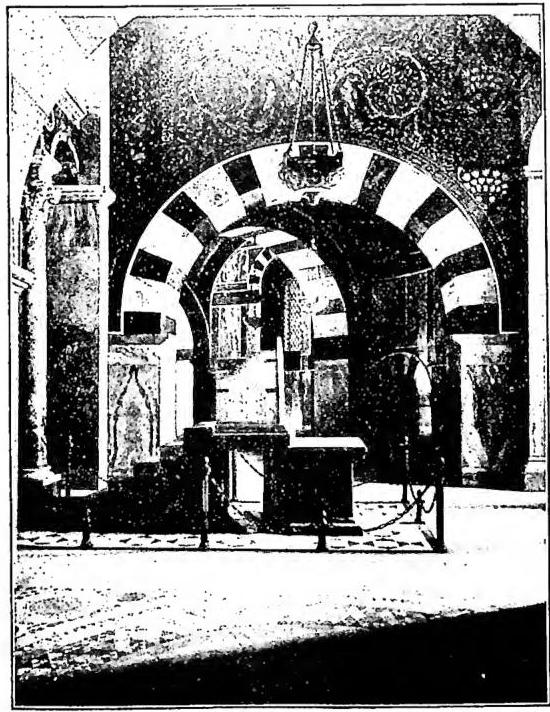
What had been outlined through conquests and vassalage during the intense work of CHARLEMAGNE, stretching from Britannia, which acknowledged itself as tributary, to the Hispanic March, from Aquitaine to Langobardia with its dependent duchies, to Westphalia, Bavaria, and Slavia, was the largest aggregate of nations the world had known since the Roman Empire. Not a unitary State: CHARLEMAGNE left each people their customs and institutions, contenting himself with a religious-military formula from which feudalism would draw great strength, thus favoring the autonomy of the great lords, which he, however, sought to level. But the reward for loyalty had become a principle of government for him. Yet from the Carolingian creation—a creation, let it not be forgotten, of barbaric origin—no harmonizing civilization could develop, as had been the case with the ancient Empire. The unifying element that had drawn its greatest expansion precisely from the Frankish countryside remained the Church. And CHARLEMAGNE drew close to it, recognized its value, and developed its civilizing potential to the fullest: yet without sacrificing any of his authority as regulator of temporal affairs, or his powers as a ruler whose sense of authority derived from God and for which the Pope could only serve as an intermediary. As long as the Chair of Peter was occupied by a man like Hadrian, who, though perhaps more concerned with establishing a temporal foundation for the papacy, was nonetheless an upright and enlightened shepherd, there was no discord or problem that could not be peacefully resolved. But when, at the end of December 795, Hadrian was succeeded by the obscure Roman priest Leo III, lacking unanimity and of a more pliable temperament, the king’s hand grew heavier. A new problem then arose in the relationship between the king of the Franks and Lombards and Patrician of the Romans and the Pope, just as the relationship between the Empire of the East and the resurrected Western Empire had been redefined after Christmas 800. The other problems, however, could be said to have been resolved or set on the path to resolution.With remarkable clarity, CHARLEMAGNE preserved the greatest autonomies without fearing them, placing his sons at the head of certain territories with royal titles, though in reality with viceregal powers: Pippin in ex-Lombard Italy, Louis in Aquitaine. Sensitive to the currents of culture, the arts, and the sciences, so much so that he desired careful and complete education for his sons, he gathered around him scholars, artists, philosophers, and scientists from every background, entrusting them with the establishment of a palace school and an academy in what, definitively departing from Frankish tradition, was now the fixed seat of the court and the resplendent capital of new constructions and artistic treasures: Aachen. Here converged the Anglo-Saxon Alcuin, the Lombard Paul the Deacon, and the Frank Einhard: the first, the greatest scholar of the age and an expert advisor to the king, met by chance in Parma in 781 and never forgotten thereafter; the second, who had come to Francia to plead the cause of Lombard prisoners, among whom was a brother, and who remained there almost as a pledge of superior collaboration in the ideal and interest of culture, the great historian of his people; the third, the most faithful, his biographer, attentive and acute. With them also appeared Peter of Pisa and Paulinus of Aquileia, a grammarian and a poet, the king’s chivalrous cousin Adalhard (the only one to lament the fate of Desiderata, the most unfortunate), Rabanus Maurus, Gottschalk, Jonas, Agobard, Walahfrid Strabo, Ermoldus Nigellus—also a Carolingian—and then Ethelwulf, Angilbert, Fredegisus, Theodulf. His conquests expanded the realm of faith, but also, in turn, of culture: churches arose, and within them, schools. Episcopal schools for higher studies also emerged: the State’s intervention is evident when one considers, for example, the capitulary of 825 by Lothar, which stands as the living legacy of the great emperor’s intentions.
V. Relations with the Church
Personal inspiration and state interest also led him (and here a negative aspect of his centralizing personality was reflected) to direct interventions in the most jealously guarded sphere of the Church: in matters of ecclesiastical discipline and theological controversies. As the driving force behind the missionary activity that, from St. Boniface to St. Willibrord, had reached its greatest impetus, CHARLEMAGNE did not hesitate to give instructions to the clergy himself, to judge them, and to regulate liturgy (v. below). But at the heart of his concerns were theological problems, whose distance from the passions of politics he did not perceive—or if he did, he wished, through his authority, to help steer them toward what he considered the right path. Indignant that the Council of Nicaea had been able to be defined as ecumenical without his participation (though with that of the papal legates),From the year 787, which definitively condemned iconoclasm, he himself did not refrain from convening a council at Frankfurt, where the issue was reopened and where it was established (and, with the support of secular authority, took on the force of law) the obligation of the ecclesiastical tithe. The embarrassment of Pope Hadrian was considerable when, with the *Libri Carolini*, the entire question of images was taken up again in opposition to the decisions of Nicaea, even if it did return to the felicitous expression of Gregory the Great, that images could be objects of veneration only insofar as they served to stimulate devotion among the masses.
Thus, in the matter of Spanish Adoptionism (the heresy that made Christ, as man, the adopted son of God, recently upheld by Felix, bishop of Urgel) and in that of the *Filioque* (the Holy Spirit proceeds from the Father and the Son: *a Patre Filioque procedit*), he wished to intervene, securing the condemnation of the former and the promotion of the latter in synods he himself presided over. And nothing availed the Pope’s sincere warnings. But the times were not yet ripe for a clash, in this arena, between the two powers. Only death, moreover, probably halted Charlemagne in his design for a general ecclesiastical reform, traces of which remain in the sources and in the work of continuators of the Carolingian movement, such as Hinemar of Reims and Gerbert of Aurillac.
A zealous guardian of the rights of the state, few acquisitions were permitted even to Hadrian himself: the confirmation of the *Promissio Carisiaca* amounted to a mere formality, and the aspirations of the papacy to the ex-Lombard territories were largely frustrated, except for the retrocession of southern Tuscany, where, around Viterbo and Orvieto, the *Patrimonium Sancti Petri* would take shape, forming, together with the Donation of Sutri, the foundation of the temporal state. Yet even in what he ceded or acknowledged, the authority of the king did not leave that of the Pope free: for, unlike Pepin, Charlemagne never for a moment neglected to attach to his title of patrician a meaning that was no longer merely honorific. In the face of the papacy, Charlemagne was indeed the devoted believer, but as a defender of the faith, he considered himself responsible for the order willed by God and thus assumed an attitude—one not always easy to sustain—that of protector. As patrician, he also gave substance to those special powers over the people of the Eternal City that the pontiffs had never envisaged except in a defensive role for themselves and their dignity.
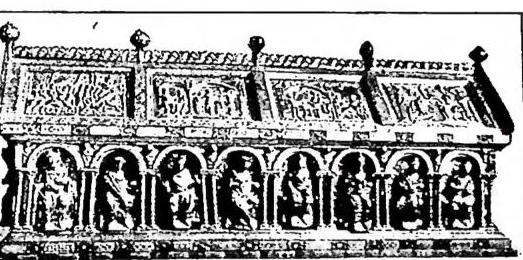
The situation worsened, and in a sense was resolved, with the succession of Leo III to Hadrian I. Whatever the pontificate of the latter had obtained in the way of Roman consent, the pontificate of his successor was from the outset undermined by strife and turbulence. Leo, barely elected, adopted toward the Frankish king an attitude almost of subjection: he wrote to him, announcing his election and promising fidelity and obedience, and sent him the keys of the confession of St. Peter and the banner of the city, requesting that he send a messenger to receive from the Romans the oath of fidelity. Charlemagne sent Angilbert and admonished the Pope, in his reply, regarding the duties of his office. Such open weakness may have been at the root of the Roman conspiracy of 799: on April 5, as the Pope was proceeding in procession to St. Lawrence, near the monastery of SS. Stephen and Sylvester, he was set upon by a mob of armed men, thrown from his horse, beaten, and left half-dead in the monastery of St. Erasmus (the legend, recorded by the papal biographer, claims that the Pope’s eyes were gouged out and his tongue cut out, from which he would later miraculously recover). Some faithful spirited him away at night and brought him back to St. Peter’s; from there, Duke Guinigis of Spoleto, who had hastened to the scene, took him to safety. But whether to excuse himself or to accuse others, the Pope resolved to make his way to Francia while Charlemagne was preparing a new expedition against the Saxons. In July, at Paderborn, the king and the Pope met, and Leo was accorded the greatest marks of deference. The Pope remained in Francia for two or three months, but the sources tell us nothing of his conversations with the king. Toward the end of September, with a large escort, Leo returned to Rome, arriving on November 30. With him came Frankish envoys charged with an investigation; Paschal the primicerius and Campulus the sacellarius were found guilty of the conspiracy and the attack and were sent as prisoners to Francia. The gravity of the events, however, made Charlemagne’s presence necessary—indeed, he had promised it to the Pope upon their farewell. He announced the task that awaited him, to restore peace in Rome, to the assembly at Mainz on August 800. He descended with an army (which, entrusted to his son Pepin, was to proceed from Ancona to the Beneventan duchy, though it never reached there, or was halted by the plague that was raging) and at Nomentum was received in person by the Pope and the Roman nobility. On November 24 he made his solemn entry into the city; a week later, in St. Peter’s, before a large assembly of ecclesiastical and lay notables, both Frankish and Roman, he convened the parties. A Frankish chronicler says that the Pope’s adversaries failed to substantiate their accusations. On December 23, in the same basilica, Leo III was induced to swear an oath to his own innocence. Only then, but a few days later, did Charlemagne bring Paschal, Campulus, and their followers before his tribunal and pronounce against them a sentence of death, later commuted to exile in Francia.
But between the last two acts of the Roman drama, on Christmas Day a grander ceremony had taken place. The flower of Roman and Frankish nobility was present at the Mass celebrated by the Pope. As the king knelt before the altar, Pope Leo placed a golden crown upon his head, while those present raised three times the acclamation: “To Charles Augustus, crowned by God, great and peace-bringing Emperor, life and victory!” Then, kneeling himself, the Pope paid homage to the new emperor.
It was, and so it was understood by contemporaries, the revival of the Empire in the West—and for it to occur in Rome, between
the exultation of the Romans, who since the first coming of C. had heard again the voice of the past (just as writers of every nation have since vied to celebrate the city that nourished universal glory), prevented people from dwelling too long on the fact that the one conferring the imperial dignity was the Pope and on the other, that another Empire was alive, beyond the sea, and likewise called the Roman Empire, until then unviolated by the barbarians, unlike the West. But if the Roman and Frankish circles, the politicians and literati of the two courts, among whom the idea of imperial exaltation had taken shape and who had skillfully stage-managed the scene, saw only its bright side, the emperor must certainly have pondered it, then and later, if the famous remark of Einhard (referring to the assumption of the imperial title: *quod primo in tantum aversatus est, ut adfirmaret, se eo die, quamvis praecipua festivitas esset, ecclesiam non intraturum, si pontificis consilium praescire patuisset*) truly reflects his own sentiment. Not perhaps so much on account of the part played by the Pope (though the different arrangement of Louis’s coronation at Aachen in 813 may carry some weight), but rather for the diplomatic repercussions of the act upon the court of Byzantium, to which Einhard’s subsequent text undoubtedly alludes (*Invidiam tamen suscepti nominis, Romanis imperatoribus super hac indignantibus, magna tulit patientia*, even though *vicit eorum contumaciam magnanimitate, qua eis procul dubio longe praestantior erat, mittendo ad eos crebras legationes et in epistolis fratres eos appellando*).
VI. Relations with Byzantium
C.’s position toward the Empire of the East was one of the utmost delicacy: the hostility aroused by the conquest of Lombard Italy had not flared into war only because of the patience and positive diplomacy of C., who had refused to embark on Beneventan adventures and had set the city of Rome as the limit of his interests on the peninsula. On the other hand, the independent stance of the Beneventan prince and the general collusion of the Byzantines with his enemies greatly disturbed him, even though distance and the lack of a fleet prevented any military solution. C., who wished for war only when peace proved impossible, anxiously sought avenues of agreement. This seemed possible when, during his third descent into Italy, at Rome in 781, Byzantine envoys came to ask for the hand of his daughter Rotrude for the very young Constantine Porphyrogenitus, who had ascended the throne the year before under the regency of his mother, the beautiful and ambitious Irene, who, by restoring the cult of images, was fostering a renewal of relations with the Roman Church and the West. It was a time when the papacy, under Frankish protection, was definitively shedding even the formal dependence on Byzantium: no trace of it remained in public and private acts or on coins. The Pope may well have taken advantage of the occasion to secure imperial consent to the changes in Italy and to the independence of the ecclesiastical state. But of the hoped-for marriage between the two young princes nothing is known: or rather, it is known only that it did not take place, perhaps because C. had come to perceive Irene’s ambitious designs or because of the subsequent clashes with Byzantium, whose complicity in the periodic revolts of Bavaria and Benevento became ever more evident. In 788 in Calabria, Franks and Lombards under Grimoald together halted the Byzantines who had landed there. Even in the religious sphere, C. convened a council at Frankfurt so that it, rather than the one at Nicaea, might be considered ecumenical. A shudder of horror swept through Christendom in 797 at the news of the outrage committed by Irene against her own son, whom she had blinded and confined in a monastery in order to seize the throne. The Empire was then regarded as vacant, both because of the crime and because it was held by a woman; and to the voices exalting Rome’s illustrious past were added the first ideas of a *translatio* of imperial dignity from the East back to the West.In this context of Franco-Byzantine relations, the Christmas ceremony of the year 800 falls into place, opportune from every point of view, indeed an element of singular value in his historical life to raise its tone and impart a salutary shock. But later, when word reached the East of the unfavorable repercussions there, and especially when the unfortunate usurper, with whom C. had attempted approaches, was succeeded by the energetic Nicephorus, it was wished—without repudiating the act itself—to shift the responsibility onto someone (and it was the Pope) and to leave open the path to what C. prized most highly: Byzantine recognition of the other Empire, arisen in the West. He would achieve this precisely through that steadfastness of which his biographer speaks, when Venice and Dalmatia fell under Frankish rule and the Greek court was greatly alarmed; the new conquests served C. as a bargaining chip for recognition and peace.
When this was signed at Aachen in 811, the long and intense life of the emperor was rapidly drawing to a close, darkened by the premature loss of his sons, King Pippin of Italy (810) and his eldest son Charles (811). The act of succession by which in 806 he had divided the great Empire (once again following his father’s example, but reserving the imperial title, of which so little is said) now had no further purpose: only one of his sons remained, Louis,
He received the epithet Pius. After the peace with Benevento had finally been concluded and the viceregal powers over Italy had been entrusted to the young BERNARDO, son of the valiant PIPINO, the emperor could die in his Aquisgrana on 25 January 814.
VII. THE FRANKISH EMPEROR
An immense construction, with contours too imprecise and a conduct too heavy, lacking unity and its own life, and therefore lacking stability, the empire of CHARLES, founded on the exceptional personality of its founder, may be said to enter into crisis as soon as he dies. It will be a long crisis: from 814 to 888. Yet even when, for the second time after the collapse of the Roman world, the nations and states of the West receive life from that crisis, the work of CHARLES will not appear less great and, in the eyes of history, less providential. From him, though he had traversed them, bloodied them, and held them firm with his iron fist, there emerge the great nations of France and Germany. Italy too owes him, even with the halt of the unifying Lombard function, at least the first unitary name of the Italic kingdom. Christian civilization becomes the common denominator of diverse peoples, the only possible basis for a moral and political unity subsequent to that of the Roman Empire. Which, if one looks closely, is the first European unity, that is, Western and surpassing the boundaries of Latinity or Germanic barbarism, and founds and sets in motion an organic process of culture.Tradition and personal creation are harmonized in the work of CHARLES. With the coronation of 800, LEO III paid the debt contracted toward the Frankish people, a faithful neophyte of Christ, by STEPHEN II and ADRIAN I, who had used them to prevent the moral and material suffocation of the papacy. It is no accident that the Frankish kings, from CHARLES MARTEL onward, had been the secular arm for the justice of Saint Peter. Nor does it matter that, when the coronation occurs, the empire is already a fait accompli: by long tradition the Church recognizes and sanctions, and one sanctions only completed works. Thus, to arrive at the result of the Franco-Byzantine agreement and the other recognition—that by Byzantium of the imperial title—there had been required all historical experience from 476 onward, and the establishment of relations with the Byzantine Empire and the Roman Church of the barbarian rulers of Italy: from ODOACER to THEODORIC, to the Lombard kings. There was, moreover, in that yearning for recognition, in that value given to formality and ceremony, the living imprint of the barbarian mentality. One may say that Rome had educated the barbarians in the sense and respect for tradition: which made them concerned and hesitant before symbols or unarmed peoples, bent them to the fountains of wisdom, without diminishing their sagacity or their boldness. But some of them, like CHARLES, opened the furrow of the future: sowing the seed of nations, diffusing the sense and practice of justice, ensuring social equality, as before the faith so before culture. Resuming from the example of Rome the military organization, based on frontier marches; imposing legislative activity, founded on assemblies and capitularies; original, in the impossibility of a more articulated structure, the control of the sovereign—through the missi dominici—over officials and vassals. And there is sometimes the flash of an anticipation that strikes: as when (and it must not have been the least welcome success of his life) the relations established with the infidels, in particular with HĀRŪN AR-RASHĪD, brought him to obtain for himself the recognition of a moral protectorate over the holy places, for Christian pilgrims, a more concrete protection from the Abbasid caliph. It was like the necessary prologue to the Crusades, laying down the fundamental premise: the guardianship of the Holy Sepulchre.
It is understandable how, already surrounded in life by admiration and respect such as men had not known for many centuries, the legend formed around CHARLES. The hints offered by EGINHARD or the Annales Laurissenses allowed the fanciful biography of the monk of Saint Gall. Then popular imagination took possession of the emperor. The chansons de geste, the chivalric poems, the dramatic poetry exalt the man and his deeds. Not only where his cult would seem most natural: in France, destined to become the seat of a universal empire. Even in Germany, which he traversed as a conqueror, saga elevates him above the very heroes of resistance, ARMINIUS or WIDUKIND: perhaps already acting in the popular soul was the consciousness of a nation drawn to civilization and history by the tenacious opponent of the Saxons. Also in Italy, in Spain, in England. Thus—as perhaps his most fervent aspiration—he would take his place, in the imaginations and legends of the Middle Ages, beside those great figures of antiquity, to whose thought he had always turned and whose work he had more or less consciously resumed.
VIII. CULT
In correspondence with the idealization thatof the figure of the emperor CHARLES was woven throughout the Middle Ages, and what colors it assumed in sagas and legends, with a particular political intent, at one of the crucial moments in the slow struggle between Church and Empire, the antipope PASCHAL III proceeded, in 1163, to the canonization of CHARLES. The initiative came from Rainaldo of Dassel, chancellor of Barbarossa. Although the decree was applied in Aachen, where devotion flourished around the tomb and on the day of his death (January 28), the Church, as was logical, never recognized the act of the antipope.
In the Middle Ages and until the reform of the diocesan Propers begun by Pius X (1912), CHARLES was venerated in various dioceses of France and especially of Germany; today this cult is confined to the city of Aachen alone, of which he is the patron (cf. Proprium diocesanum, approved by the Sacred Congregation of Rites and published in 1932).
IX. Iconography
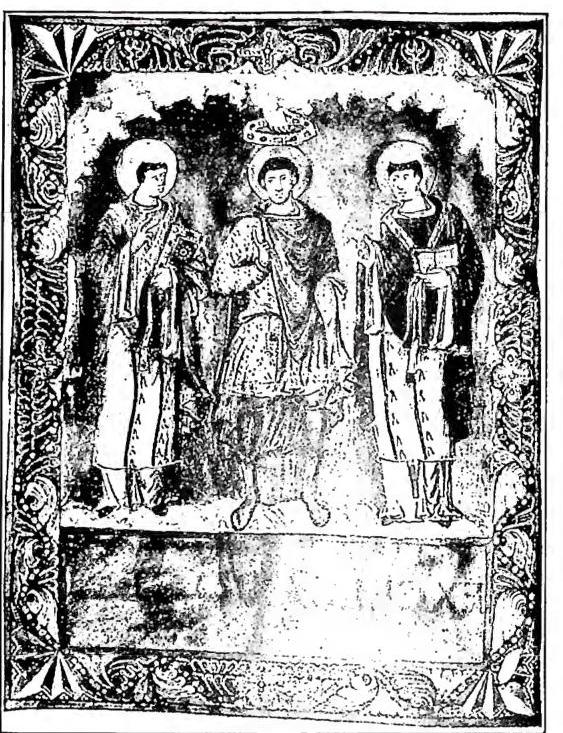
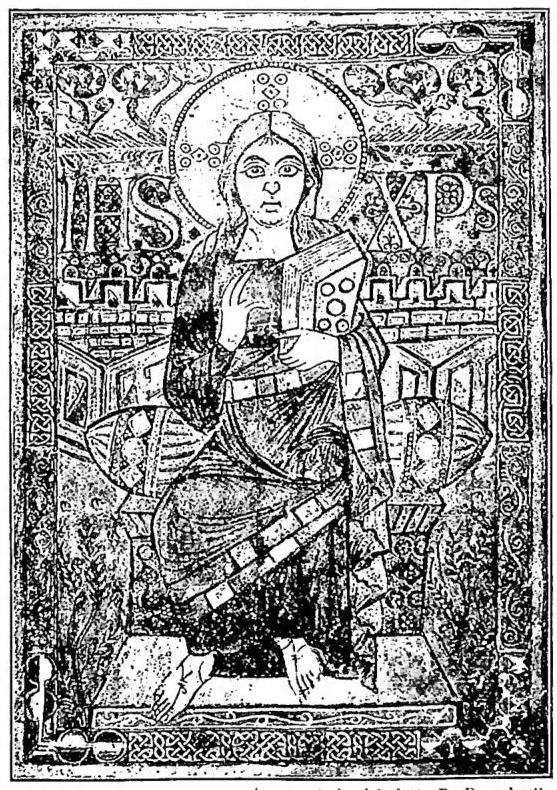
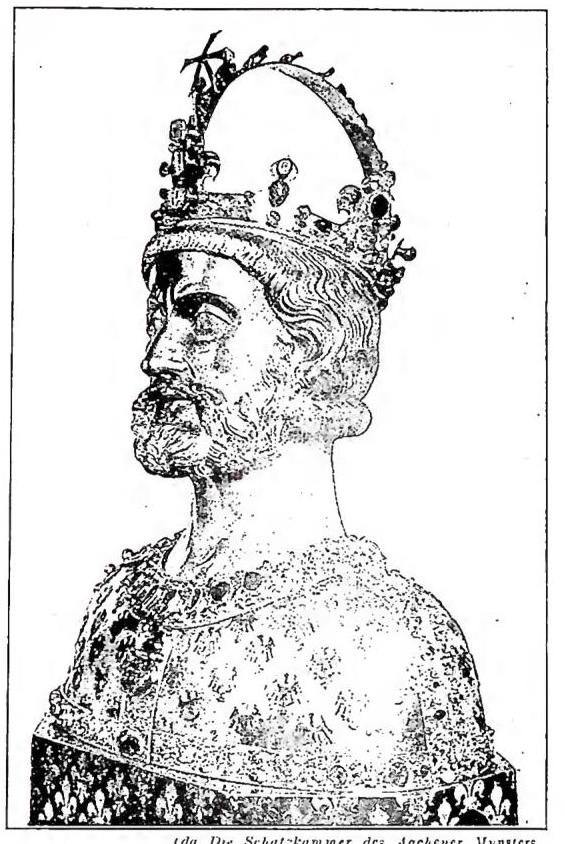
The iconography of CHARLES draws for the most part from legend. His features are those fixed by his biographers. Perhaps the only contemporary image is the Carolingian bronze statuette in the Carnavalet Museum: it represents him as a horseman, upright in posture and with a drawn sword. Not lacking in some verisimilar elements is the miniature in the 9th-century Frankish school from the Codex 84 of Gotha. Conventional is the figure of CHARLES, kneeling at the feet of St. Peter and beside the Pope, in the mosaic once existing in the Lateran Triclinium and placed there by Leo III, later restored several times.X. Reform of the Liturgy
The direct influence of CHARLES contributed to the establishment of the Roman liturgy beyond the Alps and its definitive triumph in the Latin West. He accelerated and made effective that liturgical movement toward Rome, of which the first traces appear in Gallican liturgical books from the end of the 7th and the first half of the 8th century, such as the Missale Gothicum (ed. H. M. Bannister, London 1917; C. Mohiberg, Augsburg 1929), the Missale Francorum (ed. J. Mabillon, Paris 1683), the Missale Gallicanum vetus (ed. J. Mabillon, ibid. 1683), and the Bobbio Missal (ed. E. A. Lowe, London 1920). This movement was intensified by the provident action of St. Boniface, the apostle of Germany, of St. Chrodegang of Metz, of St. Remigius of Rouen, and above all of Pippin, after the latter’s sojourn at the Frankish court (753–55) of Pope Stephen II. Pippin’s principal concern was the reform of chant, that is, the song which he wished to restore to the purity of Roman sources (cf. MGH, Capitularia, I, p. 82: Epistola generalis, written between 786 and 800; Walahfrid Strabo, De ecclesiasticarum rerum exordiis et incrementis, 23: PL 114, 937). Naturally, the reform of chant also provoked that of the other books necessary for psalmody, that is, for the entire choral office (Office and Mass), and first of all of the Sacramentary. Thus, around the middle of the 8th century, through the work of a Benedictine, there appeared the book called by E. Bishop the “Gelasian Sacramentary of the 8th Century,” which could satisfy the reformer’s requirements by combining the ancient Gelasian Sacramentary with a Gregorian one, without neglecting some usages of the old Gallican liturgy, which was certainly very dear to the clergy (cf. P. de Puniet, Le Sacramentaire de Gellone, Rome n.d., excerpt from Ephemerides liturgicae, 1934–38; cf. Sacramentario). Consequently, there immediately followed the parallel composition of Lectionaries and Gospel Books of the same type (cf. Th. Klauser, Das römische Capitulare Evangeliorum, Münster in V. 1935). The Capitulare de imaginibusCarolini) ensures that Pippin took care to reform the liturgy "ut non esset dispar ordo psallendi, quibus erat compar ardor credendi" (I, 6: MGH, Concilia, II, suppl., p. 21) or, as the Admonitio generalis of 23 March 789, § 80, puts it: "ut unanimitatem Apostolicae Sedis et Sanctae Dei Ecclesiae pacificam concordiam" (MGH, Capitularia, I, p. 61).
Charlemagne, with a spirit eminently unifying and deeply human in all that concerned theology and worship (it suffices to recall his interventions in the matters of images, Spanish Adoptionism, and Baptism), took a lively interest in his father’s reforming initiative and contributed decisively to it with the aid of skilled specialists directed by Alcuin (v.), who was exquisitely Roman in his culture. With a truly brilliant gesture, Charlemagne ordered a complete revision of the text of Sacred Scripture, the book par excellence of worship. The work was carried out in parallel by Alcuin and Theodulf of Orléans: the latter’s revision had little following, whereas the former’s, now known as the Alcuinian edition, enjoyed great success; Alcuin was still working on it in April 800, and on an unspecified Christmas offered the Gospels to Charlemagne (cf. MGH, Epistolae Karolini aevi, IV, pp. 322–23 [see also pp. 418–20]; PL 100, 374, 923).
While this revision was underway, Charlemagne took steps to spread liturgical books of the “Gregorian type,” in order to eliminate the hybridism of the liturgical books in use in his states, such as the Comes revised by Alcuin ca. 781 (ed. A. Wilmart, cited below) and especially the Sacramentary, which liturgists call the Hadrianum because it was obtained, after repeated requests, from Hadrian I between 785 and 791 (cf. the letter of Hadrian to Charlemagne: MGH, Epistolae Merovingici et Karolini aevi, I, p. 626); the original manuscript was placed in the imperial library at Aachen, and the bishops were invited to transcribe and disseminate II. Copies made directly from this manuscript bear the note: “ex authentico libro bibliothecae cubiculi scriptum.” The oldest copy known to date bearing this note is contained in Cambrai codex 159 (164) (ed. H. Lietzmann, Münster in V. 1921), executed at the order of Bishop Edward of the same city in 811 or 812.
Alcuin, who had already revised the Comes (cf. information and texts in Wilmart, pp. 146–48, 164; note that the supplement to the Comes is later than Alcuin), set about filling the serious lacunae of the Sacramentary that had come from Rome by adding a substantial supplement to II. For this work, to which he prefaced the short Flacusque, he made use of an eighth-century Gelasian Sacramentary and of usages already familiar to the Frankish clergy and people (cf. the edition of a Gregorian with the aforementioned preface and supplement by H. A. Wilson, The Gregorian Sacramentary, London 1915). In this way the “Temporal”
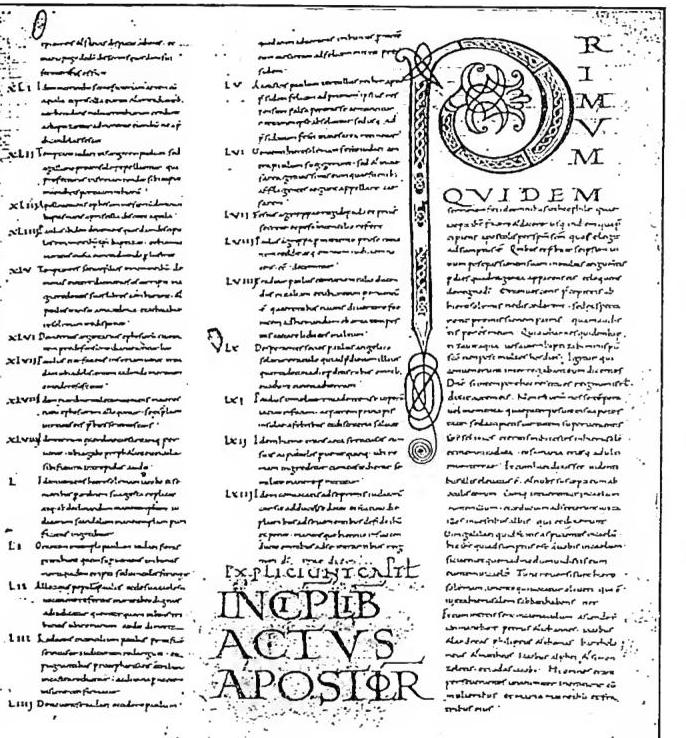
began to take shape. This lectionary spread slowly but eventually supplanted older Roman-type lectionaries, such as those of Agimundus, Alcuin of Farfa, and Egino of Verona (cf. G. Löw, Il più antico sermonario di S. Pietro in Vaticano, in Riv. di archeol. crist., 19 [1942], pp. 143–83).
At the emperor’s behest, the clergy were required to study systematically the Roman chant (cf. Admonitio generalis of 789, §80: Capitularia, I, p. 61; Capitula de examinandis ecclesiasticis of 802, § 2: ibid., p. 110; Quae a presbyteris discenda sint, ca. 805, § 9: ibid., p. 235) and the Roman usage for the celebration of the Mass (cf. Interrogationes examinationis, after 803, §4: ibid., p. 234; Council of Reisbach, 798 [Arnonis instructio pastoralis, IV: MGH, Concilia II, p. 198]) and the administration of the sacraments, including Baptism (cf. Duplex legationis edictum of 23 March 789, § 23: MGH, Capitularia, I, p. 64; Council of Mainz, May–June 813: ibid., Concilia, I, p. 261).
The Ordines Romani, small booklets containing the description of the papal rite of the Mass, Baptism, ordinations, etc., were at the same time collected in the area north of the Alps, adapted to the usages and needs of their new homeland. Moreover, the Sacramentary, which originally contained all the formulae pertaining to the Mass and the administration of the sacraments but without rubrics, began to lose the formulae relating to the latter; for practical reasons they were gathered into the Ordines, thus giving rise to the so-called Carolingian Pontifical, the first examples of which date precisely to the beginning of the ninth century—progenitor of the Romano-Germanic Pontifical of the tenth century and hence of the present-day Roman Pontifical.
In his reform work, Charlemagne was ably assisted by the episcopate, which made it a duty to adhere fully to the imperial will, as is evident from the acts of the synods, among which are noted that of Reisbach (Bavaria) in 798 and the reforming synods of 813 held at Arles, Reims, Mainz, Chalon-sur-Saône, and Tours (cf. MGH, Concilia, II, pp. 196 ff., 245 ff.), as well as from the Statutes of Reisbach, Freising, and Salzburg of 799 and 800 (cf. MGH, Capitularia, I, pp. 229–30), the Capitula de examinandis ecclesiasticis of 802 (cf. ibid., p. 110), and the Capitula ecclesiastica of 807–23 by Haito, bishop of Basel (cf. ibid., p. 363).
Charlemagne also gave thought to the accurate transmission of liturgical texts, which was then quite difficult: indeed, in the Admonitio generalis of 23 March 789, § 72 (cf. ibid., p. 60), he decreed that the Gospel, Psalter, and Missal were to be copied diligently by men of mature age, “perfectae aetatis.” This ordinance certainly contributed to encouraging the great Carolingian scriptoria—first among them that of Tours—to produce the numerous lavishly decorated liturgical and biblical manuscripts, sometimes even on purple parchment, with gold and silver lettering, written in the clear Carolingian minuscule with rare abbreviations, and richly adorned with miniatures; these manuscripts constitute to this day the finest adornment of many public and private libraries.
Nevertheless, despite all the emperor’s efforts (there are interesting legendary accounts on this subject) and those of the episcopate, the reform proceeded rather slowly for various reasons. Two were the main difficulties: 1) poverty prevented many churches and monasteries, often plundered, from immediately procuring the entire library then necessary for the celebration of the liturgy; 2) the differences existing even among the principal liturgical books that had come from Rome must have caused a certain confusion, as is also evident from the fact that Amalarius saw fit to address these discrepancies in his Liber officialis and to compose the Liber de ordine Antiphonarii (cf. critical editions by J. M. Hanssens [Studi e Testi, 139–40], Città del Vaticano 1948–49). Apart from the general outline of the “Temporal” and the “Sanctoral,” there was in fact no absolute unity among these books, simply because the major Roman basilicas from which they came each had its own calendar. Thus the Roman Comes, revised by Alcuin, and the Sacramentary sent by Hadrian I, though of the same type and in simultaneous use at Cambrai, do not agree with each other except in Lent, the Ember days, and a few feasts of the “Sanctoral.”
In any case, the liturgical reform, firmly grounded, was carried out with all the means then available and illustrated by the works of the great liturgists of the period, more or less indebted to Alcuin, such as Wala, abbot of Corbie, Walafrid Strabo, Paul the Deacon, Elisachar, Amalarius of Metz, and Rabanus Maurus. The intense liturgical work promoted by Charlemagne’s reform also has the merit of having preserved for us, in numerous manuscripts, almost all the documents of Roman liturgy prior to the tenth century.