
CIRCUMCISION (from Lat. *circumcido*, “to cut around”): Gr. περιτομή
The rite of circumcision consists in the excision of the foreskin of the male sexual organ. In the Old Testament it is presented as the sign of the covenant established by God with Abraham and his descendants (Gen. 17:9-14). It was to be performed on the eighth day after birth (Lev. 12:3) and was a condition for participation in the religious life of Israel. In the New Testament, circumcision is discussed in relation to the controversy over the admission of Gentiles to the Church (Acts 15; Gal. 2:3-12; 5:2-12; 6:12-15; Col. 2:11; 3:11). St. Paul emphasizes that Christian salvation does not depend on circumcision but on faith in Christ (Rom. 2:25-29; 4:9-12; Phil. 3:2-3).
In the early Church, circumcision was not imposed on Gentile converts, as evidenced by the decree of the Apostolic Council (Acts 15:19-29). However, Jewish Christians continued to practice it, leading to tensions within the Church (Gal. 2:11-14). The Church Fathers, such as St. Augustine, defended the abandonment of circumcision as a necessary condition for salvation, affirming that it had been superseded by baptism.
In Jewish tradition, circumcision (*berith*) remains a fundamental religious obligation, symbolizing the covenant between God and Israel. It is performed on the eighth day after birth and is a prerequisite for Jewish identity and religious practice.
and, from Abraham (Gen. 17). But such a supposition is based solely on the Wellhausenian theory of the sources of the Pentateuch. Moreover, the biblical narrative excludes the idea that Israel took circumcision from Egypt, as Herodotus, Celsus, and Julian thought in antiquity, and as various rationalists do today (J. Spencer, W. Nowak, E. Meyer, J. C. Matthes, R. Reitzenstein, etc.).
The rite was directly instituted and imposed by God as a sign of the covenant (Gen. 17). Abraham, who during his stay in Egypt (Gen. 12:10 ff.) must certainly have known that custom, did not practice it until he received a formal order from God at the age of 99. Nor is it problematic that God chose an ancient rite, already in use among other peoples, since He gave it an entirely new meaning and the essential value of a sacred sign. The circumcision of women, which was never widely practiced in antiquity and appears as an extension of that of men, is not known in Israel. From the time of Joshua, circumcision was universally observed and became the sacred seal of the people of God: its absence was a cause of dishonor and ignominy (cf. Judg. 14:3; 15:18; 1 Sam. 14:6; 17:26, 36; Ezek. 28:10; 31:18; 32:19 ff.). It was also a sign of distinction from other neighboring peoples, most of whom were uncircumcised, especially the Philistines, who were the "uncircumcised" (*‘arelîm*) par excellence. It is true that some texts (Jer. 9:26; Ezek. 3:18; 32:19–42) seem to imply that circumcision was practiced only by the Jews and by no pagan people; but this must be understood as referring to circumcision "of divine right," that is, as it was practiced in Israel by divine prescription and with its well-defined meaning. The distinction lay more in the meaning than in the material rite. Although a religious meaning may be admitted among other peoples, especially in Egypt, the meaning of circumcision in Israel (a sign of alliance with God, admission to the chosen people, purification) finds no parallel among other peoples. Through it, the newborn entered into the sacred community and participated in the divine blessings promised to Abraham and his descendants. It is true that to be a perfect Jew, it was sufficient to be a descendant of Abraham by flesh (the ethnic element, which was indispensable), but circumcision was the first act of religious and moral life in the community and fundamentally included the acceptance of the entire Torah. The symbolism of the rite (consecration, spiritual rebirth) was further highlighted by the fact that the child was circumcised on the eighth day after birth (unlike other peoples, who usually circumcised at the age of three, four, or seven years, or even at puberty). Along with circumcision, the custom arose of giving the newborn a name (cf. Luke 1:59; 2:21), just as God had given Abraham a new name when instituting the rite (Gen. 17:5).
During the Babylonian exile, the Sabbath and circumcision were the two greatest symbols of Judaism; so too in the Hellenistic-Roman period, when circumcision became a subject of mockery by pagans. Although Hellenistic influence led to some apostates (some Jews ashamed to appear circumcised in the eyes of pagans in public gymnasia) attempting to hide the signs of circumcision (1 Macc. 1:15), the majority of Jews remained faithful to their ancestral prescriptions and heroically resisted the persecutory laws of Antiochus Epiphanes, who had forbidden circumcision (1 Macc. 1:51); many women risked their lives to circumcise their sons (1 Macc. 1:65 ff.). Under the Hasmonean dynasty, circumcision was imposed, as a sign of judaization, even on non-Israelite subjects within the borders of Palestine, namely the Idumeans and Itureans; but care was taken not to extend it to the Philistine cities. Regarding the obligation of circumcision for proselytes (v.), there were disagreements even among the tannaim: R. Joshua, with the liberal current, held that any purification rite (such as ritual bathing) was sufficient to make a proselyte and circumcision was not necessary; whereas R. Eleazar, with the stricter current, maintained that circumcision was always necessary.
The emperor Hadrian prohibited circumcision, along with castration, under severe penalties (Lex Cornelia, *de sicariis*: Dig. XLVIII, 8, 4, 2); under Antoninus Pius (ca. 138 AD), the law was repealed for Jews but remained in force for Arabs and Nabataeans of the desert, as well as for Samaritans and Egyptians: only Egyptian priests who could prove their priestly descent were allowed to be circumcised.
In the early centuries of Christianity, the rabbis (e.g., R. Ishmael, R. Akiba) vigorously defended circumcision against both pagans and Christians, increasingly emphasizing its necessity and significance, even going so far as to assert that circumcision includes all 613 precepts and equals in value all the other commandments combined, and that one who is not circumcised is incapable of learning the Torah.
For Jews by race, circumcision remains, even today in different countries, the first and fundamental practice, faithfully observed even by unbelievers, as a distinctive sign of the race. On the other hand, circumcision for proselytes is now excluded; besides the official decision of the reformed rabbis of America at the New York conference of 1892, cf. A. Pallière, *Le sanctuaire inconnu*, Paris 1926.
2. **Rite.** — In biblical times, it was usually the father (or mother) who circumcised the newborn. Later, the office, which is quite delicate, was entrusted to a special operator (*mōhēl*, "circumciser"): an honorary office performed gratuitously. Circumcision is performed on the eighth day, even if it falls on the Sabbath, according to the most ancient tradition (cf. John 7:22). The rite is accompanied by a twofold blessing, one pronounced by the *mōhēl* and the other by the father of the newborn; followed by wishes of happiness and the imposition of the name, and finally a longer blessing that celebrates the divine covenant with Abraham and its sacred sign, circumcision. A feast is usually held, to which at least ten men are invited. Among the principal guests, who sit near the father, besides the *mōhēl* there is the *sandāq*, a kind of godfather who holds the child on his lap during the rite (this is the most honorable office). The chair on which the *sandāq* sits during the circumcision is usually called the chair of the prophet Elijah, who is believed to invisibly attend every circumcision and is popularly called the "Angel of the Covenant" (cf. Mal. 3:1; 4:5).
The symbolism of circumcision soon led to the idea of its metaphorical significance, namely spiritual circumcision, of the mind and heart (purification of the spirit, submission to God), a condition necessary, far more than carnal circumcision, to please God and enjoy the benefits of the promise. Already in Deut. 30:6, the necessity of this spiritual circumcision is emphasized (cf. Jer. 4:4: "circumcision of the heart"), and in Lev. 26:41, the wicked and rebellious are called "uncircumcised in mind" (cf. Jer. 6:10; 9:26; Acts 7:51: "uncircumcised in heart and ears"). St. Paul observes that circumcision was given to Abraham as a sign and seal of the righteousness that comes through faith (Rom. 4:11). Therefore, carnal circumcision presupposes and imposes spiritual circumcision, of which it is a symbol and reminder. Even Jesus subjected Himself to the law of circumcision (Luke 2:21). But with the institution of Christian Baptism, the obligation of circumcision ceased. Against the Judaizers who wanted to impose circumcision on all converts from the Gentiles, the Apostles took a stand at the Council of Jerusalem (Acts 15:1 ff.) and especially St. Paul, who repeatedly demonstrated the uselessness of the rite after the redemptive death of Christ (cf. Gal. 5:2 ff.; 6:12 ff.; Col. 2:11 ff.; etc.).
II. AMONG OTHER PEOPLES. — Circumcision in antiquity is attested first among the Egyptians in a period prior to Abraham, at least under the Fourth Dynasty (ca. 2400 BC). Besides the well-known testimony of Herodotus (II, 36, 37, 108) and other writers (Diodorus Siculus, I, 28; Philo, *De circumcisione*, I; Flavius Josephus, *Antiquitates Judaicae*, VIII, 10, 3; *Contra Apionem*, I, 22; Ps.-Barnabas, 9; PG 2, 752; Clement of Alexandria, *Stromata*, I, 15: PG 8, 768, etc.), proof is found in mummies and monuments. In a good number of mummies
The signs of circumcision are still clearly evident today: this is true of the statue of Būlāq, from the 5th Dynasty, and of the tomb at Saqqarah, from the 6th Dynasty; in a bas-relief from Karnak, coming from the temple of Yfons, 20th Dynasty, the circumcision of a boy aged 6 to 12 is depicted. According to Herodotus (II, 36), it was practiced, at least in ancient times, by all classes of the population. But it is difficult to establish whether and when it was obligatory: the mummies of many Egyptians show it, while many others do not (J. C. Matthes, in Zeitschr. f. Alttest. Wiss., 29 [1909], pp. 70 ff.). Probably circumcision was a practice more or less widely observed according to different epochs and regions. It was particularly honored among the priestly class, which attached a sacred and religious significance to it, so much so that, in time, "uncircumcised" (anm) became synonymous with "impure." Later it fell into disuse, and in the Hellenistic-Roman period, when attacks by Greco-Roman writers multiplied, it was practiced almost exclusively by priests, who clung tenaciously to it and made it a necessary condition for the exercise of priestly functions (cf. Flavius Josephus, Contra Ap., II, 13; Origen, In Rom., II, 45; Ambrose, Ep., II, 72, 5): according to a papyrus from Tebrunis (II, no. 293) an uncircumcised priest cannot perform sacred functions. Circumcision did not come to the Egyptians from the Hebrews or other descendants of Abraham, as the author of the Rec. Clem. supposes (PG 1, 1227), because it is older. It is one of those typical rites whose origin is lost in the obscurity of time.
Circumcision was also practiced by the Colchians and Ethiopians, as Herodotus informs us (II, 104). The same historian is of the opinion that from Egypt the rite passed also to the Phoenicians and to the "Syrians who dwell in Palestine" (that is, the Hebrews, and perhaps other neighboring peoples, such as the Ammonites and Moabites). But it is disputed whether the Phoenicians practiced circumcision. It seems that the Ammonites and Moabites practiced it, at least for some time. The same is true of the Idumeans and Midianites. It is known, however, that at the time of the Hasmoneans, circumcision was imposed on the Idumeans by the Jews. Among other Western Semites, the Arabs practiced circumcision, and they have preserved it to this day. There are no traces of it, however, among the Eastern Semites (Assyrians-Babylonians) or among the Indo-European, Mongol, or Finno-Ugric peoples.
Ethnological research has confirmed the existence of circumcision among numerous primitive tribes, which still practice it today: in Australia, Polynesia, Central America (Mexico, Nicaragua, Yucatán) and South America (Amazonia), and especially in Africa, where circumcision is so widespread that it is easier to list those who do not practice it than those who do. It is usually performed with a stone knife, proof of its great antiquity. Circumcision has remained in use among the Coptic Christians of Egypt and the Monophysites of Ethiopia (under Jewish or Islamic influence), who, however, do not attribute a religious but rather a rationalistic-social meaning to II.
The greatest spread of circumcision is due to the Islamic religion. It is commonly believed that circumcision was already in use in ancient Arabia. Islam maintained the practice, and although the Qur’an does not mention it, the hadith ("tradition") documents speak of it repeatedly. In the traditional estimation of the people, abstention from pork and circumcision are considered in many places as the fundamental practices of Islam (Encycl. de l’Islam, II, 1028); and this is connected with the tradition according to which Muhammad was born already circumcised (in North Africa a child born with a larger prepuce is considered a blessing from heaven). Only in the Jaʿfari or orthodox rite is circumcision obligatory (for both sexes), but in practice it is generally observed in different countries (Arabia, Persia, Asia Minor, the Balkans, North Africa, Ethiopia, India, Malaysia, etc.); male circumcision (properly called hisda) is more common, though female circumcision (hafd) is also frequent.
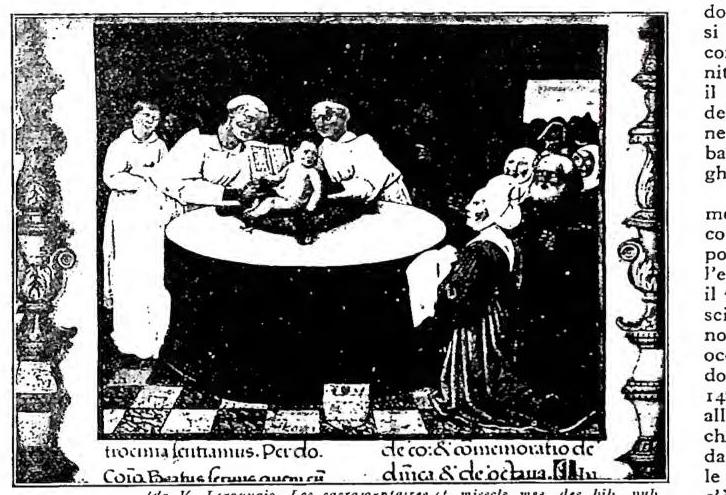
(15th century) — Paris, Bibliothèque Nationale, ms. lat. 886, f. 29.
The ritual and method vary according to different peoples. Even more varied is the age, which ranges from the 7th day after birth to the 15th year: Southwestern Arabs circumcise children on the 7th, 14th, 21st, and 28th days; at Mecca (where the rite is called tahdrah) between 3 and 7 years (also girls, but there is no special rule); the Mazequas in East Africa between the 1st and 2nd month; in Egypt between 5 and 6 years, in other parts of North Africa the age varies from the 7th day to 13 years; between 10 and 14-15 years in Java (girls between 2 and 8 years); in Persia in the 3rd or 4th year; Coptic Christians between the 6th and 8th year. Almost all others, including primitives, circumcise at the age of puberty, which is generally the preferred age, as it was in ancient Egypt. This circumstance seems to give circumcision the value of a youthful initiation into the passage from childhood society to that of adults and warriors, as well as an initiation into marriage: this, according to many, would be the original and fundamental meaning of the rite, to which a religious meaning was soon added, which is not always easy to define; it appears evident, for example, in the circumcision of priests in ancient Egypt and among Muslims.
Various other explanations have been attempted: a hygienic motive, especially in hot countries; a mark of racial distinction; a sacrificial motive; purification of generative power, etc. Worthy of note is the hygienic motive, already adduced by Herodotus for the Egyptians, and for the Hebrews by Philo (who, however, sees in circumcision essentially the sign of holiness and election of Israel: cf. Philo, *De spec. leg.*, I, 1-12; *De migr. Abr.*, 12; *Quaest. in Gen.*, III, 47), later by Maimonides, often repeated in modern times down to E. Baras, who suggests various considerations on the hygienic advantages of the cut. But these advantages are not clearly demonstrated, and the hygienic motive retains for many only a historical value (Jewish Enc., IV, 93).
tiorum auctoritas quantum ad Israelitarum instituta (Comment. tat. Bibl. 8), Innsbruck 1933, pp. 61-66; G. Ricciotti, Storia d'Israele, I, Torino 1934, pp. 147-50; E. Baras, La Circoncision, son histoire et son importance au point de vue hygiénique, Parigi 1896; The Jewish Encycl., IV (1903), pp. 92-102; Encyclopaedia Judaica, IV (1929), pp. 346-61. Per l'antico Egitto sono tuttora importanti: R. Reitzenstein, Beschneidung und Priesterordnung (Zwei religionsgeschichtl. Fragen), Strasburgo 1901; P. Wendland, Die hellenistischen Zeugnisse über die ägyptische Beschneidung, in Archiv. f. Pap. Forschung, 2 (1902) pp. 22 sgg.; A. Wiedemann, Beschneidung im alten Ägypten, in Orient. Literaturzeitung, 6 (1903), p. 99 sgg.
III. FESTA DELLA C
Presso i primi cristiani le calende di genn. erano una festa solamente civile. In molti luoghi la si celebrava con gioia sfrenata, quasi simile a quella dei pagani, tanto che i Padri della Chiesa più volte si videro costretti a richiamare il popolo a maggior serietà. A Ravenna, ad es., S. Pier Crisologo (Senn., 155) proibì di partecipare ad assistere a danze scomposte ed a mascherare. Simili disordini avvenivano anche nelle Gallie e nella Spagna nel sec. VI (cf. Concilio di Tours [567], cann. 17 e 22, e di Toledo [633], can. 11). Per sopprimere gli abusi i vescovi di Tours e di Auxerre avevano istituito delle processioni di penitenza col canto delle lincee ed altre funzioni sacre espiatorie in quel giorno. Un altro ricordo di simili abusi offrono vari libri liturgici che, a cominciare dal sacramento cosiddetto Leoniano, hanno per la data del 19° genn. una messa ad prohibendum ab idolis, per fronteggiare i divertimenti paganeggianti delle calende di genn. Capodanno (v.). Avendo però il cristianesimo concordato il suo calen- dario religioso con i fatti salienti della vita di Cristo, e non con quello civile, il Capodanno coincide semplicemente con l'ottava di Natale.Le Kalenda di genn. come festa ecclesiastica erano infatti sconosciute a Roma nel 600. Ben presto tuttavia, come la Pasqua e la Epifania, anche il Natale di Nostro Signore ebbe la sua ottava, e conseguentemente l'ottavo giorno era semplicemente chiamato Octava Domini, o in octava Domini; il che dimostra che quel giorno non era considerato come una festa propria. Nel calendario dell'evangelario di S. Genoveffa, copiato ca. il 714-31, è chiamato Natale s. Mariae (ed. F. G. Fronteau, Parigi 1652) quasi ad insinuare un profondo e delicato pensiero, di voler cioè dedicare alla Madre di Gesù, nel giorno ottavo della nascita del Figliolo, un ricordo speciale, dato che il giorno del Natale è tutto per il Pargolettto Divino. A tal fine fu composto un formulario di ufficio che è di ammirazione e lode alla Vergine Madre, ed anche nelle orazioni della Messa si fa una particolare commemorazione della maternità verginale di Maria. Inoltre a lei fu dedicata la Statio nella basilica di S. Maria ad Martyres (Pantheon); ma dopo che Gregorio IV ebbe eretto un presepio a S. Maria in Trastevere, ad imitazione della Liberiana, vi si trasferì anche la Statio. L'Omidiaro composto ca. il 786-97 da Paolo Diacono, nomina il 19° genn. come giorno in octava Domini i. e. Calendaia Ianuariae (ed. Wiegand, p. 27).
Fuori Roma e in particolare nelle Gallie prevalse invece il ricordo della Circumcisio, come si rileva dal Lezionario di Vittore di Capua (546), dal can. 17 del II Concilio di Tours (567), dagli Statuta di Sonnazio di Reims (614-31: PL 80, 446), dal Missale Gothicum (ed. Muratori, II, p. 552), dal Calendario premesso all'evangelario copiato dal monaco Gotescalco (781-82: ed. F. Pieper, Berlino 1858) ecc. Tale ricordo è poi passato nell'intitolazione dell'odierna ricorrenza liturgica del 19° genn., ad onta dei testi che ricordano prevalentemente la divina maternità di Maria SS.ma.