
CLUNY (Cluniacum, Cluni). – A city in the Rhône region, department of Saône-et-Loire, diocese of Mâcon, with remains of the eponymous Benedictine abbey, called the "second Rome," and the ideal center of the reformist tendencies of the late Middle Ages.
Subsections:
I. History of the Abbey
II. Organization of the Congregation
III. Spiritual Characteristics
IV. Extent of the Reform
V. Methods of Expansion
VI. Causes of Rise and Decline
VII. Customs of the Cluniacs
VIII. Importance
IX. Restoration of C
X. Art of C.I. History of the Abbey
The act of foundation dated 1 September 910 (reproduced by A. Bruel, tav. I) designates C. as a "free monastery" under the protection of Rome. Its founders were William, Duke of Aquitaine (d. 918), and Bl. Abbot Berno of Baume (d. 927). The classical age of C. (910–1156) is marked by its influence and administration under capable and saintly abbots. St. Odo (927–42 or 948) concluded in 931 the most important union with Rome (Jaffé-Wattenbach, 3854). The saintly abbots Maiolus (954–94), Odilo (994–1048), and Hugh (1049–1109) established Cluniac supremacy over Europe. After the failure of Pons (resigned in 1122, excommunicated in 1126), C. reached the height of its power under Peter the Venerable (400 monks in C., maximum extension of the Congregation; in 1131 Hugh’s basilica, a magnificent five-aisled building, was completed). The period of internal reforms (1156–1621) revealed a weakening of expansionist capacity; it led to numerous attempts at internal reform and to the surrender of the right of independence to the French Crown (1258), after which it became a royal commendam and suffered serious losses (fire of 1157, Hundred Years’ War, looting of library treasures during the Huguenot disturbances [1562], loss of foreign communities due to 16th-century reforms). The period of decline (1621–1790) began with the division of the Congregation into two groups—reformers and non-reformers—under Abbot Jacques de Veny d’Arbouze (1621–29). Cardinal Richelieu, as commendatory abbot, united C. for ten years with the Maurists (1629–42). His successor, Cardinal Mazarin, united C. with the Congregation of St-Vanne (1654–61), an arrangement that ended in 1661. Under the last commendatory abbot, Cardinal Dominique de La Rochefoucauld (1757–90), only forty monks remained in C. The execution of the state decree suppressing the abbey on 19 February and from 20 March 1790 was completed in July 1791. The last conventual Mass in Hugh’s basilica was celebrated on 25 October 1791. On 21 April 1798 the lands were sold to private individuals for two million and fourteen thousand francs. The destruction of the abbey buildings began in September 1801. In June–July 1811 the nave of the church was blown up to make way for a road, for which the inhabitants of C. heard harsh words from Napoleon I: “Allez, vous êtes des vandales!”II. Organization of the Congregation
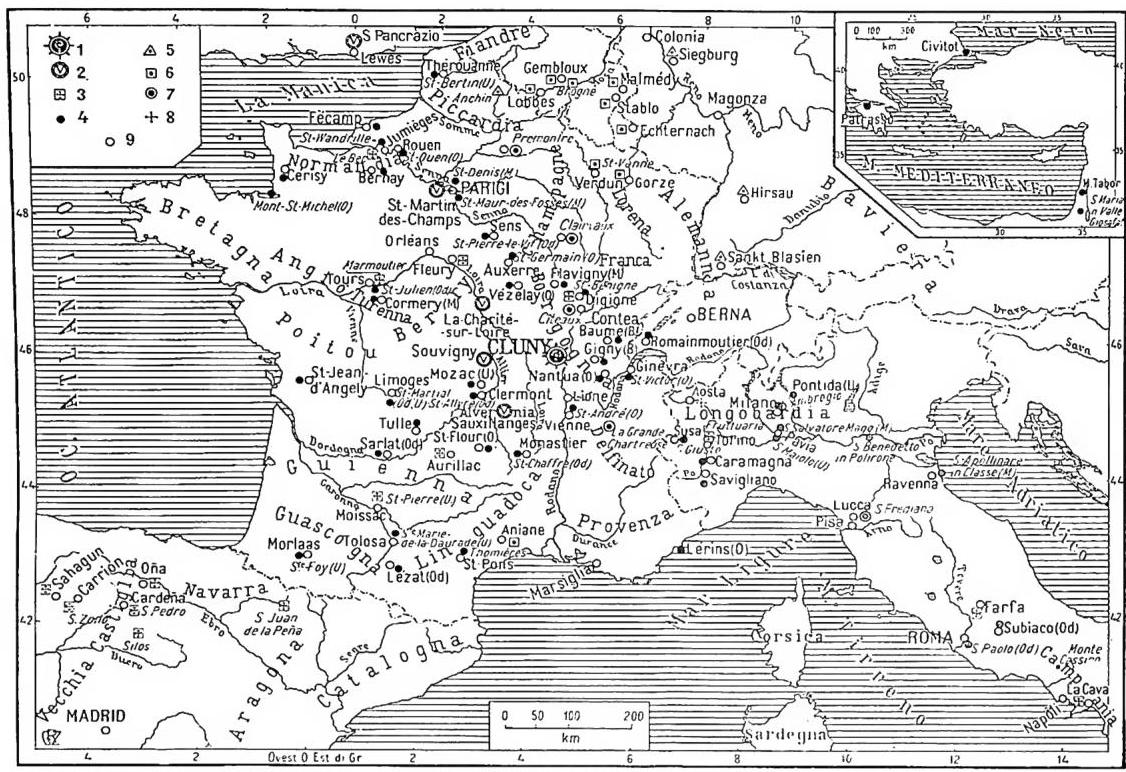
The constitution rested on the Consuetudines, the Statutes of the abbots, the General Chapters, and the Roman pontiffs. The Consuetudines of Odo’s time (B. Albers, Consuetudines monasticae, II, pp. 1–24) are an elaboration of the provisions of Benedict of Aniane (d. 821; ibid., III, pp. 154–56); a second redaction dates to 1000–30 (ibid., II, pp. 31–61). Another redaction is from the year 1043 (ibid., I, p. 1 ff.). For the redaction by Bernard (1063–87) and Udalric (1079), cf. below, bibliography. From the 12th century onward many supplementary Statutes follow (texts in Marrier, pp. 1053–76, 1457–70, 1471–1541, 1616). The structure of C. was based on an immense endowment of real property (documents in A. Bruel, Recueil, I–VI). The hierarchy of offices (camerarius, cellarius, cantor, etc.) was later expanded (forestarius, sepiarius, harengerius), and the traditional deanery was replaced by the new constitution of the priory. In Cluniac social stratification one finds: priests and lay monks; nutritii, drawn from the Oblates (suppressed by Peter the Venerable) and later the conversi; finally affiliates, officials, and servants. The Congregation of C. did not, however, recognize the "civil procurator" (advocatus). The structure of the Cluniac Congregation rested on three constitutive principles: the feudal principle of traditio, the Anian idea of union under control, and the scheme, already known from the time of Gregory the Great, of a mother monastery and affiliated monasteries. The Congregation thus constituted was divided into five unequal groups: a) the group of priories immediately subject (the so-called "Five Daughters" of C.: Lewes in England, La-Charité-sur-Loire, St-Martin-des-Champs [Paris], Souvigny, Sauxillanges, to which may be added certain abbeys that retained the abbatial title, such as Camprodon, S. Benedetto in Polirone, etc.); b) the priories mediately subject (i.e., monasteries subject to the "Five Daughters"); c) the group of incorporated abbeys; d) abbeys placed only under direct supervision and not incorporated, in which C. directed or confirmed the election of the abbot (Vézelay, Moissac, St-Martial of Limoges, etc.); e) abbeys temporarily entrusted for reform (Fleury, St-Maur-des-Fossés, Marmoutier). The head of the Congregation was the "prior abbas" (Marrier, p. 1406), whose authority at the beginning of the 13th century was already shared with ten provincial heads (camerarii); Gregory IX (28 July 1231) further limited it through the General Chapter and the definers (4, then 15). The abbot’s revenues came from real estate, chancery income, and taxes. The fiscal complex of 1377 amounted to 16,122 livres.
Cluny – Plans of the abbey before its suppression (1790) and its destruction (September 1801–July 1811). The parts drawn in black are those still extant today.

Cluny — Reconstruction of the monastic complex at Cluny before its destruction (between 1801 and 1811): A. Enclosure; B. Cloistered buildings (17th century); C. Facade of the coadjutor palace of Pope Gelasius (early 14th century with modifications by Richelieu, 17th century); D. Palace of Giacomo d’Amboise (early 16th century); E. Palace of Giovanni di Barbone (second half of the 15th century); F. Stables of St Hugh; H. Remises and servants’ quarters; I. Prison; K. Fabr Tower (14th century); L. Round Tower (15th century); M. Mill Tower (11th century); N. Cheese Tower (11th century); basilica (12th century); 2. Archives Tower; b. Justice Tower; c. Narthex; d. Main nave; e. Choir bell tower; f. Bell tower of St Catherine; g. Bell tower of the blessed water, surviving; h. Bell tower of the lamps; i. Bell tower of the clock.
III. Spiritual characteristics
The aspiration to integral monasticism impressed upon Cluny distinctive characteristics, so that its type clearly differed from that of the noble, royal and imperial abbeys. These are:a) the liturgical ideal, which later became a kind of ritualism, consisting in the extension of the Opus Dei through the Oratio Trina; votive offices; special psalms and lengthy processional rites. The office in choir replaced manual labour and study (Petrus Ven., Statutum, 67, in M. Marrier, p. 1272);
b) the ideals of freedom, contained in the founding charter of Cluny, for which the Cluniacs fought against oppression arising from the feudal system of the noble churches. The need for freedom created the Cluniac system of priories (emancipation of the lower French Church in the 11th century from the hands of laymen), and the recent institution of lay brothers (Charité-sur-Loire) spurred Cluny to erect large monasteries and to overcome the “civil procurators” (Hirsau reform); and finally led Cluny to extend these ideas to the higher Church through the Gregorian reform;
c) union with Rome. From 910 to 1258 Cluny used Rome as a counterweight to lay feudalism but above all to episcopal feudalism. The ideal of freedom, culminating in the 11th century in exemption, led the Cluniac circles of the 11th-12th centuries into a certain emancipation psychosis with varying success. Distant echoes of these struggles are found in canons 615-18 of the present Code of Canon Law;
d) the will to reform. The abbots of the classical period (915-1156) made this legacy of Benedict of Aniane, through unremitting labour (desudati labores, says the Vita Odilonis, in M. Marrier, p. 1814), a characteristic of Cluny;
e) centralism. The reform had to be guaranteed by union in a congregation (Hugh the Great in the case of Lézat [Bruel, Recueil, IV, p. 563, no. 3454 of 5 Nov. 1073]). Thus, from 929 onwards a feudal hierarchy grew up, directed from a central authority which, despite anti-feudal resentments, was ultimately rooted, despite everything, in the idea of the noble church.
The characteristic points of Cluny’s centralist ideal are: the tendency towards stable law of ordination, the system of priories already mentioned, the right of visitation by the major abbot, and, curiously, the continuous opposition within the congregation itself to the centralist system.
IV. Extension of the reform
The reforming activity of Cluny had two aims: the spread of the reform and the annexation of the reformed monastery to the congregation. These must therefore be distinguishedTwo groups of Cluniac monasteries: the reformed ones and those attached to the Congregation. The monasteries attached to the Congregation of Cluny had reached the number of 17 by 937. In 994 there were 37, by 1048 there were 65, and under Peter the Venerable, it is said, there were 2,000 (M. Marrier, p. 600). The most recent reassessment of the question for the 12th–14th centuries gives 1,174 and 1,450 houses respectively (G. de Valous, II, pp. 179–271; Schmitz, I, p. 138). According to a preliminary and provisional statistic, the reformed houses amounted to 1,629. The overall extent of Cluniac influence from the 11th to the 14th century thus reaches at least 2,795 and 3,079 communities respectively.
Statistics by country of reforming influence:
a) France. The Cluniac Congregation (from 929) with 960 dependent houses in French-speaking territory. The early reform in southern France (from 929) not attached to Cluny: Aurillac alone had 65 dependent houses. Also included are Tulle, St-Jean-d'Angély, St-Pons-de-Thomières, Genouillac and others. The Fleury group (from 930) with more than 20 communities. The Marmoutier group (from 982) with 8 houses. The Dijon movement (from 990) with more than 60 houses in French-speaking territory. The Le Bec group near Rouen with 18 houses (second half of the 11th century).
b) Italy. The reform of Odo (936–41) with about a dozen communities in central and southern Italy. The Dijon-Fruttuaria group (from 1003) with 39 houses in northern Italy. The union of Farfa (early 11th century) with the 683 churches within its temporal domain. The union of La Cava (from 1079) with 77 abbeys, 100 priories and 33 obedientiaries. The Italian union of Cluny (from the late 10th century) with 54 attached houses.
c) Germany. The Alemannic Cluniac union (from 1050) with 22 houses in German-speaking territory. The St. Blasien reform group (from 1068–72) with 36 houses in northern and southern Germany. The Siegburg group (from 1070) with 19 communities of the Fruttuaria type. The Hirsau movement (from 1077–79) with 10 Cluniac-style communities. The Anchin group at Pas-de-Calais (from 1087) with 40 houses in Belgium and Flanders.
d) Spain. The S. Juan de la Peña group in Aragon (from 1020) with 65 houses. The S. Vittoriano de Asán group in Aragon (Orma, Taberna, Ovarra, etc.). The Oña group in Castile (from 1032) with 73 dependent houses. The S. Pedro de Cardeña group in Castile (from 1035) with 5 reformed houses. The Silos group in Castile (from 1041) with 15 dependent houses. The Sahagún group (from 1079) with 138 dependent houses. The Arlanza group near Burgos in Castile (late 11th century) with 30 reformed houses. The Cluniac reform union from 1045 with 27 houses (center: S. Zoilo de Carrión) and the union of Moissac affiliated to Cluny (from 1073–78) with 4 dependent abbeys and a large number of priories.
e) England. The reform of William the Conqueror (from 1066) which, in the 36 existing abbeys, subsequently appointed 29 abbots from the Dijon movement (Jumièges, Fécamp, Bernay, Cérisy), 15 from the Bec movement, 3 from Cluny itself and 2 from Marmoutier. The English Cluniac reform union (1077) with 43 communities still counted 35 houses at the time of their suppression in 1536.
f) The East. Under Peter the Venerable (1122–56) there existed a Cluniac colony at Civitot near Byzantium, a house at Patras, two abbeys in Palestine (Mount Tabor and St. Mary in the Valley of Josaphat).
g) Poland and Hungary. They likewise show Cluniac influences in the 11th century.
V. METHODS OF CONQUEST
The methods by which this number was achieved cannot always be called commendable. From the 11th century onward the will to dominate increasingly overshadowed the original ideal of reform. The honest methods of the early period (attracting church patrons to their cause and demonstrating monastic qualities) were replaced by: a) contempt for the ideals of others; b) inducing reform under the pretext of discipline; c) imposing reform through coercive methods under the guise of constitutional struggle.VI. CAUSES OF RISE AND DECLINE
Cluny’s expansion was due to the monastic qualities of several outstanding leaders who, from the outset, were able to impose themselves on communities truly in need of reform. To this was added the superiority of well-defined statutes, the brilliant organization with an international outlook, and the central position in the heart of Latin Christendom. For economic development, the careful cultivation of the monastic idea, the remembrance of the dead and the opportunity to offer suffrages proved important. All this, however, was fully realized only through Cluny’s unique exemption from both civil and ecclesiastical feudal arrangements (double exemption) and its close union with Rome. Cluny’s decline was brought about not so much by economic and social changes in the 12th–13th centuries or the loss of manpower in the 14th century (plague) as by numerous excesses (centralism, ritualism, excessive spiritualism, exaggerated norms of silence, etc.) and internal shifts (weakening of reforming will, growing coolness toward Rome, surrender of exemption, increasing feudalization of claustral offices; cf. Molitor, I, p. 151) as well as structural weaknesses in the entire system, with its abnormalities and inequalities in the constituent elements. The Cluniac attempt to monopolize monasticism provoked, from the 12th century onward, a reaction in favor of ideals of freedom. In the often painful competition with new types of orders (Cîteaux), Cluny’s system proved to be outdated.VII. COSTUME OF THE CLUNIACENSI
The scapular cowl is ankle-length, sleeveless, richly pleated, open on one side and fastened multiple times. The full-length cowl, without a hood, is ankle-length with long, wide sleeves as broad as the arm, puffed and closed like a shirt. Manner of wearing: both cowls (in contrast to the common monastic habit) are customarily worn simultaneously. Color: more or less black or dark.VIII. IMPORTANCE OF C
1. For the West. a) Its social thought, of international scope, manifested itself in the care of the poor and the roads used by pilgrims, in the colonization of vast lands, and above all in the propagation of the peace movement (Truce of God). By critically assessing the feudal world order, C. broadly advanced the social ideas of its time (A. Schulte). b) In the cultural sphere, it did not reach the scientific heights of other monasteries, despite intense scribal activity (the library of C. in the 12th century contained about 570 manuscripts; cf. L. Delisle, pp. 259-81), the widespread influence of the scriptorium (H. Fichtenau, Mensch und Schrift, Vienna 1946, pp. 158-76), and the broad political horizon of Cluniac historiography (Spörl). The cultural importance of C. lies rather in its architectural influences, which spread from the basilica of St. Peter, built in 981 and 1131, throughout Burgundy, the Empire, and along the pilgrimage route to Santiago de Compostela (achieving the triumph of vaulted ceiling construction over the flat basilica ceiling, emphasizing grandeur and monumental sculpture, accepting Iberian-Arab influences, reducing the crypt, etc.). c) Its political will conceived the ideal of Europe already in the days of Odilo (Schreiber, p. 418). Long before Gregory VII and 30 years before 1096, C. was mobilizing the "Reconquista" and saving Spain for Europe (Schmitz, I, p. 146; Chagny, p. 247). The European union, the rapprochement of peoples in trade and customs, and mediation between princes—particularly between sacerdotium and imperium (Canossa, 1077)—revealed C. as an embodiment of medieval universalism. It should be noted, however, that through the ancient monastic idea of "libertas," transmitted by the Cluniac branch of Dijon into the realm of international politics, C. became a ferment of division within Western unity (Umberto of Moyenmoutier).2. For the papacy
At a certain point, the Cluniac communities became a school of popes (Gregory VII, Urban II, Paschal II); they were the unconditional representatives of papal universalism, natural allies in the struggle against the system of the "Church of the nobility," promoters of reform synods even before Gregory VII, active allies of Gregorian ideas, and strongholds of these reforms. The position of C. as a great power was first felt by Gregory VII, who viewed it as a troublesome rival, and its reform program was significantly curtailed after 1080.3. For monasticism
a) C. fulfilled the historical mission of Benedict of Aniane within the monastic sphere (ritualism, reform, the founding of a "community under control," anti-federalism). By realizing the anti-federalist idea, through innovations and aggressive politics, C. opened a deep chasm between itself and the reformed monasticism of Gorze (K. Hallinger, chaps. 1-5). b) In the monastic-legal sphere, C. emphasized the opposition between "corporation-lordship" (the absorptive effect of the Cluniac system of priories), with the reconstruction of ecclesiastical patronage tending toward capitalism. In reaction, C. became a negative prerequisite for the more developed communities of Cîteaux and Prémontré, thus paving the way for medieval corporations (G. Schreiber, pp. 135-37, 429-32). The legal influence of C. is most evident through its anti-federalist stance, namely from the demand for freedom contained in the founding charter (910), the self-investiture of the newly elected superior, the stance against the "civil procurator," and the tendency toward exemption (K. Hallinger, pp. 360-92). c) C. exerted its influence in the realm of piety and liturgy. The classical age of C. (especially the homiletic and hagiographic writings of the great abbots) lived within the ideas of Gregory the Great, Bede, and the Anian reform. However, only Anselm of Bec-Canterbury (d. 1109) and John the Little of Fécamp (1028-78) contributed dogmatic-mystical elements. The "Temporale" of the Cluniac liturgy contains only the great mysteries of Redemption. The more extensive "Sanctorale" includes as distinctive features the memory and translation of the great abbots of C., of Sts. Florentina and Consortia (June 20 and 22), of St. Abbot Lautenius (Nov. 2), the commemoration of the dead (Nov. 2), etc., as well as the dedication days of the basilica on Feb. 15 and Oct. 25 (for the liturgical manuscripts, cf. A. Wilmart, Manuscrits liturgiques de C., in DACL, III, II, cols. 2074-92; for the calendar, cf. V. JALABERT, LOUIS, Les Bréviaires manuscrits des bibliothèques publiques de France, I, Paris 1934, pp. civ-cvii). On the division of the psalms, votive Masses, etc., cf. G. de Valous, I, p. 414 sqq. Characteristic signs of piety in the classical age of C. are: solemnity, display, lengthy services, love for the psalms, but above all the "piety of the Mysteries" in the Opus Dei and its annual cycle. Particular devotions (the Holy Cross, the Blessed Virgin Mary, the Day of the Dead) burst forth impetuously. In contrast, St. Bernard initiated the opposing movement against these forms of pietyBy opposing the “Cluniac decorum” with the “affective impulse,” C. and current monasticism thus elaborated in their customs the common fund of liturgical prescriptions of Benedict of Aniane in an opposite manner (cf. on this point K. Hallinger, chap. 5, pp. 632-716).
BIBL. CENOBITE
Sources: 1. Narrative: Giovanni di Salerno, Vita Odonis: PL 133, 43-89; cf. E. Sackur, in Neues Archiv, 13 (1889-90), pp. 103-16; Odilo, Vita Maioli, in Acta SS. Maii, II, Paris 1866, pp. 683-88; Nalond, Vita Maioli, ibid., pp. 657-683; cf. E. Sackur, in Neues Archiv, 12 (1886-87), pp. 303-316; id., ibid., 16 (1890-91), pp. 180-81; W. Schultze, ibid., 14 (1888-89), pp. 343-64; L. Traube, ibid., 17 (1891-92), pp. 402-407; Jorsaldus, Vita Odilonis: PL 142, 897-940; cf. E. Sackur, in Neues Archiv, 13 (1889-90), pp. 117-26; id., ibid., 24 (1898-99), pp. 728-32; Giln, Vita Hugonis, ed. A. L'Huillier, Vie de S. Hugues, Solesmes 1888, pp. 565-618.
2. Diplomatic: M. Marrier, Bibliotheca Cluniacensis, Paris 1614; P. Simon, Bullarium Ordinis Clun., Lyon 1680; G. Duckett, Charters and records of C., 2 vols., Lewes 1890; [A. Bernard-A. Bruel, Recueil des Chartes de l'abbaye de C., 6 vols., Paris 1876-1904; B. Albers, Consuetudines monasticae, 3 vols.: I, Stuttgart 1900; II-V, Montecassino 1905-12.
For the library and archive, cf. L. Nageotte, Bibliothèque de l'immense abbaye de C., in Revue Lyon, 1881, p. 213 ff.; L. Delisle, Le cabinet des mss. de la Bibliothèque Nationale, II, Paris 1874, pp. 458-85; A. Bénet-J. Bazin, Archives de C., Mâcon 1884.
Literature: R. Bauerreiss, in LThK, II, pp. 993-97; F. Sackur, Die Cluniazenser in ihrer kirchlichen und allgemeingeschichtlichen Wirksamkeit, 2 vols., Halle 1893-94; D. Brauner, Recueil historique des archevêchés, évêchés, abbayes et prieurés de France, Paris 1726, revised ed. by the Benedictines of Ligugé (Archives de la France monastique, 4), Ligugé 1906, pp. 1-39; Académie de Mâcon, Millénaire de C., 2 vols., Mâcon 1910; Fr. L. Bruel, C. Album historique, ibid. 1910; U. Berlière, L'ordre monastique des origines au XIIe siècle, Maredsous 1924, pp. 219-261; J. Virey, L'abbaye de C., Paris 1924; L. M. Smith, C. in the XI and XII centuries, London 1930; L. H. Cormpily, Histoire de l'abbaye de C., 3rd ed., Paris 1930; J. Evans, Monastic life at C., Oxford 1931; G. de Valous, Le monachisme clunisien des origines au XVe siècle, I-II (Archives de la France monastique, 39-40), Ligugé 1935 (cf. the review by L. Kern, in Memoria et Renaissance, 3 [1938], pp. 487-71); Costinossa, I, pp. 816-25; B. Malm, L'Ordre cistercien et son gouvernement, Paris 1943; Ph. Schmitz, Histoire de l'Ordre de S. Benoît, 4 vols., Maredsous 1947-48 (the complete work will consist of 6 vols.) and German trans. by L. Räber, 4 vols., Einsiedeln 1947; K. Hallinger, Garze-Klany. Studien zu den monastischen Lebensformen und Gegensätzen im Hochmittelalter, Bonn 1948; A. Chagny, C. et son empire, 4th ed., Paris 1949.

IX. Restoration of C
This attempt at restoration was made by the Benedictine scholar Dom Maiolo (in the world Carlo Arturo) Lamey, b. at Strasbourg on 17 March 1842, d. at Aosta on 15 June 1903. Ordained priest at Flavigny, diocese of Dijon, on 24 Sept. 1870, he professed on 14 Oct. 1878 at Delle (Alsace), the exiled novitiate of the Benedictine abbey of Mariastein. Early in 1879 he gathered his companions in the ancient Benedictine priory of Grignon (Côte-d’Or, diocese of Dijon); they were to devote themselves chiefly to the study of the sciences, especially astronomy, and of the philosophy of nature. Having obtained from Mgr A. L. Perraud, bishop of Autun, on 24 July 1888 the canonical institution of the new C., part of the community from Grignon settled in a small house built on the site of the glorious abbey of C. (Sept. 1888). The remainder of the community later left Grignon and took up residence (31 Dec. 1893) in the ancient Cluniac priory of SS. Maiolus and Odilo at Souvigny (Allier). But the sectarian action of the French government against religious orders forced, in 1901, Dom Lamey and his companions to abandon both priories and seek refuge at Aosta, where they revived the Benedictine priory of S. Benigno of the 11th century. The war of 1914-18 and the scant recruitment of new members—certainly influenced also by the overly narrow and specialized character of their scientific studies—gradually thinned the promising neo-Cluniac community to the point that today it numbers no more than a single monk. By virtue of the ius postliminii, Dom Lamey claimed for his community, despite lively opposition, the Cluniac privileges, including that of the ancient liturgy.At the time, the scholarly work of Dom Lamey and his companions was highly esteemed, especially by the Académie des sciences of France. The results of their scientific and historical researches are chiefly preserved in the following periodicals: Proslogium [from fasc. VIII, 1903: Cluniacense]. Bulletin de l'Observatoire de Grignon [from fasc. VIII, 1903: Des observatoires et laboratoires des Bénédictins de l'Observance de C.] pour l'avancement des sciences et de la philosophie de la nature (9 fascicles, 1887-1909); Monclogium Cluniacense. Bulletin d'histoire, de philosophie, et de théologie des Bénédictins de l'Observance de C., pour le développement de l'intelligence de la Foi et de la Sapience divine (1 vol. of 68 nos., 1891-1903); Échos de C., published to commemorate the ninth centenary of the institution of the commemoration of the dead by Odilo (1 vol. of pp. 170, 1898-1901).
A. Pietro Frutaz

X. ART OF C
1. The basilica and sacred buildings. The church of the abbey of C. was, without doubt, on account of the imposing size of its structure, the beauty and grandeur of its forms, one of the highest architectural manifestations of the Middle Ages. It consisted of two clearly distinct parts. A great five-aisled church founded by Abbot Hugh in 1089 according to the designs of the canon Hézelon, who came to C. to join the community of monks there, and a kind of vestibule, with three aisles, called the narthex, begun in 1220 by Abbot Roland of Hainaut. A monumental complex of which the plan published here gives a very clear idea. The primitive church, that of Abbot Hugh, was a great basilica 140 m. long and 35 m. wide, with five aisles and two transepts. The vault of the main nave rose 35 m. above the ground, those of the two adjacent aisles were 18 m. high, and those of the other two smaller aisles 12 m. above the ground.The presbyterial area, which together with the double transept was the most characteristic part of the entire construction, culminated in an apse supported by eight gigantic piers, beyond which ran an ambulatory opening into five radiating chapels. The choir contained 250 stalls, and in the church there were 20 altars.
A characteristic element of the ancient abbatial church of C. were its four gigantic bell towers. The largest, square in plan, stood at the intersection of the great nave with the first transept. It had an imposing structure and in its belfry housed 18 large bells. At the ends of the same transept stood two other bell towers, each with four bells, octagonal in shape, called respectively St. Catherine’s and the Blessed Water. The latter still stands at the entrance to the Bourbon chapel.
The fourth bell tower, called the Lantern Tower, stood at the intersection of the minor transept and was also octagonal.
The portal of the ancient church, 6 m. high and 3 m. wide, was adorned with magnificent sculptures, as were the capitals of the eight columns supporting the apse.
This church, which had become insufficient for the needs of worship and the great ceremonies celebrated there, was extended at the beginning of the 13th century by a three-aisled structure 35 m. long, divided into five bays: a kind of new church added to the primitive one, which in turn was preceded by a façade flanked by two square towers, of which only the ground-level structures remain, with a grand portal more than 8 m. high, adorned by a rose window 10 m. in diameter.
The plan clearly shows how of this gigantic church only the lower structures of the two towers flanking the entrance to the narthex remain, the bell tower of the Blessed Water, the 15th-century Bourbon chapel, and the adjacent ones of St. Stephen and St. Martial, along with a few other rooms built against the great transept on the right. Very little remains, and the regret is all the greater when contemplating the precious remains of the primitive construction, above all the admirable capitals of the eight gigantic columns of the choir, fragments of friezes, columns, and altars from the Romanesque period, and a notable series of tombstones, reliefs, and sculptures with the emblems of the craftsmen of C. These remains, to be considered among the cornerstones of French Romanesque sculpture, are today housed in the museum located in the ancient section of the abbatial palace built by John of Bourbon, while in the other section, due to Abbot Giacomo d'Amboise, is the town hall of the city.
The two buildings preserve quite well the original features which are respectively from the second half of the 15th century and the beginning of the 16th. To Abbot d'Amboise is also due the complete rebuilding of the Hôtel de C. (late 15th century), the Parisian residence of the abbots of C., which has housed the Museum of Medieval Antiquities since 1849.
Another ancient building standing beside the remains of the abbatial church is the so-called palace of Pope Gelasius, who died at C. in 1119, in a building later transformed by the addition of an elegant Gothic façade by Abbot Bertrand de Colombier (1295–1308). The palace, which had undergone transformations in the time of Cardinal Richelieu, had its façade rebuilt in Gothic forms during the 19th century.
The abbatial church of C. was also one of the most important centers of painting in the Romanesque period in France, and its decorations, of which little more than a memory remains, were widely imitated in other churches of the Order (v. also BENEDICTINE, ART) and especially in those of Auvergne and Burgundy. In the monastery of C. during the 11th century and the following ones, codices were also written and illuminated which reflected the artistic splendor of the environment in which they were created. This is attested by a precious 11th-century lectionary (Paris, Bibl. Nat., ms. lat. 2246) decorated with beautiful miniatures, as well as other illuminated codices in the style of C. in the abbey of Dijon and in other monasteries of the Order, especially at Limoges, Moissac, Figeac, etc.
Impressive for the grandeur and harmony of their structures are also the great abbatial buildings erected in the 18th century by Abbot Giacomo Dathoze, but left unfinished because of the Revolution. Of

Particular interest is aroused by the fine façade with its unfinished pediments and the extensive galleries and porticoes of the cloister, harmonious in their proportions, which extend in total for a length of 700 m. The building, meticulously executed in every detail, featured wrought-iron railings on the stairs that may be considered among the finest examples of that type of work. Also notable are the immense gardens with their ancient linden trees, among which is famous that which, according to legend, offered its shade even to the monk Abelard.
The town of C., despite the destruction wrought by men and time, preserves, in addition to the abbatial structures already mentioned, a series of interesting buildings that give it a distinctive character. Of the three ancient parish churches, that of S. Maiolo, whose origins date back to the 10th century, is completely in ruins, but of the other two, S. Marcello, built around 1159, still retains a fine Romanesque bell tower, while the other, Notre-Dame, clearly maintains the character of a building begun during the Romanesque period and continued in the 13th century in Gothic style. Also worthy of mention are the chapel of the hospice of S. Biagio (15th century), which was reserved for foreigners, the Pont de la Levée, and numerous houses in which the characteristics of the Romanesque period are still evident.
2. Architecture of C.
During the period of Cluny’s greatest splendor, while the mother church of the Order was being renewed (its high altar consecrated by Urban II in 1095), abbeys sprang up in the principal European countries to attest to its diffusion (in France that of Moissac; in Italy those of S. Antimo near Siena and of Cava dei Tirreni; in Spain, especially in Navarre).
It is still debated whether the vast constructive activity of the Order gave rise to particular architectural forms; Rivolta denies this, limiting the Cluniac contribution to the reworking of schemes derived from the Lombards, while Michel and Bertaux affirm it, emphasizing its importance. Toesca, taking a middle position, admits that this movement did indeed introduce distinctive elements into architecture. These are to be sought particularly in the arrangement assumed by certain parts of the churches of the Order, in which the existence of a narthex is sometimes noted, and in which the development of an ambulatory around the choir is characteristic, from which deep radiating chapels project; and also in the decoration, richer and of unusual forms, especially in the capitals.
These new elements and features also influenced contemporary religious buildings, among which are the cathedrals of Acerenza and Aversa, St-Sernin of Toulouse, S. Martial of Limoges, and the sanctuary of St. James of Compostela. The Cluniac architectural current, however, was short-lived, giving way to the new Cistercian forms that would mark the decisive transition to Gothic. — See Plate CXXII.