
COMMUNE. — In the history of Italy, as in that of all the West, the commune (c.) holds great importance: it is the autonomous government that was established not only in cities but also in smaller settlements, with more or less extensive powers depending on the development permitted by particular local circumstances.
In southern Italy, the establishment of communes, which had already taken shape in the decline of Byzantine rule and at the beginning of Norman rule, was halted in its development due to the policy of reconstituting state power pursued with great vigor by various sovereigns of the Kingdom of Sicily. Thus, except in a few special cases, communal autonomies did not develop widely there. In northern and central Italy, however, the gradual weakening and then dissolution of the bonds of the Empire, and the prolonged periods of weakness into which the temporal power of the popes fell, meant that many communes achieved, if not full legal independence, at least complete de facto independence and became true states. Where the commune reached such full development, it possessed all the powers of an independent state; but even where its authority was restricted by the overlordship of a prince, in much of Italy it still retained legislative, military, and financial jurisdictions that constituted a characteristic system of its own. From this perspective, the commune—which, from the standpoint of the classes that dominated it during its period of full development, represented the antithesis of the feudal system—was instead a continuation of the particularism introduced by feudalism into the structure of the Carolingian Empire.
The problem of the origins of communal autonomy is highly controversial due to the scarcity of historical sources for the formative period of this autonomy, which roughly spans the 11th and 12th centuries.
Naturally, this development was closely tied to the revival of commerce in western Europe after the cessation of the raids by the Hungarians and Saracens and the resumption of maritime trade in the Mediterranean. However, this alone does not explain how the city separated itself from the countryside and established its own autonomous government. In Italy, the problem differs from that in France and Germany, where, generally speaking, Roman cities were destroyed and new ones arose from the growth of merchant settlements at the foot of a comital or episcopal castle or at the intersection of important roads. In Italy, this occurred only as an exception: here, the development of urban administration in lands subject to Lombard-Frankish rule—which broke the continuity of Roman institutions—differed from that in lands that remained entirely free of such rule or were free for long periods. Even in these latter regions, however, as in the others, the municipal institutions of the late Empire disappeared, and the Byzantines placed military commanders at the head of urban administration: dukes in the major cities, counts or tribunes in the smaller ones.
These officials were chosen from the local aristocracy and governed with the assistance of a small group of citizens. Violent conflicts often arose; for example, in Venice, such conflicts ended in bloodshed when doges or dukes attempted to make their supreme dignity hereditary within their families, until by the mid-11th century the power of the doges was greatly restricted, and they ruled with the oversight of councils representing property owners, navigators, and merchants—the groups that formed the economic life of the great commercial empire of the lagoon. Similarly, in Naples, at a not dissimilar historical moment, Duke Sergio was obliged by a pact not to make peace or war or impose new taxes without the consent of an elevated class of citizens who, to better their cause, had formed a societas that the duke promised to respect, as well as to protect land and sea trade and markets.
In the Lombard-Frankish territories, power in the city lay with military officials—dukes, marquises, or counts—who frequently became integrated into the feudal system. However, beginning in the late Carolingian period, emperors and kings of Italy, irritated by the rebellions and infidelities of the great feudal lords, entrusted cities to bishops, whether these prelates replaced the counts outright or exercised broad powers over the city itself and the territory immediately surrounding its walls.
During this period, the urban population—or, more precisely, the lesser feudal lords tasked with defending the city, the owners of houses and lands, and the wealthiest merchants—performed specific functions, both military (defending the walls) and judicial (participating in the judgments or *placita* of the count, bishop, or the particular officials they maintained in the city).
This class, either through a gradual abandonment of authority by the higher powers (especially if the higher power was the bishop) or, more rarely, through revolts, succeeded in concentrating the powers of the city in the hands of its leaders. These leaders thus commanded the city’s forces, maintained order (the *pax* or *treuga*), and defended the fortified city with the royal *banno* against those who disturbed the peace. They also presided over urban justice, initially often sharing this role with the officials of the count or bishop, but later exercising it alone.
It cannot be said that contemporaries generally attached great importance to this transfer of power, nor that royal authority always viewed communal autonomy with hostility. Indeed, there are diplomas from emperors or kings—such as those of Henry IV for Pisa and Lucca, Henry V for Bologna, and Conrad III for Genoa—that demonstrate the contrary. There are also communes that, upon their emergence, were recognized in 1248 by the Patriarch of Aquileia. However, in Italy, the privileges of the bourgeoisie are not as numerous as those across the Alps. There are also cases of violent conflicts, such as in Benevento, where Prince Pandulf III of Benevento was driven out in 1042 by a conspiracy of citizens, and a *communitas* was established; or, as happened a century later in Rome, where a bloody rebellion by citizens led to the formation of a council, the core of the commune, which, in classical reminiscence, was called a "senate." A typical example of such unions among citizens is the "company" (*compagnia*) of Genoa, which appears to have been formed by men capable of bearing arms to defend the structure of the commune and protect commerce, maintaining peace among citizens and punishing those who harmed them. Despite these examples, it is difficult to demonstrate either that such associations were generally formed and served as the foundation of the communal bond, or that the rise of the commune was ordinarily tied to violent rebellions.
The earliest communal structure was quite simple. At the head of the city were consuls, whose number often corresponded to the internal divisions of the city, such as quarters or sestieri. They served as both military and administrative leaders and exercised the portion of jurisdiction that the commune gradually acquired.
They were assisted by a very restricted council called the “di credenza,” composed of persons drawn from some of the more prominent citizen families. Only for reasons of great importance was the general assembly of citizens possessing full political capacity convened; at the outset, these were few, since a large part of the populace was excluded because of servile or semi-servile origin or because they were rustics who had moved into the city. Moreover, high-ranking feudal lords residing in the city were excluded from the civic bond because they were not subject to civic burdens and did not take the oath that bound citizens to obedience to their leaders and to the customs and statutes. Often, ecclesiastics were also excluded because their immunity shielded them from civic burdens.
The market formed a separate entity, with its own jurisdiction and particular privileges, and in some places it long remained under the authority of the bishop. During this period, the struggle between the Lombard communes and Frederick Barbarossa occurred, because the Swabian emperor sought to recover “regal” rights (such as the appointment of municipal magistrates, the mint, rights over waters, markets, etc.) that the principal communes had appropriated. It is not the place here to discuss this famous conflict, but it is worth noting that in the Peace of Constance (1183) Frederick recognized the right of the cities to appoint consuls, though these were to receive investiture from the emperor or the bishop, and he indirectly acknowledged the validity of their customary statutes. For this reason, jurists themselves, as the foundations of these rights, were considered “free” and “liberated” in their own sphere.
After this initial phase of the commune, struggles soon began for its conquest by citizen classes that had been excluded from government, among whom the lower feudal lords and the wealthiest landowners and merchants long prevailed. Retail traders and master artisans took advantage of political events to secure a broad share in power.
Emperor Otto IV promoted, in Milan, an agreement that was later imitated in many other cities, by which the civic councils were divided equally between the milites—that is, the wealthiest who fought on horseback—and the pedites, that is, the rest of the people. Elsewhere, however, these disputes led to the replacement of the consuls with a podestà called from outside, a man unconnected with the city factions, who arrived accompanied by judges to guarantee impartial justice and to arbitrate between the parties, and to the formation of a large council, called the greater or the “gross” council (in Florence, the “Council of the Five Hundred”), in which the various citizen classes had broad representation. This council truly became the arbiter of communal life, and within it the statutory legislation of such importance for the formation of Italian law was elaborated.
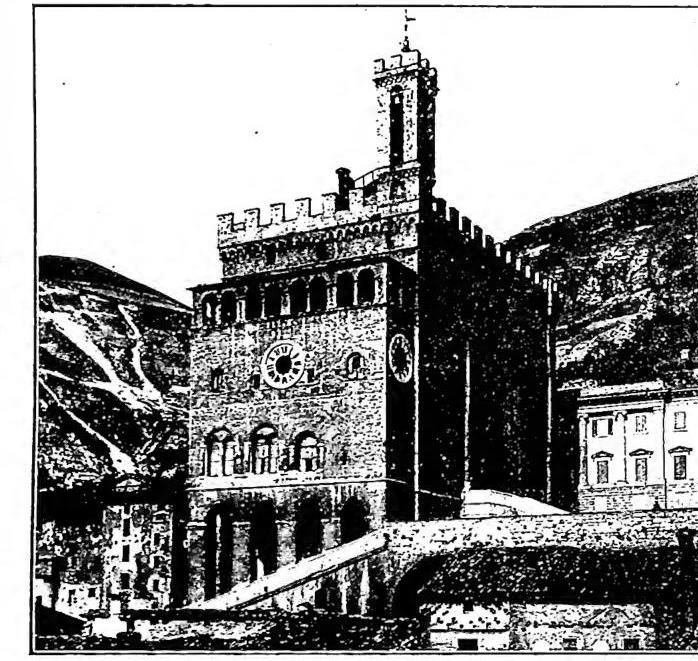
It was in this age that the greater communes expanded the boundaries of their dominion, subjecting not only rural communities but also large communes. Thus Florence subjected Prato, Pistoia, Arezzo, and later Pisa. Magnificent communal palaces adorned even smaller cities, and the communes generously supported, driven by intense religious fervor, the construction of churches adorned with works of art. Unfortunately, however, such vibrant life was disturbed by severe struggles between opposing factions and between the wealthier citizens on one side and, on the other, the lesser merchants and artisans organized in their guilds or *arti*.
From this arose, in some cities—especially Bologna and Florence—the ordinances against the “magnates” and the establishment of the “popolo’s commune,” in which the elders or priors nominated by the guilds governed the city. Most of the communes of Emilia, Romagna, and central Italy adopted similar ordinances. Elsewhere, however, the principal families of the city—wealthy merchants, shipowners, and owners of houses and lands—formed closed circles, and the commune assumed an oligarchic character; particular importance in this type of evolution was held by Venice and Genoa. The Venetian constitution, centered on the Great Council, composed of all adult members of the families inscribed in the patriciate and considered sovereign of the state, the Council of the “Pregadi” (or “Senate”), and a restricted college of sages who formed a kind of ministry, was regarded in the 16th and 17th centuries by political writers as an unsurpassed model of wisdom.
During the 13th and 14th centuries, many communes were transformed into lordships. This was a profound change in substance but not in form, since the communal institutions remained virtually unchanged; everything, however, depended in the city on the will of the lord, that is, of a faction leader who had succeeded in becoming the dominant figure with the support of his consortia. Many lords had themselves acclaimed as lifelong podestàs or captains of the people by the city parliament, thereby legitimizing their power. They then sought a title from a higher authority, being created imperial vicars, as the Scaligers in Verona and the Carraresi in Padua; or even dukes, as Gian Galeazzo Visconti, who in 1395 received from Emperor Wenceslas the title of Duke of Milan.
The existence of the communes continued into the 16th and 17th centuries, since absolutist governments respected local autonomies, allowing cities to preserve their statutes, jurisdictions, and tax systems; however, the communes lost their political and military functions, which were now the exclusive preserve of the sovereign, whether prince or “dominant” city. With such subjection, however, the principal characteristics of the “city-state” were lost.
The rural communes presented another aspect: these were subject to feudal lords or ecclesiastical bodies that had allowed them to form a communal organization with limited autonomy. In most cases, rural communes had statutes granted to them by the lord, and these statutes contained regulations relating to rural policing, essential trade, and the use of woods and pastures belonging to the inhabitants. In the Alpine regions, such statutes were often called “regole” or “favore.”