
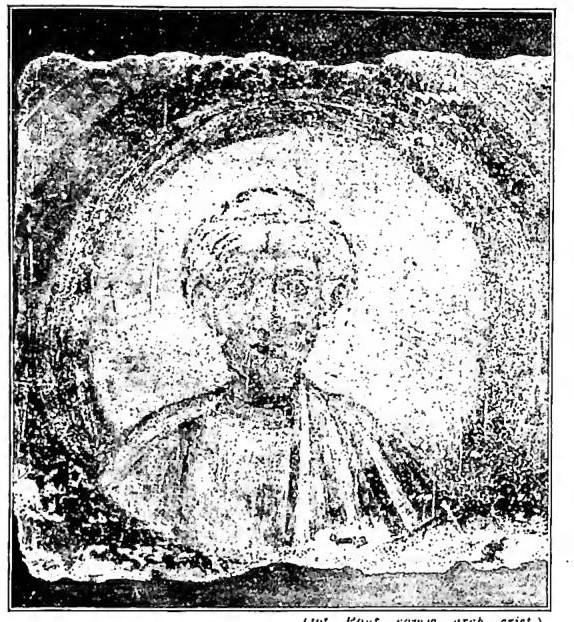
DAMASUS I, POPE - Portrait of Pope Damasus. Medallion from the series of popes (9th century) in the basilica of St. Paul - Rome.
DAMASUS I, POPE - Portrait of Pope Damasus. Medallion from the series of popes (9th century) in the basilica of St. Paul - Rome.
DAMASUS I, POPE
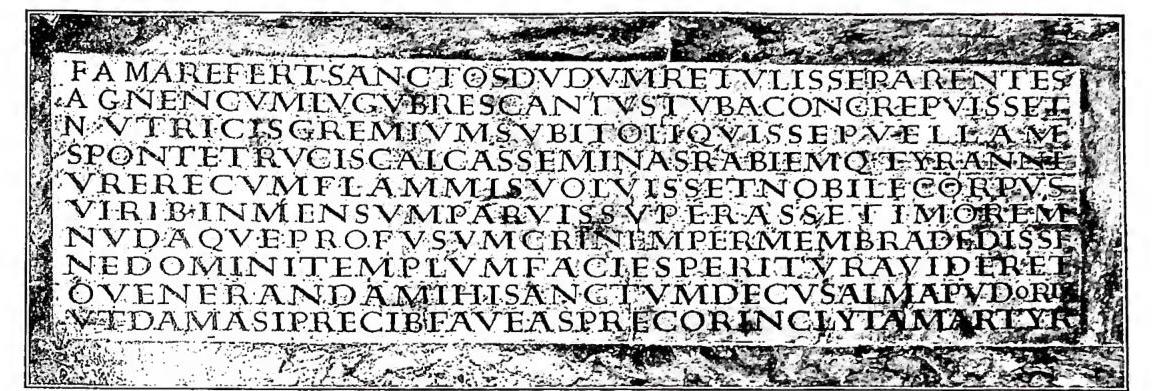
DAMASUS I, POPE - Damasian poem in Philocalian characters in honor of St. Agnes (only the upper left corner has been restored) - Rome, basilica of St. Agnes.
a perpetual alternation of severity and indulgence, continuous annoyances and dangers for D.
Three moments are especially noteworthy. In 368 D. succeeded in driving his rivals from the last basilica they still held, St. Agnes outside the walls, indeed 20 miles from Rome (this is the period to which Epigrammata, 42,4 should be referred: pro reditu cleri Christo prestante triumphans). In 373 the skillful intervention of Evagrius, Jerome’s friend, saved him from being almost ensnared in the toils of faction (Jerome, Epist., 1,15). At that time there was issued the important rescript of Valentinian reserving the cases of ecclesiastics to the emperor himself and to the Pope. In 377-78 Ursicinus, through the learned converted Jew Isaac, managed to bring against D. a major lawsuit, probably de vi (the emperor called it turpissimae calumniae). D. then made a vow to St. Felix of Nola, renowned vindicator against calumny, by which he was subsequently acquitted (and Isaac was also banished to a corner of Spain), and he thanked him in the words: servatus mortis quod vincula rupi, hostibus extinctis fuerant qui falsa locuti (Epigr. 59). Shortly afterward the Roman Council of 380 protested to the emperor against these continual extortions. Finally, in 381, the intrigues of the eunuch Pascasius, Ursicinus’ emissary exiled to Cologne, created serious embarrassments for the Pope; hence the protests (which seem to have had full effect this time) of the Council of Aquileia to Emperor Gratian.
Amid such tribulations at home (added to those caused by the ever-active Luciferians, Novatians, and Donatists in Rome), D. could not attend to the general interests of the Church as much as he would have wished. Nevertheless, he accomplished much. He is the first pope who, every year on the anniversary of his election (September 30), seems to have gathered the bishops of Suburbicarian Italy around him in council. In these councils he made many decisions of interest to the universal Church. Although he unfortunately did not wish to deal with the nascent Priscillianism in Spain and with the explicit complaints of Priscillian himself, contenting himself with vague recommendations of moderation to the Council of Saragossa in 380, he responded exhaustively to the consultations of the Gallic bishops in a letter (c. 374) that may be called the first decretal. He established with Acilius the papal vicariate of Thessalonica for Eastern Illyricum, and in various synods he acted against the last Western Arian bishops (especially those in Illyricum), thereby supporting the more energetic action of Ambrose. From 373 to 378 he welcomed to Rome Peter, who had fled from his see in Alexandria. He was a strong advocate of the papal primacy, so much so that when Theodosius recalled the Eastern Empire to Catholicism, he gave the bishops there as a norm the faith followed by D. of Rome and Peter of Alexandria. Hence, with the codices, the first three chapters of the so-called Decretum Gelasianum (v. GELASIAN DECREE) can be traced back to D. (perhaps to the Roman Council of 382), with their scriptural canon and energetic affirmation of the papal primacy.
But the East would have especially needed his decisive and enlightened intervention against the Arians protected by Valens, the nascent Apollinarianism, and to regulate the Antiochene and Constantinopolitan successions. This was also desired by Athanasius and even more by Basil, but it was done only in small steps and as if under compulsion, and for the most part unsuccessfully. D. and the Westerners (Ambrose in particular) were too compromised with the minority at Antioch—Paulinus, Marcellus of Ancyra, and his little sect, Apollinaris and Vitalis; their close union with Alexandria even led them to give some support to the intruder Maximus the Cynic in Constantinople and to ignore the Nazianzen. This half-heartedness and continual controversy grieved the soul of St. Basil, who allowed himself to speak very bitterly against D., calling him proud and merciless. It must be said, however, that the Roman Council of 377 pronounced condemnation of the doctrines, if not of the persons, and in 381 the letter from Thessalonica stigmatized the attempt of Maximus the Cynic. It is therefore no wonder that D. remained practically estranged from the Council of Constantinople of 381 (the Second Ecumenical Council) and little less so from the parallel Western Council of Aquileia, which was Ambrose’s work. The council that met in Rome in the middle of 382 was to have been ecumenical and to have composed in common agreement what had been done at Aquileia and Constantinople, but it succeeded only in ratifying the election of Nectarius.
To this council came St. Jerome from Constantinople, already known to D. by letter, especially for his scriptural knowledge. D. held him dear until his death, as his secretary and biblical consultant. At his request Jerome carried out a first revision of the Psalter and that of the New Testament. According to Jerome, he would naturally have been designated to succeed D., had it not been for the opposition of the ecclesiastics, irritated by his sharp criticism of their morals and jealous of his apostolic successes in the sphere of women.
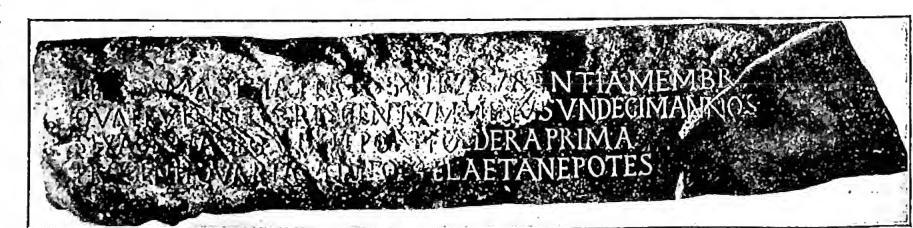
D. is the pope of the first decretals and also the first writer to illustrate the See of St. Peter. Jerome mentions various short works of his in elegiac couplets and a treatise De virginitate in both verse and prose, praising his elegant talent for composing verse (De viris inlustribus, 103 and Epist., 22, 22). This may have been so, but such do not appear to be the many compositions that remain of him in the treasuries—poor in content, style, inspiration, and even in phrasing, though valuable for their archaeological and hagiographical interest. In fact, they are generally metrical eulogies in honor of Roman martyrs, made to be inscribed on marble slabs over their tombs by the hand of the celebrated calligrapher Furius Dionysius Philocalus (v.), a personal friend of the Pope. Others commemorate works carried out in the cemeteries at the tombs of the martyrs or in the Roman catacombs; a good group has considerable autobiographical interest. Thanks to these, D. is the first pope of whom we know something of his life before his pontificate.
He was not, however, the first to concern himself with ecclesiastical building, but he far surpassed all his predecessors. In this he earned the everlasting gratitude of archaeologists, who have chosen him as their patron. Besides the basilica of St. Lawrence, he built the suburban basilica of SS. Mark and Marcellian, in which he was buried with his mother and sister; he built and adorned the basilica of the Apostles on the Appian Way and in almost all the catacombs he carried out significant works to adorn the tombs of the martyrs and to facilitate their visitation and veneration. In this he was paying his tribute at a time when the cult of the martyrs was flourishing exuberantly; to suppose that all this activity was aimed at (foundation of jurisdictional primacy, placating Roman hostility) is simply anti-historical.
The apocryphal D. threatens to surpass the genuine. Numerous are the poems falsely attributed to him, numerous the pieces included in the False Decretals, especially those of Pseudo-Isidore. Noteworthy apart is the correspondence with St. Jerome for the Liber Pontificalis (v. since this work too was soon attributed to D), and the other concerning the translation of the Psalter, in which the Western custom of chanting the psalms in churches, concluding them with the Gloria Patri, is traced back to D.—a legend already found in the Liber Pontificalis.