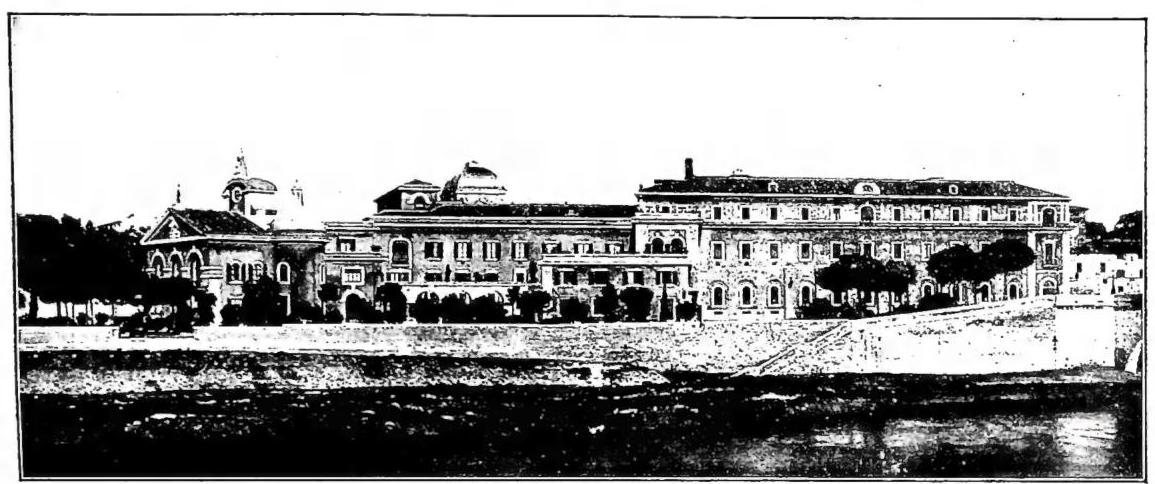
ITALIAN LAW. – Under Italian law, a hospital is a public institution intended to provide free medical assistance to the sick and wounded through admission, maintenance, and medical-surgical treatment. The element of gratuitousness must never be absent, even if limited to a certain number of beds; otherwise, it would be a private nursing home operated for speculative purposes. Free care, which may be limited to certain categories of in-patients, may be provided not only for purposes of public charity, but also by virtue of a social insurance relationship.
According to the entity to which hospitals belong, they are distinguished as public and private; public are those administered by public bodies, private those maintained by private individuals or legal persons; the latter category includes hospitals operated by religious orders or congregations. Most of the public hospitals in existence belong to charitable institutions; there are also hospitals belonging to many municipalities, the State’s civil and military hospitals, those of the Sovereign Order of Malta, of the Mauritian Order, and of many welfare and social-security institutions.
As a consequence of this distinction, it follows, first, that relations between the institution and its employees, in the former case, fall within the sphere of public employment, and in the latter within that of private employment, with all the effects of a substantive, formal, and procedural legal nature. Secondly, the relationship between the institution and the in-patient must likewise be distinguished as a relationship governed by public law, with the consequent application of the principles relating to public-law contracts, and as a relationship governed by private law, with application of the principles governing contracts between private parties. Finally, public hospitals are subject, in addition to ordinary administrative supervision, to that of the central and provincial health authorities. Private hospitals are subject only to external police supervision concerning compliance with the rules of public health and safety (art. 193 of the Consolidated Act of 27 July 1934, no. 1265).
All hospitals managed by public bodies must comply with a body of common rules concerning the technical construction of buildings and their installations, the internal organization of services, and the legal status of personnel. The rules on the construction of hospitals are contained in a decree of the Head of Government dated 20 July 1939. The organization of services is governed by a special regulation issued by Royal Decree of 30 Sept. 1938, no. 1631, to which art. 192 of the Consolidated Act of the Health Laws refers. The legal status of the personnel assigned to hospitals was likewise governed by that regulation; previously, it had been regulated in various ways according to the different administrations by the
OSPEDALI – OSPEDALIERI DI SAN GIOVANNI DI DIO