
P. V. Baur, Christian church at Dura Europus, New Haven, Yale University Press 1931, pl. 15) Christian church (3rd century).
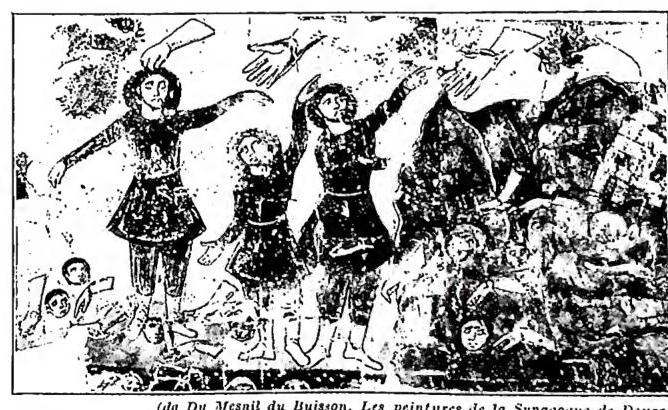
The Jewish synagogue, uncovered during the excavation campaign of 1931–32, was also situated within a building complex partly used for administration and partly as the rabbi’s residence. After crossing a large atrium, one entered the large hall where the Tôrâh was read. The main door, following Eastern custom, opened on the long side directly opposite the center of worship, namely a horseshoe-shaped aedicula surmounted by a shell-shaped pediment: this was the place reserved for the archisynagogue. The façade of the aedicula contains on the left sacred emblems—the seven-branched candelabrum, a cedar, a palm; in the center the ark of the Law, of which the Ark is the prototype; it is shaped like a temple with a door framed by four columns; on the right, the sacrifice of Abraham with Isaac lying on the altar, from above the divine hand emerges, halting Abraham as he is about to sacrifice with the knife. The vast hall, rebuilt in larger form in 245, as learned from an Aramaic inscription painted on a ceiling beam, had—an exceptional feature for Jewish places of worship—the walls completely covered with paintings, overlapping in up to four zones. The subjects represented are drawn mainly from the Old Testament, such as, for example, the stories of Ezekiel and Elijah, of Esther, of David, of Samuel, etc.; however, there are also those inspired by post-biblical tradition, as shown by the painting depicting Moses dividing the waters of the spring into twelve branches, each flowing toward the twelve tents of the twelve tribes. In
DURA EUROPOS — DURAND GUILLAUME
V. DURAND GUILLAUME
The synagogue and the Christian domus ecclesiae at Dura Europus have been the subject of numerous studies, among which we cite: G. R. Driver, The Dura Synagogue and its paintings, in Palestine Exploration Fund Quarterly Statement, 65 (1933), pp. 104–124; R. Dussaud, Les peintures de la synagogue de Doura-Europos, in Syria, 14 (1933), pp. 1–16; M. Rostovtzeff, Dura-Europos and its Art, Oxford 1938; A. Grabar, Le thème religieux des fresques de la synagogue de Doura (245–256 après J.-C.), in Revue de l'histoire des religions, 123 (1941), pp. 143–92; 124 (1941), pp. 1–35.
On the domus ecclesiae and the baptistery see: C. Hopkins, The christian chapel at Dura-Europos, in Atti del III Congresso internazionale di Archeologia cristiana, Rome 1934, pp. 483–92; A. von Gerkan, Die frühchristliche Kirchenanlage von D., in Römische Quartalschrift, 42 (1934), pp. 219–32; G. P. Kirsch, La «domus ecclesiae» cristiana del III sec. a Dura-Europos in Mesopotamia, in Studi dedicati alla memoria di Paolo Ubaldi, Milan 1937, pp. 73–82; W. Sexton, L'église et le baptistère de Dura-Europos, in Annales de l'Ecole des Hautes Etudes de Gand, 1 (1937), pp. 161–77; H. Grégoire, Encore les baptistères de Cuicul et de Dura, in Byzantion, 14 (1939), p. 317; A. Grabar, Les fresques de Dura-Europos, in Comptes rendus de l'Acad. des Inscr. et Belles lettres, 1941, pp. 77–90; C. Hopkins, The architectural background in the paintings at Dura-Europos, in American Journal of Archaeology, 45 (1941), pp. 18–29.