
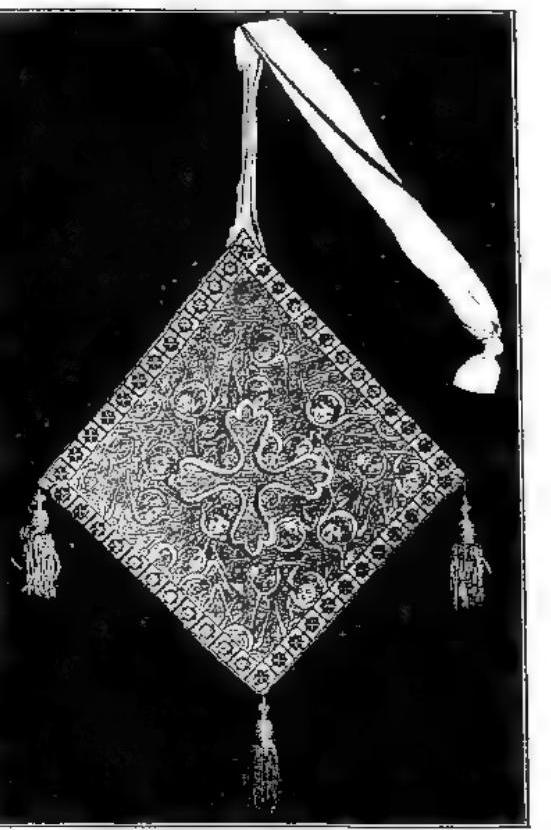
Epigonation (ἐπιγονάτιον, ἐπιγνώτιον). — It is a liturgical ornament of the Byzantine rite, suspended from a ribbon at the height of the right knee. It takes the form of a rhombus and consists of a cloth-covered cardboard, richly embroidered and adorned with a sword, a cross, or an image: a cherub or a saint. Its origin is unclear.
It may have been a simple handkerchief or a pouch containing the text of the liturgy or the homily read by the pontiff. Initially, only the patriarch had the right to wear the epigonation; later it was granted to bishops, and finally to archimandrites and other ecclesiastical dignitaries. In the list of officials of the patriarchal Church of Constantinople, one of them carried and placed the epigonation on the person of the patriarch. Whoever has the privilege of wearing the epigonation, placing it on, recites a prayer. This alludes to the victory of Christ and of Grace over the powers of death. The epigonation is also a sign of authority.
Placido de Meester