
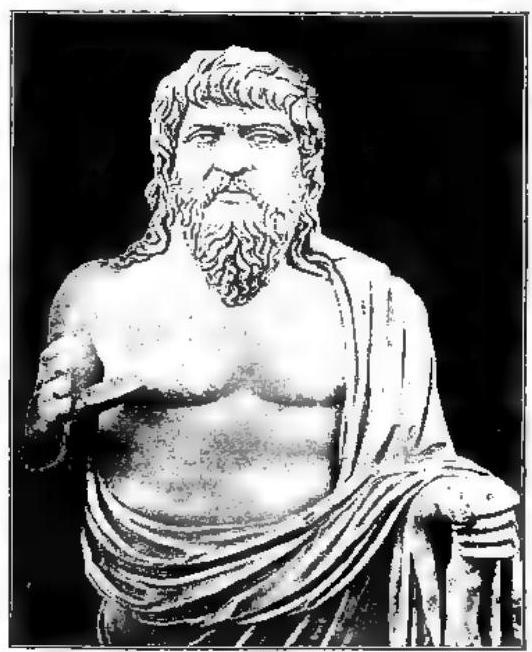
HERACLITUS of Ephesus. – Greek philosopher who lived approximately between 540 and 475 B.C. Of noble birth, he displayed throughout his life, devoted to philosophy, a stern superiority toward the multitude and vulgar religion. He loved to express himself in aphoristic form, by hints rather than fully (ἡμι-τελές says Theophrastus), hence his proverbial obscurity (ὁ σκοτεινός).
His principal work, of which only fragments remain, was probably entitled *Peri physeōs* and is connected with the philosophy of the early Ionians, inasmuch as it posited the principle of all things in fire: but what is most characteristic of his thought is the negation of being and its resolution into becoming. “Everything flows” (ἐνίσχυσεν) is the traditional form of the statement. Plato (*Cratylus*, 402 A) says much the same: «ἐνίσχυσεν καὶ οὐδὲν μένει». Effective is the image of the river in which one cannot bathe twice in the same water. Becoming is not an easy process, without resistance, but a struggle of opposing forces, one of which, descending from above, tends to transform celestial fire into solid matter, while the other, rising toward the sky, tends to transform terrestrial matter into fire. War is the mother and queen of all things (πόλεμος πάντων μὲν πατήρ ἐστι, φησὶν Ἡράκλειτος; Hippolytus, *Refutatio omnium haeresium*, IX, 9). All things come into being through the strife of contraries. As fire lives the death of air, air the death of fire, water the death of air, earth the death of water, so the soul lives the death of the plant, man the death of the animal, the gods the death of man, good the death of evil, evil the death of good.
And, insisting on the absolute instability of things, on the vanity of every individual existence, he is for the ancients the type of the pessimist. But fire, being for H. a rational principle (πρόφρων), according to the testimony of Hippolytus and Clement of Alexandria (*Stromata*, V, 14), is identified with the supreme divinity incomprehensible in its essence and is called ἕν, σκότος, δίκη, γνώμη; more often λόγος; for God all things are beautiful and good; just; only men suppose that some things are just and others not. From this cosmic law there also derive civil laws, so that the people must fight as for the walls of their city. The soul of man is the better, the drier it is, as can be seen in the opposite extreme, the drunkard. It is a kind of exhalation (ἀναθύμιασις) of the cosmic fire. True knowledge is not possible without thought; the senses, not guided by λόγος, are poor witnesses. The source of truth is the thought common to all (ἓν τὸ σοφὸν μοῦνον λέγεσθαι οὐκ ἐθέλει καὶ ἐθέλει Ζηνὸς ὄνομα).
The school of H. and especially Cratylus (the best-known of his disciples, who, insisting on the concept of becoming, affirmed that not even once can we immerse ourselves in the same river) professed skepticism.
---
ERASMUS, St. – He is commemorated in the Gerontian Martyrology on June 2. St. Gregory the Great, in a letter of Oct. 590, attests that his body rested at Fornìta (*Registrum Epistolarum*, I, 8). His cult was very widespread in antiquity and he was numbered among the Holy Helpers (v.).
The accounts of his life and martyrdom are drawn from a *Passio* rather legendary in character and composed between the 6th and 9th centuries, according to which E., a native of Antioch, at the beginning of the persecution of Diocletian, took refuge in the mountains of Lebanon. Returning to the city, he was seized, scourged, flayed, and imprisoned. Miraculously freed, passing through Sirmium, where he suffered at the hands of Maximian, he arrived at Fornìta, where shortly afterward he died. Uncertain is the title of first bishop of the city attributed to him by later documents.
Iconography. – The earliest representation of his martyrdom is in an 8th-century fresco in the underground church of S. Maria in via Lata in Rome, where E. stands before the consul, with two scribes nearby. Beside it, in another fragmentary fresco, the Saint is carried to heaven by two angels.