
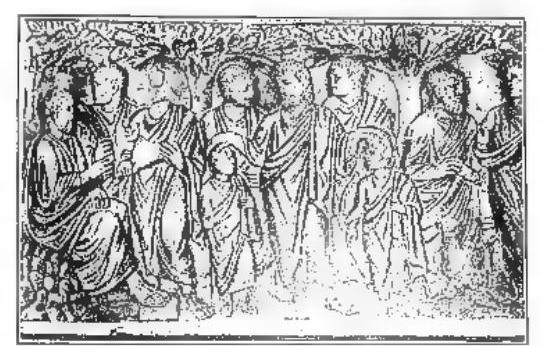
ESAU — Isaac blesses E. and Jacob. Detail from a sarcophagus (4th century) — Paris, Louvre.
He was “a skilful hunter, a man of the field” (Gen 25:27).
With great levity Esau bartered away his birthright to his brother. This seems to have occurred at a moment when Isaac was blind, yet Isaac still confirmed the transfer with his blessing, which Jacob had obtained in a rather underhand way with his mother’s connivance (Gen 27:1 ff.). The deed deepened the brothers’ hatred; Esau formed the purpose of fratricide (Gen 27:41), but Rebecca’s prudence prevented its execution. In accordance with the divine plan Jacob, whose history is recounted at length, became the heir to the patriarchal promises, while Esau was condemned to a life of hunting (Gen 27:39). Later the two brothers were reconciled, but to avoid further dissension they separated: Esau withdrew to the mountains and steppes of Seir, the ancient name of Edom; Jacob went to Shechem in Samaria.
Esau is therefore regarded as the eponymous ancestor of the Edomites, whom the Hebrews despised as descendants both of a man who had forfeited his patriarchal rights and of Canaanite women (Gen 36:1 ff.). Thus Esau disappears from Hebrew history to become the symbol of a people rejected by God (cf. Mal 1:2–3; Rom 9:11), and as such he figures in numerous rabbinic legends.