
### ESTIENNE, FANTICIA
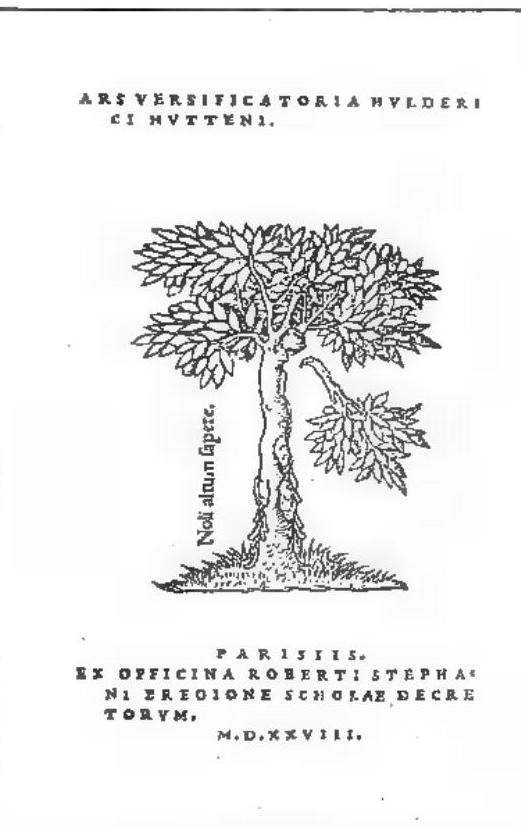
Frontispiece of the *Ars versificatoria* by Ulrich von Hutten, Paris 1528.
e. stretched, beyond the bounds of ordinary logic and morality, into exaggerated superhuman assertions. Wagner and Nietzsche attract and repel each other as do the solar and nocturnal aspects of their *e.* The intrinsic drama of *e.*, in all its historical expressions, governs the disarray of a life that disregards the proper proportion among the human values of truth, goodness, and beauty.
**
---
### ESTIENNE (Stephanus), FAMILY
Printers who carried out their activity in Paris and Geneva in the 16th century, beginning in 1502.
The founder was **HENRI I** (b. between 1465 and 1475, d. 1526), renowned for his edition of a Psalter in five columns (1509). His second son was **ROBERT I**, born in Paris in 1499, who died in Geneva on 7 September 1559. “A man, as it were, born to promote good letters” (*Thesaurus*, I, ed. 1740, p. 12), highly skilled in Latin, Greek, and Hebrew, from 1526 he energetically edited and disseminated critical editions of Latin classics, ecclesiastical Greek writers, and a most useful *Thesaurus linguae latinae* (4 vols., Paris 1531; 2nd ed. 1536; 3rd ed. 1543; later editions in Lyon 1573, London 1735, Basel 1740-43), earning the title of *imprimeur du roi* (1539) and *lexicographorum princeps*. His activity, clearly divided into a Catholic period in Paris (until 1551) and a Protestant one in Geneva (1551-59), was particularly devoted to Sacred Scripture from as early as 1523.
Thus he produced multiple editions of the New Testament in Latin (1523), the complete Bible in Latin or the Vulgate (1528), the Hebrew Bible (4 vols., 1539-44), the New Testament in Greek (1546), and the New Testament in French (1553). In 1555 he followed this with *Concordantiae Bibliorum utriusque Testamenti, Veteris et Novi, novae integrae*, which one might truly call the first work of its kind.
In the various editions of the Vulgate (1528-57), E. strove to restore the authentic text of St. Jerome and “has earned a place of the first order in the history of the Vulgate” (H. Quentin, *Mémoire sur l'établissement du texte de la Vulgate*, Rome 1922, pp. 104-20). In the 4th edition of the Greek-Latin New Testament (Geneva 1551), he introduced the division of the sacred text into numbered chapters and verses, a system he had devised while traveling between Paris and Lyon—a division not always well received, yet still in use today. His biblical editions, especially on account of his annotations, were viewed with disfavor by the Sorbonne, so that in 1551 he moved to Geneva and embraced Protestantism, placing his printing house at the disposal of the “reformers.” See his *Responsio ad censuras theologorum Parisiensium, quibus Biblia a Roberto Stephano, typographo regio, excusa calumniose notantur* (Geneva 1552, also issued simultaneously in French).
Other notable works on biblical themes include a thesaurus of the Hebrew language and glosses on the Gospels, namely: *Nomina hebraea, chaldaea, graeca et latina virorum, mulierum, populorum, idolorum, urbium, fluviorum, montium caeterorumque locorum quae in Bibliis leguntur, restituta...* (Paris 1537); *Phrases hebraicae, seu loquendi genera hebraica quae in Vetere Testamento passim leguntur... thesauri linguae hebraicae altèra pars* (ibid. 1538); *In Evangelium secundum Matthaeum, Marcum et Lucam commentarii ex ecclesiasticis scriptoribus collecti, novae glossae ordinariae* (Geneva 1553).
His son **HENRI II** (b. 1521, d. in Lyon 1598) brought the printing house into decline, but as a Hellenist he achieved great renown for his edition of Anacreon (1554) and even more so for the *Thesaurus graecae linguae* (1572), which, revised and reworked (Paris 1831-65), remains to this day the most extensive Greek lexicographical repertory.
**