
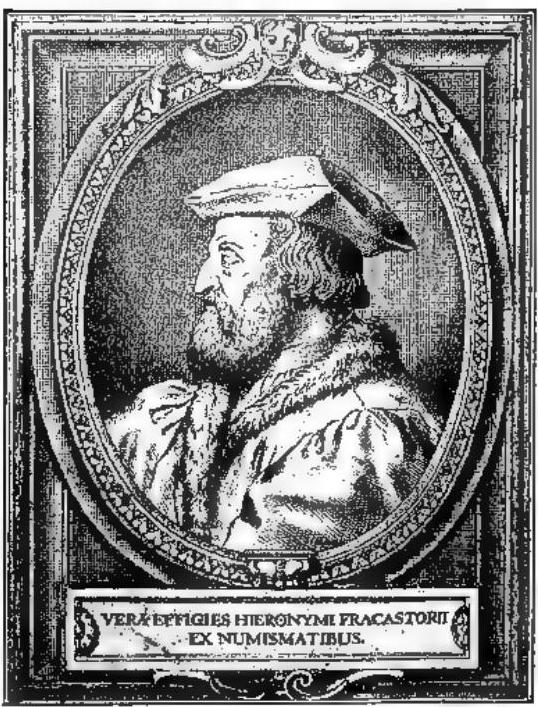
(from Girolamo Fracastoro, Carmina, Padua 1789)
FRACASTORO, GIROLAMO — Rijatto — Vatican Library, copy from the Fermioli collection.
**fractio panis** (pars pro toto), which in ancient Christian literature often signifies the celebration of the Eucharist.
Similar expressions are found in the Old Testament (Is. 38:7; Jer. 16:6-7; Lam. 4:4; Ez. 18:7, 16), and partly reflect Jewish thought, among whom the rite of breaking bread, performed by the head of the household at the beginning of a common meal, held religious significance and indicated a sacred bond uniting all the diners.
This custom was adopted by Jesus, who, as head of a new spiritual family, broke bread before the crowd he had fed in the miracle of the multiplication (Mt. 14:19; 15:36; Mk. 6:4; 8:6; Lk. 9:16; Jn. 6:11). On the eve of his death, he repeated the rite in the institution of the Eucharist (Mt. 26:26; Mk. 14:22; Lk. 22:19; 1 Cor. 11:24), which St. Paul calls "panem quem frangimus" (ibid., 10:16).
Due to the double use made of it by the Lord, in the New Testament the *fractio panis* can denote either a common meal or the Eucharistic Supper; only from the context can the meaning of the expression in individual cases be determined. The *fractio panis* at Emmaus (Lk. 24:30-35), by the lake (ibid., 24:41-43; "piscis assus") and during the stormy voyage to Malta (Acts 27:35) is today commonly considered an ordinary meal, whereas that celebrated by the first Christians in Jerusalem (Acts 2:42, 46) and by St. Paul at Troas (Acts 20:7, 11) is regarded as Eucharistic. When *fractio panis* has an Eucharistic meaning, it does not refer to the consecration under one species, but to the entire sacred rite, which is named after its most significant part (a potiori).
Among Christian writers (e.g., Didache 14:1; Ignatius Martyr, Eph., 20:2; *Evà πρòς πávτας*) the *fractio panis* signifies "Eucharist," as also in the art of the Catacombs (cf. J. Wilpert, *Fractio panis, die älteste Darstellung des eucharistischen Opfers in der Cappella greca* discovered and explained, Freiburg in Br. 1905; V. BANCHETTO).
From the *fractio panis* came the *fractio Sacramenti*, which is that rite of the Latin Mass by which the Host is divided into three parts (corpus tuforinum) and which, since the time of Amalarius (9th century), has acquired an ecclesiological meaning (cf. the learned work of H. De Lubac, *Corpus Mysticum. Eucharistie et Église au moyen âge*, 2nd ed., Paris 1949, pp. 297-339). In the 16th century, Melchior Cuno argued that in the *fractio Sacramenti* the sacrificial nature proper to the Eucharist is realized (De locis theologicis, Bassano 1776, bk. XII, ch. 12, p. 302), but his opinion, already contested by St. Thomas (Sum. Theol., 3, q. 83, a. 4; a. 6, ad 6), did not gain acceptance (v. FRAZIONE DELL'OSTIA).