
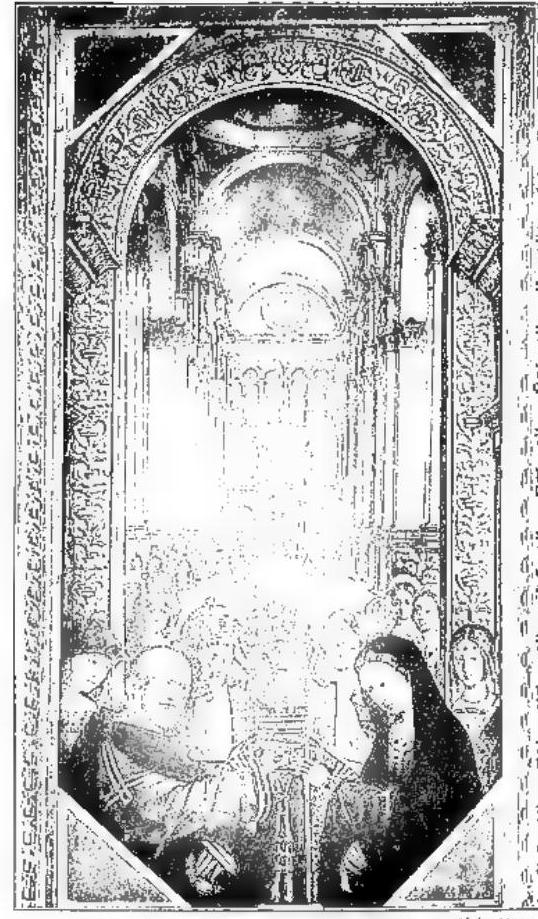
FERRARI, Gaudenzo. - Piedmontese painter, b. in Valduggia, near Borgosesia, c. 1471 (according to others c. 1480), d. in Milan on 31 Jan. 1546. In some documents he is called “Gaudentius de Vince” (from his mother’s name); in others:
"Mag. Gaudentius de Ferrari de Varallo Vallis Sicidae, filius quondam Antoni Lanfranchi".
According to Lanzaro, he would have been a pupil of a mediocre Milanese painter, Stefano Scotto; but various art writers have suggested the names of Perugino, Raphael, and Leonardo as possible masters of G.
Both the panels depicting Stories of St Joachim (Turin, Galleria Sabauda), the earliest dated works by the master (1507), and many of his drawings, indicate a concrete relationship with Bramantino and link G.’s art to the Lombard pictorial tradition. Bramantino’s influence is evident in the particular graphic luminism of the drapery, clear in both drawings and paintings, as well as in certain playful effects. Yet even in the earliest frescoes of the Sacro Monte at Varallo (antedating 1513), a reference to Leonardo is discernible, and there emerges that distinctive mannerism of G.’s, in the undulating and billowing folds of drapery, which has led his art to be described now as Gothic, now as Baroque—at least as a stylistic reference. The early period also includes the altarpiece of Arona (1511), among the artist’s masterpieces, where the Umbrian-Peruginesque influence is evident, an influence that becomes more pronounced in the fresco cycle of the Life and Passion of Christ (1513), in S. Maria delle Grazie at Varallo. Next comes the polyptych of S. Gaudenzio in Novara (1515), another significant work in which the extraordinarily vivid colouring of G. is tempered by Leonardo’s chiaroscuro.
Between 1528 and 1539, G. worked in Vercelli and Saronno. To this period belong the fresco cycle in S. Cristoforo at Vercelli, with Stories of the Magdalene, characterized by a broad and calm manner; the Madonna degli Aranci (Vercelli, S. Cristoforo); and the frescoes of the sanctuary of S. Maria dei Miracoli at Saronno (1534), among others. From 1539 until his death, G. worked in Milan.
To this later period, dominated by a more pronounced mannerism and more complex Leonardesque influences, belong, among other works, the altarpiece of S. Maria di Piazza at Busto Arsizio (1539); the frescoes in S. Maria delle Grazie in Milan (1542); the St Paul in the Louvre (1543); and the beautiful frescoes depicting Stories of St Anne for S. Maria della Pace, later transferred to Brera. - See pl. LXXIX.