
FICINO, MARSILIO. — Platonic philosopher; restorer of Platonism. Born at Figline in the Valdarno on 19 Oct. 1433, son of Ficino (shortened from Diotifece) d’Agnolo di Giusto, a physician; died at Careggi (Florence) on 1 Oct. 1499.
He studied the humanities in Florence and Pisa. The three books *De Vita*, the *Consiglio contro la pestilenza* (written in 1479), and some *Ricette contro alla peste* show that Ficino had made early studies in medicine.
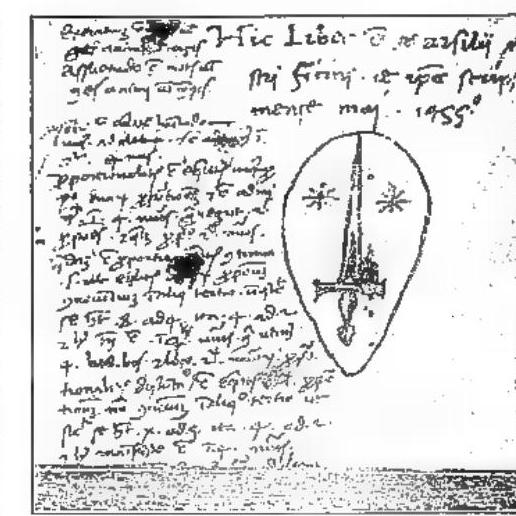
His spiritual orientation between the ages of 22 and 24 is attested by the *Epistola a’ fratelli* (1455), the short treatise *De Deo et anima* (1457), *De magnificentia* (1457), *De furore divino* (1457), *De voluptate* (1457), the declamations *De laudibus philosophiae* and *De laudibus medicinae*, and *De quatuor sectis philosophorum*. Having just begun the study of Greek, he set about translating the hymns attributed to Homer, the *Theogonia* of Hesiod, the hymns and the *Argonautica* of Orpheus, and the hymns of Proclus. At Careggi, barely thirty years old, he undertook the great series of translations from the *Corpus Hermeticum* or *Pimander* to the *Enneads* of Plotinus. After translating several Platonic dialogues, such as the *Symposium*, the *Phaedrus*, and the *Phaedo*, he composed commentaries on them. The most notable is that on the *Symposium*, composed no later than 1469 and translated into the vernacular a few years later by himself and in 1544 by Ercole Barbarossa.
The labour of translating and commenting nourished his speculative spirit. If Plato had appeared to Numenius as nothing other than “a Moses who spoke Attic,” Augustine declared that “no Latin Platonist expressed the majesty of Plato in wisdom and eloquence more exactly” (*Theologia Platonica*, XI, 6), and pointed to Plato as a guide to Christ. With this conviction, Ficino set himself to gather the fruit of his Platonic meditations in a work of great scope, the *Theologia Platonica de immortalitate animorum*, which in its first draft was composed between 1469 and 1474. St. Thomas had made Aristotelian philosophy a propaedeutic to theology. But errors and misunderstandings had distorted the Thomistic interpretation of Aristotle. Even Cardinal Bessarion (*In calumn. Platonis*, III, cap. 22) had shown that, according to the most certain principles of Aristotelian metaphysics, the human intellect either perishes with the body, as Alexander of Aphrodisias held, or is unique for all men, as Averroes thought. Plato, on the other hand, had given a solid demonstration of individual immortality and of future life, and had pointed to the supreme end of human life in the *homoiōsis* (τὸ θεῖον κατὰ τὸ δυνατόν) (*Theaetetus*, 176 b). It is noteworthy that just as Ficino was striving to demonstrate the harmony between Platonic philosophy and Christian Revelation, he matured, now past forty, the intention of seeking priestly ordination, which was conferred upon him on 18 Dec. 1473. Alongside the *Theologia Platonica* he composed a commentary on the Gospels, now lost.
In his new state he continued to alternate between sojourns in Florence and Careggi, where the noblest spirits gathered to discuss with him Platonic doctrine. What was later, improperly and not without some confusion, called the Florentine Platonic Academy was nothing other than this circle of friends gathered around Ficino and animated by the spirit of the *Symposium*.
Having developed the religious elements of Platonism, in 1474 he wrote the *De Christiana religione* as a logical complement to the *Theologia Platonica*. The incarnation of Christ appeared to him as the greatest work of which God, in His omnipotence, was capable (*De Chr. rel.*, cap. 16), since only through the union of created nature with the infinite and eternal nature of God is the distance between God Himself and the world bridged and perfect unity of the finite with the infinite attained. This concept would suggest that Ficino, like Pico della Mirandola shortly afterwards, adhered to the sceptical thesis that Christ would have become incarnate even if Adam had not sinned.
In 1475 he resumed the commentary on the *Phaedrus*, and between October 1476 and the early months of 1477 he completed several short treatises, five of which were collected under the title *Quirino claves Platonicae sapientiae*; two others are the *De raptu Pauli* and the *De luce*. Although absorbed in his philosophical world, Ficino remained aloof from the political events of Florence after the death of Cosimo, yet he could not be indifferent to the storm unleashed by the Pazzi conspiracy in April 1478, especially after Sixtus IV had fulminated excommunication against Lorenzo the Magnificent. To this event are related the *Oratio Christiani gregis* and the *Vaticinium ad Pontificem* (*Epistolae*, VI, pp. 508 ff.). The war was followed by the plague of 1478–79, during which literary activity came to a halt. Nevertheless, he composed the *Consiglio* and the *Ricette contro la peste*.
Once calm returned, he was able to put the final touches to the *Theologia*, of which he supervised the Florentine edition on 7 Nov. 1482; this was followed, at the beginning of autumn 1484, by that of Plato’s dialogues, so that he could announce to Pico della Mirandola, who had come to visit him: “Plato noster... hodie inimicis nostris est egressus” (*Opera*, p. 1537). It was the heroic mind of the Mirandolan that spurred him to begin as soon as possible the translation of Plotinus’s *Enneads*, which he had long contemplated and which he finished on 16 Jan. 1485. Thus Plato would no longer wander among the Latins without his “faithful Aeneas” (*Opera*, p. 870). Around 1478 the *De mysteriis* of Iamblichus was translated, together with other short treatises or excerpts from Neoplatonic philosophers. The *De vita coelitus comparanda* dedicated to Matthias Corvinus, king of Hungary, is dated 1489. Because of this last book, in May 1490 he was accused before the Roman Curia of magic and heresy. The accusation came to nothing, and a few months later Ermolao Barbaro reassured him of Innocent VIII’s goodwill toward him. In the same year, while preparing the edition of Plotinus (translation and commentary), he set to work translating and commenting on the *De mystica theologia* and the *De divinis nominibus* of the Pseudo-Dionysius the Areopagite, in which he believed he had discovered the highest expression of Platonic theology no less than of Christian theology: “Dionysius Areopagita platonicae disciplinae cultum et christianae theologiae cultum” (*Opera*, p. 1014).
After the death of the Magnificent, the villa at Careggi became more welcome to him than ever; yet even there he could not remain estranged from what was happening in Florence. If at first he had seen in Savonarola a prophet sent by God to admonish the Florentines, the political upheaval that followed the initial enthusiasm, and the fanaticism of the *piagnoni* even when the friar rebelled against the Pope and the civil authorities, led him to denounce the Dominican, recently hanged and burned, as the Antichrist.
Ficinian Platonism exercised the widest influence on Renaissance thought and contributed to restoring harmony between religious aspirations and the passion for the resurgent classical beauty, in the arcane light of Diotima’s teaching.
Most of F.’s works were collected in the 2‑volume edition issued at Basel in 1561 and reprinted, apart from a few additions, in 1576. A third edition is the Paris one of 1541. Outside the 1561 edition there remain the De virtutibus moralibus seu de magnificentia, the De quatuor sectis philosophorum, and the Disputatio contra iudicium astrologorum, all three edited by P. O. Kristeller in Supplementum Ficinium (II, Florence 1937, pp. 1–76); the Apologia contra Savonarola, already printed by Passerini in 1859, is re-edited by Kristeller (loc. cit., pp. 76–79); certain Epistles not included in the Epistolarie in twelve books, arranged by F. Gess, now printed by Kristeller (loc. cit., pp. 79–96); the pieces gathered under the title Nigrae edited by Kristeller (loc. cit., pp. 96–97); some dedicatory epistles and apologues issued by Kristeller (op. cit., I, pp. 10–15, 21, 37–64, 71–72, 88–91); and other minor items noted by Kristeller (loc. cit., p. cxlii ff.) and partly by him edited (op. cit., I, pp. 96–98). In particular, missing from the 1561 edition are the translation of Plato’s dialogues, first printed in Florence in 1484 and reissued many times up to the revised version by R. B. Hirchig (Platonis opera graece et latine, Paris 1880), and the translation of Plotinus’ Enneads, first printed in Florence in 1492 and repeatedly reproduced, corrected or not, down to the edition by Creuzer and Moser (ibid. 1896). The vernacular translation of Dante’s Monarchia was first issued by Fratricelli in Florence in 1839, then by Torri at Leghorn in 1844, and subsequently many times. For other writings of F. omitted from the Basel edition, as for editions of individual works such as the Theologia Plat. and De Christ. rel., and for the manuscript tradition of all F.’s works, Kristeller’s careful work is fundamental. This holds also for the chronology of Ficino’s writings and the stages in the composition of the Epistolarie, which is so important for reconstructing F.’s biography and his relations with contemporary scholars.