
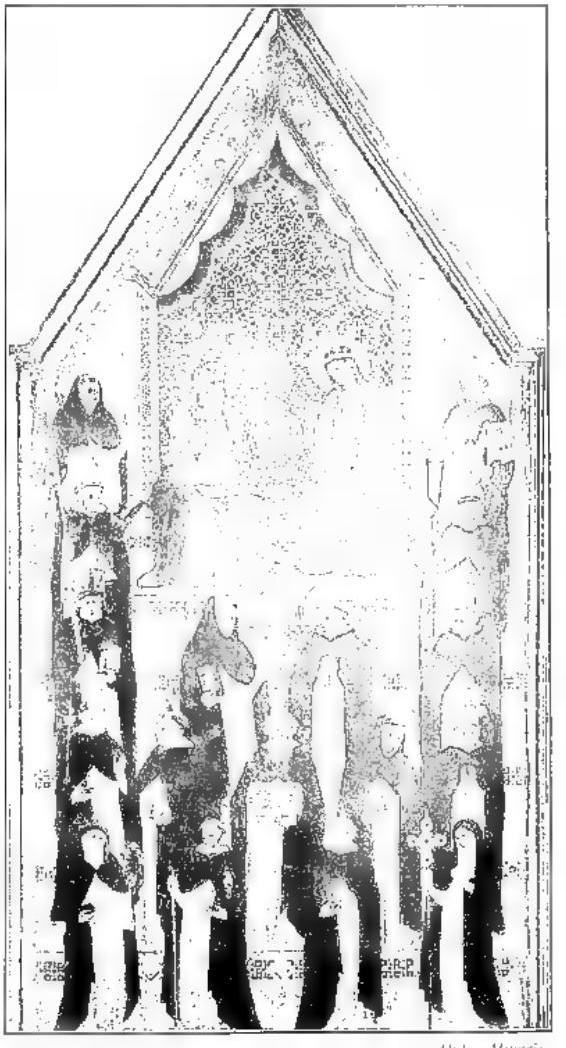
FRATI PREDICATORI, ORDER OF — A mendicant order founded by St. Dominic (hence: Dominicans) for preaching. Its modern constitutions indicate the means employed to prepare the friars for this mission: 1) public recitation of the Divine Office, 2) regular life, 3) observance of certain ascetical practices, 4) assiduous study of sacred sciences.
Summary:
I. Foundation
II. The Dominican constitution
III. Doctrinal activity and preaching
IV. Missionary activity
V. Crisis of mendicancy and poverty
VI. Return to common life
VII. The church
VIII. Dominican priesthood
IX. The Dominican Third Order
X. Dominican confraternities
XI. Modern era
XII. Revival
XIII. Present state
XIV. Dominican architecture.I. FOUNDATION
The Order arose from an apostolic mission (*Sacra praedicatoria*) in Languedoc among the Albigensian heretics, directed in 1206 by Diego, Bishop of Osma (Spain), and after his death (6 Feb. 1207) by his companion Dominic, subprior of the regular Chapter of Osma. In April 1215, with the approval of the Bishop of Toulouse, Dominic transformed this association of preaching clerics into a permanent religious community and established it near Toulouse, first in a provisional house and then at the church of St. Romano, which had been ceded to him by the bishop. As a rule for the house, the community adopted some usages of the Premonstratensian canons, much revised by Dominic himself to adapt them to the apostolic aims of his congregation. After a journey of St. Dominic to Rome, the community chose as its code of spirituality the Rule of St. Augustine, generally followed by the canons regular. A few months later, the Holy See approved the new institute (22 Dec. 1216) and its purpose (21 Jan. 1217). On 15 Aug. 1217 the spread of the Dominican Order throughout the Church began, with the expanded aim of forming learned clerics dedicated to preaching, especially among urban populations, without being tied to a specific parish. Therefore, Dominic began by founding convents in the two principal university centers: Paris (1217) and Bologna (1218). The extension of this apostolic mission was announced to the whole Church by Honorius III (1218). At the death of the founder (6 Aug. 1221), the Order already had several houses in France, Italy, and Spain; it had established itself in Germany, England, Hungary, and was about to enter Poland and Scandinavia.III. DOCTRINAL ACTIVITY AND PREACHING
Under Jordan of Saxony (1222–37), the Order saw a growing influx of students from all nations, enabling it to establish itself in the principal cities of the West. In 1228, besides the original eight, four more provinces were added (Poland, Scandinavia, the Crusader States, and the Holy Land). Subsequently, some provinces were subdivided, so that by 1303 there were eighteen provinces with 582 convents. Under the same Master General, the Order developed its own program of philosophical and theological instruction, obtaining two chairs of Theology at the University of Paris, and devoted itself to the compilation of scholarly works, soon imitated by other religious orders. From the mid-13th century, it held the first place in the scientific and cultural field in the West, with figures such as Albert the Great and Thomas Aquinas, without losing sight of the primary purpose for which it had been founded. Indeed, the intense practice of preaching absorbed most of its energies. The convents, established in major cities, were the principal centers of their activity. In their churches, adapted for this purpose (*ad captandum homines in praedicationibus*), they preached up to twenty-five times a year, both in the morning (*sermo*) and in the evening (*collatio*). They also founded confraternities to facilitate preaching in assemblies. The provinces were divided into a certain number of preaching circuits (*dieta*), one for each convent, and as new convents were established, each with its own sphere of action (*praedicatio*), the circuits became smaller. The rural parishes within these circuits were periodically visited by the preachers of the respective circuit and served as the limits (*termini*) of its apostolic outreach. In some of these more important *termini*, the convent later built a hospice where some preachers resided for a time, if not the whole year, to evangelize the neighboring parishes more intensively. In this way, the entire conventual circuit was subject to the continuous apostolic action of the Friars Preachers.To promote the practice of preaching, even outside the Order, the Friars Preachers published several manuals, some in use until the 18th century. Most of the surviving sermon texts come from academic centers; others, unfortunately rarely written down, though preached in the vernacular, were almost always recorded in Latin (at least in the 13th century). For Italy, one may turn to the sermons of the Blessed Jordan of Pisa (d. 1311) to gain an idea of this type of popular preaching. By the end of the 13th century, the Order had already achieved the purpose of its foundation, not only by practicing preaching intensively itself but also by drawing other orders and the secular clergy to this ministry. If in the 13th century northern Italy escaped the Cathar and Waldensian threat, it was largely due to Dominican preaching. From 1220 to 1240, the great communes were so influenced by it that they entrusted the Friars Preachers with the revision of their communal statutes. They were also consulted on internal affairs.
IV. MISSIONARY ACTIVITY
Heir to the missionary aspirations of its founder, the Order entrusted to its provinces situated on the frontiers of Christendom the task of crossing the border to convert pagans and schismatics and then to found convents among the evangelized populations to ensure permanent religious instruction. Such was the development of the Polish province among the Lithuanians, Russians, and Ruthenians (St. Hyacinth in Kiev before 1233); of the Hungarian province among the Cumans (Paul of Hungary: 1221), the Bosnians (John of Wilhelmshausen, Bishop of Diakovár in 1233), and the pagan Hungarians in the middle Volga (Julian of Hungary in 1232); of the Scandinavian province among the Estonians (convent at Reval in 1248) and in Finland (convent at Åbo in 1249); of the Spanish province in Morocco (Dominic, titular bishop in 1225) and in Tunisia (school of Hebrew and Arabic); of the Holy Land province (1225) among schismatics (1244) and Muslims (1257) in the East. The Order was about to penetrate further into Asia when political upheavals, particularly the fall of Acre in 1291, forced it to change tactics. Following the trail of Italian merchants at Pera, Caffa, and Trebizond, it entered Persia and Mesopotamia, founding convents as operational bases like those in other provinces, but these were grouped into a "Convergence of Friars Pilgriming for Christ." The first vicar of this Congregation for the Master General was Francis of Perugia, who set out for the East in 1238. The missionary activity of the Congregation reached its peak in the first half of the 14th century. The Greek province was formed with Italian and French friars; like their confreres in the Holy Land and the Pilgrims, they were concerned not only with reconverting dissidents but also with transmitting to the West the treasures of Eastern philosophy and theology (e.g., the Fleming William of Moerbeke, Archbishop of Corinth, d. 1286).V. Crisis of Mendicancy and Poverty
The renunciation of the possession of material goods had been willed by St. Dominic in 1220 so that the administration of such goods would not distract the friars from study and preaching; they were to live solely on these and on the spontaneous alms of the faithful. However, the needs of the convents grew with the number of friars, and the generosity of the faithful did not keep pace, so that the quest for alms was no longer sufficient to feed and clothe so many people, and it prevented many friars from dedicating themselves entirely to preaching. Meanwhile, the need to dedicate a significant portion of the personnel to teaching grew, and the demands of the life of study increased. Some convents found themselves compelled to secure a minimum of fixed income. To this end, they leased the immovable goods donated by benefactors, either to a monastery of nuns that always had lay personnel for the management of its lands, or to some lay confraternity, for example, that of the Brothers of Penance (as in Florence in 1221), that of the Virgin (Florence after 1308), of St. Dominic (Bologna), of St. Peter Martyr (Milan), with the obligation to regularly provide the convent with certain consumer goods. The General Chapter of 1228 forbade the possession of immovable goods or other sources of income, without, however, prohibiting the acceptance of alms derived from goods possessed and administered by some friendly association. Yet, even with this expedient, the convents could not do without the quest for alms; the income was insufficient for the purchase of books (our weapons) from the common fund: the friars thus had to procure them individually with money earned through work or given by friends. In some populous studia convents, professors and students also had to provide their own clothing. The friars then obtained from their superiors special and even general permission, explicit or even presumed, to procure the things indispensable or useful for the fulfillment of their respective duties; with this, the practice of poverty established dependence on obedience, yet it opened the door to individual arbitrariness. And this door grew ever wider. By the end of the 16th century, the practice of individual poverty was already a memory, that of common poverty a legal fiction that did not even have the advantage of effectively meeting the real needs of each. Absolute mendicancy, as understood by St. Francis and St. Dominic, had provoked in their two Orders a serious crisis, which did not fail to have its repercussions throughout the Church.VI. Return to Common Life
At the beginning of the 14th century, a first reaction had arisen against the abuse of private life, especially in Tuscany. The Dominicans outside this movement, called, like the Friars Minor, the "Spirituals," knew how to avoid the excesses of their namesakes. Moreover, since poverty had never constituted a special objective in the Dominican Order, it was not defended with such passion, nor did it give rise to the same extravagances. The impetus of the first Dominican reformers was checked in 1348 by the plague that depopulated the convents. The remaining friars were not overly concerned with the qualities of the new recruits; hence a further relaxation, even in other fields of conventual discipline. A second attempt at reform, undertaken with the support of the Dominican Spirituals of Tuscany and Lombardy, by Fra Stefano Comba (from Languedoc, Provincial of Tuscany and Vicar of the Master General in Italy) during a canonical visitation in Lombardy (1369-70), failed because of its rigidity. His candidacy for the generalship was nonetheless proposed by St. Catherine of Siena, guided by the Spirituals of Siena; but when the Great Schism began (1378), the severe reformer, exiled in Languedoc, adhered to the Avignon obedience, his Tuscan friends abandoned him and replaced him with the confessor of the Saint, Raymond of Capua, who was indeed elected Master General for the Roman obedience (1380). Raymond proved more accommodating in his reforming work, and since he stood with Urban VI, the latter and his successors supported him wholeheartedly. For the friars desirous of living according to the ideal of poverty, he founded special convents dependent on a Vicar of the Master General (Congregations of the Observance in Italy, Germany, etc.). Such convents did not admit the possession of revenues; but a few years after Raymond’s death (d. 1399), the old difficulties in living solely on alms resurfaced. Therefore, Bartholomew Texier (1426-49), the most illustrious exponent of Dominican reform in the 15th century, obtained from Martin V the power to grant fixed revenues to some convents. Finally, in 1475, Sixtus IV completely removed the prohibition for the entire Order, freeing it from an unbearable burden that was undermining individual poverty. Gradually, the Observants abandoned their austerities, so that the austerity, now more bearable, was adopted by the Conventuals (i.e., the non-reformed). Under the generalship of Thomas de Vio Gaetano (1508-18), the majority of the "Conventual" provinces merged with the Observant Congregations of their respective territories, introducing the practice of individual poverty, based on the common possession of some revenue, though in fact too restricted. This modus vivendi is called by Gaetano the "end of the reform of the Order." Yet the unity of the Order was preserved thanks to the wholly Dominican conception of the vow of obedience.VII. St. Thomas. — It is a fact that the philosophical-theological system constructed by St. Thomas Aquinas (v.) has attained the foremost place in ecclesiastical teaching, not only for its intrinsic value but also for the support given it by the Holy See from the canonization of the Angelic Doctor (1323) to the present day. The constant transmission and further development of the system are largely the work of successive generations of the Aquinate’s confreres. The doctrine of the Aquinate has so permeated Dominican generations and their intellectual orientation as to become an integral element of Dominican spirituality and preaching, even in its popular form, and of the scientific method of the Dominicans, even outside the fields of philosophy and theology.
- 1
- 2
- 3
- 4
- 5
- 6
- 7
- 8
- 9
- 10
- 11
- 12
- 13
- 14
- 15
- 16
- 17
- 18
- 19
- 20
- 21
- 22
- 23
- 24
- 25
- 26
- 27
- 28
- 29
- 30
- 31
- 32
- 33
- 34
- 35
- 36
- 37
- 38
- 39
- 40
- 41
- 42
- 43
- 44
- 45
- 46
- 47
- 48
- 49
- 50
- 51
- 52
- 53
- 54
- 55
- 56
- 57
- 58
- 59
- 60
- 61
- 62
- 63
- 64
- 65
- 66
- 67
- 68
- 69
- 70
- 71
- 72
- 73
- 74
- 75
- 76
- 77
- 78
- 79
- 80
- 81
- 82
- 83
- 84
- 85
- 86
- 87
- 88
- 89
- 90
- 91
- 92
- 93
- 94
- 95
- 96
- 97
- 98
- 99
- 100
- 101
- 102
- 103
- 104
- 105
- 106
- 107
- 108
- 109
- 110
- 111
- 112
- 113
- 114
- 115
- 116
- 117
- 118
- 119
- 120
- 121
- 122
- 123
- 124
- 125
- 126
- 127
- 128
- 129
- 130
- 131
- 132
- 133
- 134
- 135
- 136
- 137
- 138
- 139
- 140
- 141
- 142
- 143
- 144
- 145
- 146
- 147
- 148
- 149
- 150
- 151
- 152
- 153
- 154
- 155
- 156
- 157
- 158
- 159
- 160
- 161
- 162
- 163
- 164
- 165
- 166
- 167
- 168
- 169
- 170
- 171
- 172
- 173
- 174
- 175
- 176
- 177
- 178
- 179
- 180
- 181
- 182
- 183
- 184
- 185
- 186
- 187
- 188
- 189
- 190
- 191
- 192
- 193
- 194
- 195
- 196
- 197
- 198
- 199
- 200
- 201
- 202
- 203
- 204
- 205
- 206
- 207
- 208
- 209
- 210
- 211
- 212
- 213
- 214
- 215
- 216
- 217
- 218
- 219
- 220
- 221
- 222
- 223
- 224
- 225
- 226
- 227
- 228
- 229
- 230
- 231
- 232
- 233
- 234
- 235
- 236
- 237
- 238
- 239
- 240
- 241
- 242
- 243
- 244
- 245
- 246
- 247
- 248
- 249
- 250
- 251
- 252
- 253
- 254
- 255
- 256
- 257
- 258
- 259
- 260
- 261
- 262
- 263
- 264
- 265
- 266
- 267
- 268
- 269
- 270
- 271
- 272
- 273
- 274
- 275
- 276
- 277
- 278
- 279
- 280
- 281
- 282
- 283
- 284
- 285
- 286
- 287
- 288
- 289
- 290
- 291
- 292
- 293
- 294
- 295
- 296
- 297
- 298
- 299
- 300
- 301
- 302
- 303
- 304
- 305
- 306
- 307
- 308
- 309
- 310
- 311
- 312
- 313
- 314
- 315
- 316
- 317
- 318
- 319
- 320
- 321
- 322
- 323
- 324
- 325
- 326
- 327
- 328
- 329
- 330
- 331
- 332
- 333
- 334
- 335
- 336
- 337
- 338
- 339
- 340
- 341
- 342
- 343
- 344
- 345
- 346
- 347
- 348
- 349
- 350
- 351
- 352
- 353
- 354
- 355
- 356
- 357
- 358
- 359
- 360
- 361
- 362
- 363
- 364
- 365
- 366
- 367
- 368
- 369
- 370
- 371
- 372
- 373
- 374
- 375
- 376
- 377
- 378
- 379
- 380
- 381
- 382
- 383
- 384
- 385
- 386
- 387
- 388
- 389
- 390
- 391
- 392
- 393
- 394
- 395
- 396
- 397
- 398
- 399
- 400
- 401
- 402
- 403
- 404
- 405
- 406
- 407
- 408
- 409
- 410
- 411
- 412
- 413
- 414
- 415
- 416
- 417
- 418
- 419
- 420
- 421
- 422
- 423
- 424
- 425
- 426
- 427
- 428
- 429
- 430
- 431
- 432
- 433
- 434
- 435
- 436
- 437
- 438
- 439
- 440
- 441
- 442
- 443
- 444
- 445
- 446
- 447
- 448
- 449
- 450
- 451
- 452
- 453
- 454
- 455
- 456
- 457
- 458
- 459
- 460
- 461
- 462
- 463
- 464
- 465
- 466
- 467
- 468
- 469
- 470
- 471
- 472
- 473
- 474
- 475
- 476
- 477
- 478
- 479
- 480
- 481
- 482
- 483
- 484
- 485
- 486
- 487
- 488
- 489
- 490
- 491
- 492
- 493
- 494
- 495
- 496
- 497
- 498
- 499
- 500
- 501
- 502
- 503
- 504
- 505
- 506
- 507
- 508
- 509
- 510
- 511
- 512
- 513
- 514
- 515
- 516
- 517
- 518
- 519
- 520
- 521
- 522
- 523
- 524
- 525
- 526
- 527
- 528
- 529
- 530
- 531
- 532
- 533
- 534
- 535
- 536
- 537
- 538
- 539
- 540
- 541
- 542
- 543
- 544
- 545
- 546
- 547
- 548
- 549
- 550
- 551
- 552
- 553
- 554
- 555
- 556
- 557
- 558
- 559
- 560
- 561
- 562
- 563
- 564
- 565
- 566
- 567
- 568
- 569
- 570
- 571
- 572
- 573
- 574
- 575
- 576
- 577
- 578
- 579
- 580
- 581
- 582
- 583
- 584
- 585
- 586
- 587
- 588
- 589
- 590
- 591
- 592
- 593
- 594
- 595
- 596
- 597
- 598
- 599
- 600
- 601
- 602
- 603
- 604
- 605
- 606
- 607
- 608
- 609
- 610
- 611
- 612
- 613
- 614
- 615
- 616
- 617
- 618
- 619
- 620
- 621
- 622
- 623
- 624
- 625
- 626
- 627
- 628
- 629
- 630
- 631
- 632
- 633
- 634
- 635
- 636
- 637
- 638
- 639
- 640
- 641
- 642
- 643
- 644
- 645
- 646
- 647
- 648
- 649
- 650
- 651
- 652
- 653
- 654
- 655
- 656
- 657
- 658
- 659
- 660
- 661
- 662
- 663
- 664
- 665
- 666
- 667
- 668
- 669
- 670
- 671
- 672
- 673
- 674
- 675
- 676
- 677
- 678
- 679
- 680
- 681
- 682
- 683
- 684
- 685
- 686
- 687
- 688
- 689
- 690
- 691
- 692
- 693
- 694
- 695
- 696
- 697
- 698
- 699
- 700
- 701
- 702
- 703
- 704
- 705
- 706
- 707
- 708
- 709
- 710
- 711
- 712
- 713
- 714
- 715
- 716
- 717
- 718
- 719
- 720
- 721
- 722
- 723
- 724
- 725
- 726
- 727
- 728
- 729
- 730
- 731
- 732
- 733
- 734
- 735
- 736
- 737
- 738
- 739
- 740
- 741
- 742
- 743
- 744
- 745
- 746
- 747
- 748
- 749
- 750
- 751
- 752
- 753
- 754
- 755
- 756
- 757
- 758
- 759
- 760
- 761
- 762
- 763
- 764
- 765
- 766
- 767
- 768
- 769
- 770
- 771
- 772
- 773
- 774
- 775
- 776
- 777
- 778
- 779
- 780
- 781
- 782
- 783
- 784
- 785
- 786
- 787
- 788
- 789
- 790
- 791
- 792
- 793
- 794
- 795
- 796
- 797
- 798
- 799
- 800
- 801
- 802
- 803
- 804
- 805
- 806
- 807
- 808
- 809
- 810
- 811
- 812
- 813
- 814
- 815
- 816
- 817
- 818
- 819
- 820
- 821
- 822
- 823
- 824
- 825
- 826
- 827
- 828
- 829
- 830
- 831
- 832
- 833
- 834
- 835
- 836
- 837
- 838
- 839
- 840
- 841
- 842
- 843
- 844
- 845
- 846
- 847
- 848
- 849
- 850
- 851
- 852
- 853
- 854
- 855
- 856
- 857
- 858
- 859
- 860
- 861
- 862
- 863
- 864
- 865
- 866
- 867
- 868
- 869
- 870
- 871
- 872
- 873
- 874
- 875
- 876
- 877
- 878
- 879
- 880
- 881
- 882
- 883
- 884
- 885
- 886
- 887
- 888
- 889
- 890
- 891
- 892
- 893
- 894
- 895
- 896
- 897
- 898
- 899
- 900
- 901
- 902
- 903
- 904
- 905
- 906
- 907
- 908
- 909
- 910
- 911
- 912
- 913
- 914
- 915
- 916
- 917
- 918
- 919
- 920
- 921
- 922
- 923
- 924
- 925
- 926
- 927
- 928
- 929
- 930
- 931
- 932
- 933
- 934
- 935
- 936
- 937
- 938
- 939
- 940
- 941
- 942
- 943
- 944
- 945
- 946
- 947
- 948
- 949
- 950
- 951
- 952
- 953
- 954
- 955
- 956
- 957
- 958
- 959
- 960
- 961
- 962
- 963
- 964
- 965
- 966
- 967
- 968
- 969
- 970
- 971
- 972
- 973
- 974
- 975
- 976
- 977
- 978
- 979
- 980
- 981
- 982
- 983
- 984
- 985
- 986
- 987
- 988
- 989
- 990
- 991
- 992
- 993
- 994
- 995
- 996
- 997
- 998
- 999
- 1000
- 1001
- 1002
- 1003
- 1004
- 1005
- 1006
- 1007
- 1008
- 1009
- 1010
- 1011
- 1012
- 1013
- 1014
- 1015
- 1016
- 1017
- 1018
- 1019
- 1020
- 1021
- 1022
- 1023
- 1024
- 1025
- 1026
- 1027
- 1028
- 1029
- 1030
- 1031
- 1032
- 1033
- 1034
- 1035
- 1036
- 1037
- 1038
- 1039
- 1040
- 1041
- 1042
- 1043
- 1044
- 1045
- 1046
- 1047
- 1048
- 1049
- 1050
- 1051
- 1052
- 1053
- 1054
- 1055
- 1056
- 1057
- 1058
- 1059
- 1060
- 1061
- 1062
- 1063
- 1064
- 1065
- 1066
- 1067
- 1068
- 1069
- 1070
- 1071
- 1072
- 1073
- 1074
- 1075
- 1076
- 1077
- 1078
- 1079
- 1080
- 1081
- 1082
- 1083
- 1084
- 1085
- 1086
- 1087
- 1088
- 1089
- 1090
- 1091
- 1092
- 1093
- 1094
- 1095
- 1096
- 1097
- 1098
- 1099
- 1100
- 1101
- 1102
- 1103
- 1104
- 1105
- 1106
- 1107
- 1108
- 1109
- 1110
- 1111
- 1112
- 1113
- 1114
- 1115
- 1116
- 1117
- 1118
- 1119
- 1120
- 1121
- 1122
- 1123
- 1124
- 1125
- 1126
- 1127
- 1128
- 1129
- 1130
- 1131
- 1132
- 1133
- 1134
- 1135
- 1136
- 1137
- 1138
- 1139
- 1140
- 1141
- 1142
- 1143
- 1144
- 1145
- 1146
- 1147
- 1148
- 1149
- 1150
- 1151
- 1152
- 1153
- 1154
- 1155
- 1156
- 1157
- 1158
- 1159
- 1160
- 1161
- 1162
- 1163
- 1164
- 1165
- 1166
- 1167
- 1168
- 1169
- 1170
- 1171
- 1172
- 1173
- 1174
- 1175
- 1176
- 1177
- 1178
- 1179
- 1180
- 1181
- 1182
- 1183
- 1184
- 1185
- 1186
- 1187
- 1188
- 1189
- 1190
- 1191
- 1192
- 1193
- 1194
- 1195
- 1196
- 1197
- 1198
- 1199
- 1200
- 1201
- 1202
- 1203
- 1204
- 1205
- 1206
- 1207
- 1208
- 1209
- 1210
- 1211
- 1212
- 1213
- 1214
- 1215
- 1216
- 1217
- 1218
- 1219
- 1220
- 1221
- 1222
- 1223
- 1224
- 1225
- 1226
- 1227
- 1228
- 1229
- 1230
- 1231
- 1232
- 1233
- 1234
- 1235
- 1236
- 1237
- 1238
- 1239
- 1240
- 1241
- 1242
- 1243
- 1244
- 1245
- 1246
- 1247
- 1248
- 1249
- 1250
- 1251
- 1252
- 1253
- 1254
- 1255
- 1256
- 1257
- 1258
- 1259
- 1260
- 1261
- 1262
- 1263
- 1264
- 1265
- 1266
- 1267
- 1268
- 1269
- 1270
- 1271
- 1272
- 1273
- 1274
- 1275
- 1276
- 1277
- 1278
- 1279
- 1280
- 1281
- 1282
- 1283
- 1284
- 1285
- 1286
- 1287
- 1288
- 1289
- 1290
- 1291
- 1292
- 1293
- 1294
- 1295
- 1296
- 1297
- 1298
- 1299
- 1300
- 1301
- 1302
- 1303
- 1304
- 1305
- 1306
- 1307
- 1308
- 1309
- 1310
- 1311
- 1312
- 1313
- 1314
- 1315
- 1316
- 1317
- 1318
- 1319
- 1320
- 1321
- 1322
- 1323
- 1324
- 1325
- 1326
- 1327
- 1328
- 1329
- 1330
- 1331
- 1332
- 1333
- 1334
- 1335
- 1336
- 1337
- 1338
- 1339
- 1340
- 1341
- 1342
- 1343
- 1344
- 1345
- 1346
- 1347
- 1348
- 1349
- 1350
- 1351
- 1352
- 1353
- 1354
- 1355
- 1356
- 1357
- 1358
- 1359
- 1360
- 1361
- 1362
- 1363
- 1364
- 1365
- 1366
- 1367
- 1368
- 1369
- 1370
- 1371
- 1372
- 1373
- 1374
- 1375
- 1376
- 1377
- 1378
- 1379
- 1380
- 1381
- 1382
- 1383
- 1384
- 1385
- 1386
- 1387
- 1388
- 1389
- 1390
- 1391
- 1392
- 1393
- 1394
- 1395
- 1396
- 1397
- 1398
- 1399
- 1400
- 1401
- 1402
- 1403
- 1404
- 1405
- 1406
- 1407
- 1408
- 1409
- 1410
- 1411
- 1412
- 1413
- 1414
- 1415
- 1416
- 1417
- 1418
- 1419
- 1420
- 1421
- 1422
- 1423
- 1424
- 1425
- 1426
- 1427
- 1428
- 1429
- 1430
- 1431
- 1432
- 1433
- 1434
- 1435
- 1436
- 1437
- 1438
- 1439
- 1440
- 1441
- 1442
- 1443
- 1444
- 1445
- 1446
- 1447
- 1448
- 1449
- 1450
- 1451
- 1452
- 1453
- 1454
- 1455
- 1456
- 1457
- 1458
- 1459
- 1460
- 1461
- 1462
- 1463
- 1464
- 1465
- 1466
- 1467
- 1468
- 1469
- 1470
- 1471
- 1472
- 1473
- 1474
- 1475
- 1476
- 1477
- 1478
- 1479
- 1480
- 1481
- 1482
- 1483
- 1484
- 1485
- 1486
- 1487
- 1488
- 1489
- 1490
- 1491
- 1492
- 1493
- 1494
- 1495
- 1496
- 1497
- 1498
- 1499
- 1500
- 1501
- 1502
- 1503
- 1504
- 1505
- 1506
- 1507
- 1508
- 1509
- 1510
- 1511
- 1512
- 1513
- 1514
- 1515
- 1516
- 1517
- 1518
- 1519
- 1520
- 1521
- 1522
- 1523
- 1524
- 1525
- 1526
- 1527
- 1528
- 1529
- 1530
- 1531
- 1532
- 1533
- 1534
- 1535
- 1536
- 1537
- 1538
- 1539
- 1540
- 1541
- 1542
- 1543
- 1544
- 1545
- 1546
- 1547
- 1548
- 1549
- 1550
- 1551
- 1552
- 1553
- 1554
- 1555
- 1556
- 1557
- 1558
- 1559
- 1560
- 1561
- 1562
- 1563
- 1564
- 1565
- 1566
- 1567
- 1568
- 1569
- 1570
- 1571
- 1572
- 1573
- 1574
- 1575
- 1576
- 1577
- 1578
- 1579
- 1580
- 1581
- 1582
- 1583
- 1584
- 1585
- 1586
- 1587
- 1588
- 1589
- 1590
- 1591
- 1592
- 1593
- 1594
- 1595
- 1596
- 1597
- 1598
- 1599
- 1600
- 1601
- 1602
- 1603
- 1604
- 1605
- 1606
- 1607
- 1608
- 1609
- 1610
- 1611
- 1612
- 1613
- 1614
- 1615
- 1616
- 1617
- 1618
- 1619
- 1620
- 1621
- 1622
- 1623
- 1624
- 1625
- 1626
- 1627
- 1628
- 1629
- 1630
- 1631
- 1632
- 1633
- 1634
- 1635
- 1636
- 1637
- 1638
- 1639
- 1640
- 1641
- 1642
- 1643
- 1644
- 1645
- 1646
- 1647
- 1648
- 1649
- 1650
- 1651
- 1652
- 1653
- 1654
- 1655
- 1656
- 165
I. THE DOMINICAN THIRD ORDER
It is the branch attached to that of the Fathers Preachers, under the name of "Order of the Penance of St. Dominic," in a manner analogous to the "Third Franciscan Order." The ancient Order of Penance was a collective denomination for the lay fraternities of Penance, which arose at the beginning of the 13th century, then grouped into more or less uniform regional associations and strongly influenced by the two great mendicant Orders. The primitive rule comes from the fraternity of Cannara near Assisi, drawn up by an unknown author and recommended by St. Francis of Assisi in 1221 to the Penitents of Florence. The original text is not extant, but only a revised version from around 1224-27 by the Fathers Preachers (probably by the Blessed John of Salerno, prior of Santa Maria Novella in Florence) and adopted by all the fraternities of Penance. In 1284-85 a double reform, undertaken by the Friars Minor and the Fathers Preachers with the support of the Holy See for the purpose of subjecting these fraternities to stricter Church control, had the effect of affiliating the Penitents to these two mendicant Orders. The group affiliated to the Order of the Fathers Preachers received as its rule a radically revised version of the ancient rule. This statute, published in 1285 by Munio of Zamora, Master General of the Fathers Preachers, aimed to intensify the religious life of the Penitents, who had long been absorbed by their social works (hospitals, public assistance, etc.); it demands great zeal for the truth of the Catholic faith and imposes certain more specific practices of piety and penance. From the Dominican Third Order emerged a considerable number of mystical souls: the Blessed Benvenuta Boiani, John of Orvieto, Margaret of Castello, Villana de’ Botti, Sibillina Biscossi, St. Catherine of Siena and St. Rose of Lima, etc. From the 16th century, priests (e.g., St. Louis-Marie Grignion de Montfort, Ven. Michael Olier) and laypeople, desirous of sharing in the ideal of apostolic holiness of the Fathers Preachers, also joined the Dominican Third Order. After the Lacerdario, it spread especially among lay intellectuals. Toward the end of the 15th century, the Blessed Colonna of Rieti (d. 1501) inaugurated in Perugia a new form of Dominican life, namely the Regular Dominican Tertiaries. Today, congregations of this kind have multiplied. There are 125 of them (with a total of 40,000 sisters), of which 17 have their motherhouse in Italy with about 275 houses and 3,503 religious. Their activity is carried out in various charitable works: teaching, care of the sick, orphanages, and missions, etc.X. DOMINICAN CONFRATERNITIES
The principal lay fraternity erected in the churches of the Fathers Preachers was that of the Virgin, founded in Italy by St. Peter Martyr between 1240 and 1252, with the aim of spreading knowledge of the Marian dogma and the cult of the Virgin, threatened by the Cathars, through Marian preaching, the performance of Marian songs in the vernacular (lauds), the recitation of glossed Ave Marias, and public processions. Like all lay confraternities, this one also engaged in works of charity. In certain places, such as Florence, it split around 1260 into two independent confraternities, one of which continued to pursue the original aim, while the other took up a secondary purpose, freeing itself from Dominican influence. Where it remained undivided, its social works gradually took precedence over its religious and Marian activities (Arezzo). In the mid-15th century, the need for reform became pressing. It was begun in 1468 by the Dominicans of the Observance (Alain de la Roche, James Sprenger, Michael Francis) by promoting the Rosary of the Virgin as a popular devotion. In all the convents of the Observance, the Confraternity of the Rosary was thus established (in 1480 by John of Erfurt in Venice, then at San Marco in Florence, at Santa Maria sopra Minerva in Rome, etc.), with the obligation for members to recite a fifteen-decade Rosary each week. The confraternity met with extraordinary favor throughout Christendom. In non-reformed convents, the ancient confraternity of the Virgin gradually died out with the conventual life, and was replaced by that of the Rosary. From the 17th century onward, the Dominican confraternity became better known. The most notable events are: the struggle against Luther, the great role played in the Council of Trent, its often bloody suppression (St. John of Cologne, martyr of Gorcum) in Protestant countries, the expansion of its missions in Africa, Asia, and America, the establishment of new provinces in America and the Philippines, with their general houses and even universities (in Manila in the Philippines, in Santo Domingo), its doctrinal struggles, its theological, philosophical, and historical publications. Under the leadership of enlightened and prudent Masters General, the Order developed extraordinary activity, as evidenced by the monuments erected by Baroque architecture in all countries. Then, like all other Orders, it was attacked, even in Catholic countries (Austria, Bavaria, Naples, Tuscany, Spain), by state absolutism, and suppressed in France, Belgium, the Rhineland, and northern Italy by the French Revolution.XII. REBIRTH
With the 19th century came a revival, generally steady but often delayed by serious setbacks and local regressions caused by open or covert persecutions. The awakening began with the establishment of a province (1804) in the United States (now three) and the resumption of regular life in Piedmont (1814), counterbalanced by the removal of the Spanish provinces from the authority of the Master General by a royal decree, in force until 1872. Then came the restoration in France with Fr. Lacordaire (1839)—the establishment of three French provinces (Paris in 1850, Lyon in 1862, Toulouse in 1865), one in Belgium (1860), and one in the Netherlands (1862)—but also the suppression in Russia and partial in Poland, the secularization in Italy (1870), the sequestration of the Casanatense Library in Rome (1876), the persecution of the Kulturkampf in Germany (1878), and the repeated expulsions of religious from France (1880–1903). Yet these tribulations contributed to the strengthening of other provinces (Canada, autonomous province in 1911) and to the establishment of the convent of St. Stephen (1883) and the Biblical School (1890) in Jerusalem. In the last quarter of the 18th century and the first half of the 19th, when scholastic philosophy was abandoned, even denigrated, in ecclesiastical institutions everywhere, the Fathers Preachers, deprived of their convents and libraries, dispersed and exiled, sometimes hidden with relatives or friends, continued to study St. Thomas Aquinas, to apply his doctrines to contemporary problems, and to seek his guidance in the face of “new ideas.” Their doctrinal tradition remained alive. When Leo XIII sought to restore Christian philosophy to honor, they became his best collaborators, well prepared for the task assigned by the Pope.XIII. PRESENT STATE
The Roman convent of Santa Sabina is the residence of the Master General with the General Curia; there are also housed the archives of the Order, the Pontifical Leonine Commission for the edition of the works of St. Thomas, the Historical Institute, and the Liturgical Institute. Always “Rome, at the convent of Saints Dominic and Sixtus”: the Pontifical faculties of theology, canon law, and philosophy (Angelicum). The Order numbers 7,661 members, divided into 33 provinces, 6 in Italy (Piedmont, Lombardy, San Marco and Sardinia, Romagna, Neapolitan, Sicilian). Missionary activity extends to Scandinavia, Turkey, Syria, India, Ton-chino, China, Formosa, Japan, the Philippines, the Antilles, South America, South Africa, the Belgian Congo, and in each province an assignment for the Order’s members, public faculties in many of these Studia generalia, a university of its own at Manila, entire faculties or special chairs in several universities—whether free or state-run—entrusted to the Order as such or to its individual members (Fribourg, Nijmegen, Amsterdam, Washington, Paris, Lille, Louvain, Graz, Tokyo, etc.), about 320 periodicals ranging from popular bulletins to high-culture journals and strictly scientific reviews. The oldest Italian Dominican journal, *Le memorie domenicane*, has been published for sixty-five years (since 1884). — See plates CXVII–CXVIII.
NIV. DOMINICAN ARCHITECTURE
Although the Dominican Order produced highly skilled architects—so much so that many of their churches were built by the friars themselves (S. Maria Novella, begun by Fra Sisto and Fra Ristoro and completed by Jacopo Talenti; S. Maria sopra Minerva in Rome, perhaps by the same Sisto and Ristoro)—nevertheless no distinctive architectural features can be singled out in them. The overriding importance given to preaching required unified and spacious interiors, as is also the case in Franciscan churches (q.v.), from which these differ by a stronger upward thrust; in fact, the full development of the Order coincides with the height of Gothic architecture. The first church of the Order, erected in Bologna immediately after the Saint’s death (1221), on the site of a small church dedicated to S. Niccolò and later rededicated to S. Domenico after his canonization, is three-aisled, like most churches of northern Italy (S. Giovanni e Paolo in Venice, 1246; S. Niccolò in Treviso, 1303; S. Corona in Vicenza, 1306; S. Eustorgio in Milan, 13th c.), and in the South (Naples, Palermo). In central Italy, however, with the sole exceptions of Florence (S. Maria Novella), Rome (S. Maria sopra Minerva), and Perugia, the single nave prevails (Siena, Pistoia, Arezzo, Gubbio, Orvieto, Fano, etc.). These two planimetric schemes generally correspond, in terms of roofing, to ribbed vaulting and a trussed roof.