
FUK, JOHANN JOSEPH. — Musician, b. at Hirtenfeld in Styria in 1660, d. at Vienna on 14 Feb. 1741. From 1696 to 1702 he was organist at the Scots College in Vienna; in 1698 he received the title of composer to the imperial court, in 1705 that of second master, in 1713 of vice-master, and in 1715 of first chapel master at St Stephen’s.
Besides a few operas and the celebrated *Gradus ad Parnasum* (1725), later translated into German, Italian, French and English, of his abundant religious music (50 masses, 3 requiems, 57 versicles and psalms, 10 oratorios) there have been printed, among other works, a *Consensus musico-instrumentalis* (1701), four masses and twenty-seven motets (in *Denkmäler der Tonkunst in Österreich*, vols. I and II).
FUTURISM
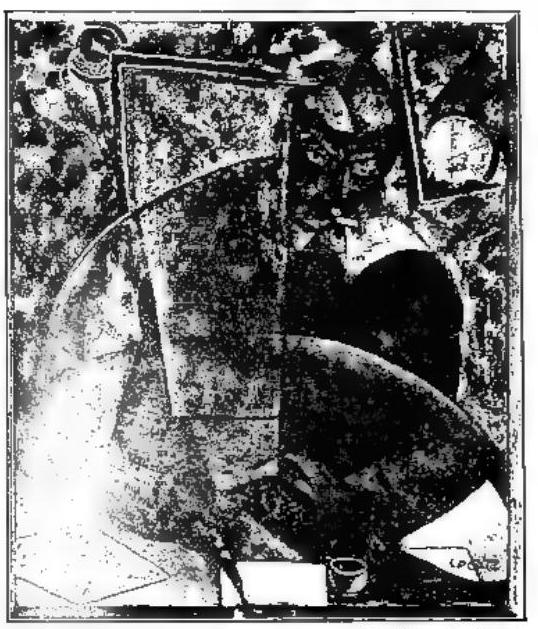
Portrait of the poet Marinetti by C. Carrà (1911), dedicated by Marinetti to the Marchesa Casati.
In this work the Futurists assigned in 1914 an architectural project to Antonio Sant’Elia. He, who in 1914 had published his manifesto of Futurist architecture and who only two years later died in war fighting on the Carso, deserves to be remembered more as a critic of architecture than as an architect (no buildings by him exist and his drawings are more expressions of a fervid imagination stirred by a keen polemical taste than manifestations of a builder). Some of his statements, such as: “By architecture one must understand the effort to harmonize with freedom and great boldness the environment with man, that is, to render the world of things as a direct projection of the world of the spirit,” or that the modern city must be understood as a “gigantic machine in which our tumult can unfold without seeming a grotesque anachronism, because only when architecture has its justification in the special conditions of modern life will it acquire