
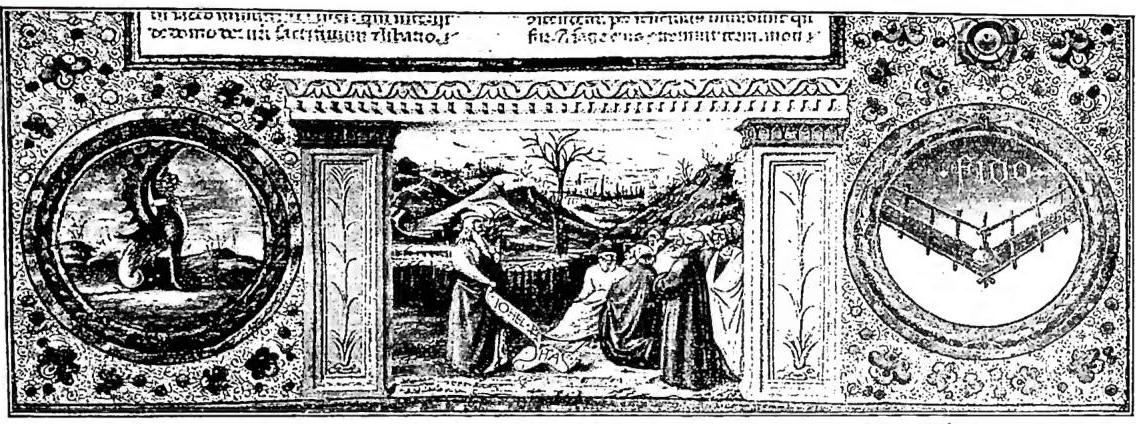
GIOCELE (Hebrew: ἠδὲ εἶ «Yahweh is God»). — Prophet, son of Pethuel (1:1). Since his book speaks only of Judah, Jerusalem, and the Temple, it may be inferred that he exercised his ministry in Judah, perhaps even in the capital itself.
Many exegetes (from Credner onward) assigned G. to the time of King Joash (836–797 BC); among recent scholars, König and Theis hold this view. However, the data provided by the book favor the position of modern exegesis (from Merx onward), which places G.’s activity after the exile, between 500 and 400 BC. Some place G. immediately after Malachi: in G., the priests appear more as intercessors (1:13ff.; 2:15ff.). G. concerns the Kingdom of Samaria, Damascus, Assyria, Babylon, the monarchy of Judah, and the sins of idolatry; he speaks only of priests; the people of Judah represent all Israel (2:17–27; 3:2–16 = Heb. ch. 4, as in Chronicles); he alludes to the destruction of Jerusalem, the dispersion of Israel among the pagans, and the occupation of the land by neighboring nations. G. diverges from earlier prophets (Driver), particularly from Ezekiel (Merx, Scholtz). The enemies of Judah are the Phoenicians, Philistines, Edomites, and Egyptians (3 [Heb. 4]:4–8, 19; cf. Ezek. 35–36; while vv. 9–17 recall Ezek. 38–39; and V. 18, Ezek. 47:1–12). Thus, it seems, we are after the return from exile.
In the Vulgate, there are 3 chapters; in the Hebrew editions, however, there are 4: 2:28–32 in the Hebrew is 3:1–5, and ch. 3 (Vulg.) = ch. 4 (Heb.).
The starting point of G.’s prophecy is a terrible invasion of locusts that devastated the land (1:1–12); the prophet urges repentance (1:13–20). In ch. 2, he takes up the same theme again; the plague, described with vivid imagery and strong metaphors, is presented as a type of the “day of Yahweh” (2:1–11); G. again exhorts to repentance (2:12–17). This is followed by the Lord’s response: cessation of the plague, promise of great temporal (2:18–27) and spiritual blessings (2:28–32; Heb. 3:1–5). Judah will be delivered from the enemies who seek to strangle it: their punishment and divine protection for Israel (3 [Heb. 4]).
The text is well preserved. The style is brilliant and generally pure. The literary unity of the book is recognized, despite a few attempts to the contrary (Rothstein, Marti, Sellin).
The central idea of G.’s prophecy is the assurance that the prophecies concerning the perpetuity of the new Israel, reborn after the exile, and its transition into the kingdom of the Messiah, will be fulfilled.
The exegesis that saw in the description of the locusts only an allegory of the enemy attacks in ch. 3 (Heb. 4) (St. Jerome, Calmet) has long since been abandoned. Some, however, have attempted an eschatological interpretation (Schegg, Merx, van Hoonacker, Tobac). The invasion of locusts would not have occurred; we would have only a description of one of the future calamities that will announce the day of the Lord: the end of the world or something similar.
In reality, this is a historical description and prophecy, with some descriptive elements that will later pass into the apocalyptic genre. “The day of Yahweh,” as used by the prophets, refers to a particular manifestation of His justice; here, for example, against the nations that attack Judah. It is the future of the new Israel (or the theocracy) that the prophet announces with its struggles and triumphs, with the messianic kingdom in the background. The famous oracle (2:28–32; Heb. 3:1–5) refers to this, and it was fulfilled at Pentecost (Acts 2:14–21; cf. Rom. 10:12ff.).
The wonders of nature described here are already traditional images (cf. Isa. 13:10; Ezek. 32:7ff.) and indicate the grandeur of the divine intervention in the outpouring of the Spirit, without reference to real cosmic changes or the end of the world. The name of the valley (cf. 3 [Heb. 4]), where God will judge the nations hostile to Judah, is symbolic (Jehoshaphat = Yahweh judges; cf. Ezek. 39:11ff.). Only from the 4th century AD onward was the name applied to the Valley of Kidron (H. Vincent, Jérusalem, II, Paris 1926, pp. 849–52).