
HOSIUS (Hos, Hozjusz, Osio), STANISLAO. — Theologian and cardinal, b. at Cracow 5 May 1504, d. at Capranica (Sutri) 5 Aug. 1579. Born of a German family that had immigrated to Poland in the service of the king, he studied first at Cracow, then at Bologna and Padua, graduating in law in 1533; there he met Ugo Buoncompagni (the future Gregory XIII, who was his teacher), Lazzaro Bonamico, Cristoforo Madruzzo, Reginald Pole, Otto Truchsess, who introduced him to the humanistic and religious currents of the time.
In contact with these eminent men he acquired a deep ecclesiastical sense and conceived an unwavering attachment to the Roman Church, which accompanied him throughout his life. Returning to his homeland, he worked for some time in the royal chancellery, assisting his patron P. Tomicki, bishop of Cracow and vice-chancellor. In 1543 he became a priest, in 1549 bishop of Kulm
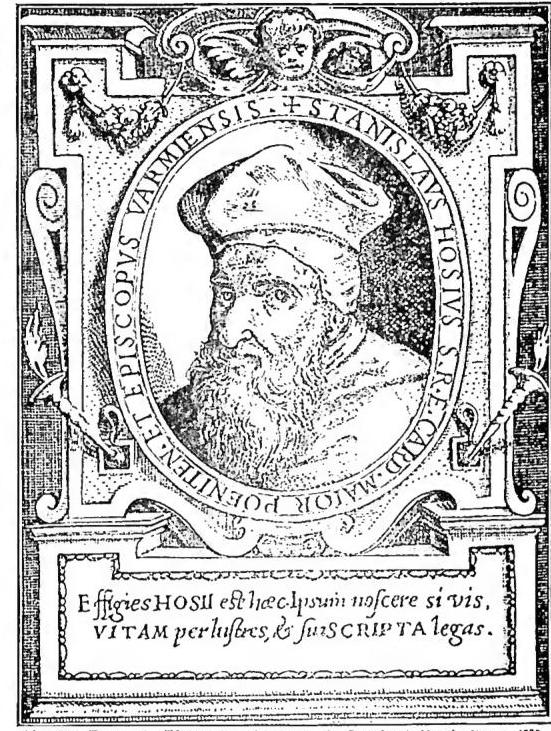
(from Th. Tretarus, *Theatrum rituum D. Stanislao Hosii*, Rome 1538, reprinted at Petplin 1938)
HOSIUS, STANISLAO — Portrait. Engraving (16th c.).
(consecrated in 1550) and ambassador of King Sigismund II Augustus to Charles V and Ferdinand I. In 1551 he was appointed bishop of Ermland (Warmia). Paul IV summoned him to Rome in 1558 for consultations on the Reformation. Pius IV sent him as nuncio to Emperor Ferdinand I to discuss the resumption of the Council of Trent and the difficulties created in the ecclesiastical sphere by the conduct of Maximilian II. In 1561, created cardinal, he was sent as papal legate to the Council of Trent. After the Council he resumed his activity in his own diocese, and together with Commendone obtained recognition of the Tridentine decrees in Poland (Diet of Parczów, 1564), invited the Jesuits to found a college at Braunsberg, carried out a pastoral visitation and celebrated a diocesan synod. In 1566 he was appointed papal legate for Poland, and in 1569, having left a coadjutor in the diocese, he took up residence in Rome, where he served as ambassador of his king; surrounded by the esteem of the cardinals and especially of Pope Gregory XIII, he was also appointed (1573) Major Penitentiary, and zealously attended to the affairs of the universal Church, especially the Catholic restoration in the northern countries.
The spiritual figure of H. stands out as a synthesis of humanistic and theological formation matured in strict orthodoxy and absolute fidelity to the Church. In his theological thought St. Augustine exercised a special influence; he knew Scholasticism well, but especially the controversial literature of his time. Above all he was a polemicist; as a theologian he deserves credit for having synthesized, with precise formulation, Catholic doctrine in such a way that its clear distinction from Protestant errors could be seen. A driving force in the Catholic restoration in Poland and uncompromising in matters of dogma, he worked to apply the principle of religious territorialism to Catholicism and to suppress heretics even by force.
Principal works: the *Confessio catholica fidei*, widely circulated, published in 1532, had 30 editions, the best being that of Cologne 1582 (*Opera omnia*, in 2 vols.); F. Hipler, *Die deutschen Predigten und Katechosen der Ermländischen Bischöfe Hosius und Kromer* (Cologne 1885); F. Hipler - V. Zakrzewski, *Stanislao Hosii epistolae* (I 1525-50), Cracow 1879; II 1551-58), ibid. 1886).