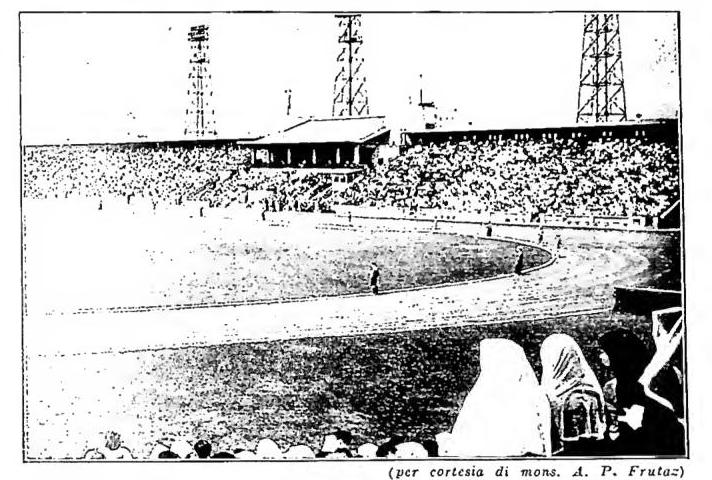
The Marianists opened a first school in Tokyo (1 February 1888), now a secondary institute attended by more than 1,500 pupils; this was followed by their schools in Nagasaki (1892), Osaka (1898), and Yokohama (1901). The Society of the Divine Word opened a secondary school at Nugoya (1932); the Franciscans opened one at Sopporonel (1934), and the Jesuits one at Höbr (1938), having already opened the «Sophia» University in Tokyo in 1913. The Salesians, too, have recently opened an industrial school in the vicinity of Tokyo.
The end of the Second World War marked a new era in the history of G. For the first time its soil was invaded by foreign troops, and many of its ancient traditions are undergoing a genuine transformation. Missionary activity can take place in an atmosphere of greater understanding, all the more so because the entire ecclesiastical hierarchy is indigenous, while the foreign missionaries, whose numbers have increased considerably in recent years, exercise a ministry of collaboration.
The situation on 30 July 1950 is indicated in the following table, which states that three apostolic prefectures and one apostolic vicariate are entrusted to foreign missionaries. This is legally true, but in practice they are governed by local apostolic administrators. The apostolic prefecture of Karafuto, on the island of Sakalin, has been excluded, since following the occupation of the territory by Russia no further missionary activity is possible.
| Mission | Rank | Entrusted to | Catholics | Catechumens | Priests | Brothers | Sisters | Catechists | Teachers | Major seminarians | |||
|---|---|---|---|---|---|---|---|---|---|---|---|---|---|
| indigenous | foreign | indigenous | foreign | indigenous | foreign | ||||||||
| 1. Fukuoka | D | diocesan clergy | 12,995 | 910 | 9 | 35 | 5 | 1 | 138 | 39 | 54 | 171 | 27 |
| 2. Hiroshima | VA | S. J. | 3,888 | 914 | 4 | 19 | 6 | 2 | 30 | 34 | 11 | — | 5 |
| 3. Kagoshima | PA | diocesan clergy | 577 | 360 | 3 | — | — | — | 7 | — | 5 | 15 | 6 |
| 4. Kyoto | PA | diocesan clergy | 3,017 | 1,900 | 6 | 23 | — | 4 | 16 | 23 | 46 | — | 7 |
| 5. Miyazaki | PA | S. S. | 2,619 | 378 | 3 | 15 | 2 | 1 | 29 | 8 | 1 | 25 | 7 |
| 6. Nagasaki | D | diocesan clergy | 62,142 | 213 | 47 | 10 | 30 | 10 | 402 | 12 | 375 | 125 | 29 |
| 7. Nagoya | PA | S. V. D. | 2,071 | 1,449 | 6 | 38 | 6 | 3 | 35 | 23 | 8 | 97 | 4 |
| 8. Niigata | PA | S. V. D. | 2,236 | 1,837 | 4 | 14 | — | — | 6 | 46 | 23 | — | 2 |
| 9. Osaka | D | diocesan clergy | 8,499 | 2,100 | 25 | 57 | 3 | 12 | 273 | 110 | 8 | — | 23 |
| 10. Sapporo | VA | diocesan clergy | 4,867 | 874 | 12 | 16 | 9 | 6 | 72 | 31 | 4 | 103 | 1 |
| 11. Sendai | D | diocesan clergy | 4,996 | 1,315 | 20 | 18 | 42 | 13 | 159 | 69 | — | — | 15 |
| 12. Shikoku | PA | diocesan clergy | 1,087 | 224 | 1 | 12 | — | — | 26 | 3 | — | — | 5 |
| 13. Tokyo | AD | diocesan clergy | 12,963 | 4,209 | 30 | 108 | 36 | 28 | 177 | 150 | 4 | 358 | 28 |
| 14. Urawa | PA | diocesan clergy | 2,355 | 481 | 3 | 12 | — | — | 9 | 7 | 8 | 16 | 3 |
| 15. Yokohama | D | diocesan clergy | 6,589 | 2,529 | 8 | 37 | — | 23 | 159 | 104 | 14 | 184 | 2 |
| 130,901 | 19,693 | 181 | 414 | 139 | 103 | 1,538 | 659 | 561 | 1,094 | 164 |
3. Protestant missions
Although the Dutch and the English had had commercial relations with G. since the beginning of the seventeenth century, Protestant missions began around the middle of the nineteenth century. After attempts to enter it through the Ryūkiū Islands (1844–55) had failed, Protestantism entered in 1859 with the missionaries of the American Episcopal Church, G. Giovanni Liggius and C. M. Williams, later followed by missionaries of other denominations. The first Protestant baptism in G. took place in 1864; other Japanese, however, had become Protestants abroad. The first Protestant community, the «Church of Christ in G.», was established at Yokohama on 10 March 1872, with only nine members. The removal of the wall posters against Christians (1873) also favored Protestantism. It spread rapidly, and by 1882 numbered 4,367 adults, rising to 25,514 in 1888, thanks to the financial assistance of American Protestants, which made possible an impressive activity in schools, publishing, and charitable works.The great missionary Conferences (for example, those of Yokohama in 1872, Osaka in 1883, and Tokyo in 1900) and the annual summer Congresses of Karuizawa addressed the various missionary problems, including that of bringing all the different denominations together in a single «Christian Church in G.», achieved only in recent times on the basis of a confession of faith drawn up according to the Apostles’ and Nicene Creeds and the new articles of the «Evangelical Alliance». Although opposed by the nationalist spirit of Shintoism and Buddhism, which renewed the accusation that Christianity undermined the State at its foundations, and by the hostility of the owners of houses of prostitution, provoked by the Protestants’ struggle against the trafficking of girls, in 1900 there were 43,000 Protestants in G., and of the 300 members of the first Parliament, no fewer than 13 declared themselves Christians. In 1925 the Protestants numbered 177,683, and in 1940 more than 220,000. The «Christian Church in G.», being only an artificial union, had to leave individuals free choice with regard to the Faith; and, possessing spectacular financial means for propaganda (in 1940, 1,578,561 books and 1,938,218 Christian pamphlets, as well as very numerous Bibles, were distributed), it reached in G. a number far greater than that of the Catholics.
4. Russian Orthodox missions
Russian priests won several Ainu families in the Kurils for the Orthodox Church; genuine Russian Orthodox missionary activity, however, began only in 1861 with Ivan Kasotkin, better known by the name Nicolai. As chaplain at the Russian consulate in Hakodate, he taught Russian and conducted religious propaganda; in 1868 he was able to baptize the first three Japanese for his Church. The Holy Synod approved this, but did not wish to provide any assistance from Russian missionary personnel. It granted Nicolai financial means alone. In 1872 Nicolai moved to Tokyo, where he was joined (1879) by the priest Anatoly, his successor at the Hakodate embassy. In 1883 there were 8,863 Orthodox Christians in G., with three Russian priests, eleven Japanese priests, and 106 Japanese catechists. Nicolai, consecrated bishop, was appointed archbishop in 1906, and continued his work even during the war of 1904–1905; he brought the number of Japanese Orthodox Christians (1917) to 36,265. Today there are barely 13,000, because nationalist religions suffer the fate of their governments. The Japanese Orthodox Church became completely independent of the Russian Church; and it has many members distinguished for their piety and fervor.RIBL.: J. Orfanel, Historia ecclesiastica de los Sucesos de la Christiandad del Japon, Madrid 1633; D. Aduarte, Historia de la Provincia del S. Rosario de la Orden de Predicadores en Philippians, Japon y China, Manila 1640; D. Bartoli, Dell’Historia della Compagnia di Gesù, Il G., seconda parte dell’Asia, Rome 1660; L. Pagès, Histoire de la religion chrétienne au Japon depuis 1598 jusqu’à 1651, 2 vols., Paris 1869–70; J. Ferrando y J. Fonseca, Historia de los PP. Dominicos en las Islas Filipinas y en sus Misiones del Japón, China, Tung-King y Formosa, 6 vols., Madrid 1870–72; Fr. Marnas, La «Religion de Jésus» (Iaso Jo-Kyō) versuscitée au Japon dans la seconde moitié du XIXe siècle, 2 vols., Paris and Lyon 1896; G. Schurhammer and I. Vicki, Epist. s. Francisci Xaverii, alioque eius scripta, 2 vols. (Monumenta Historica Societatis Iesu, 67–68), Rome 1944–45; Fr. Colin, Labor evangelica, ministerios apostólicos de los obreros de la Compañía de Jesús, Nueva ed. a cura del p. Pablo Pastells, 3 vols., Barcelona 1900–1902; H. Hass, Geschichte des Christentums in Japan, 2 vols.,
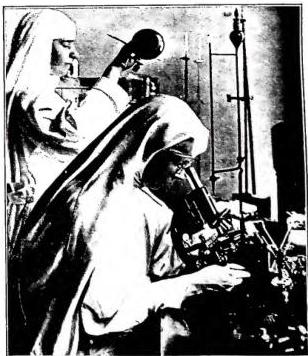
(photo Fides)
GIAPPONE — Bacteriology laboratory in the Hospital of Maria S.ma, directed by the Franciscan Missionaries of Mary — Tokyo.
stianesimo 4), ibid. 1930; J. Vernier, La Société de Marie au Japon (1887-1932), ibid. 1933; B. de Avila Giron, Relación del Reino del Nippon, edited by D. Schilling and Fidel de Lejarza, in Archivo Ibero-Americano, 33-37 (1933-35); L. Frois, Segunda parte da Historia de Japan... (1578-82), edited by Joao do Amaral Abranches Pinto and Yoshitomo Okamoto, Tokio 1938; M. Domenzain, El Japon, su evolución, cultura, religiones, Bilbao 1942; P. Humbertclaude, Petit guide culturel à l'usage du missionnaire, Tokio 1948. Doroteo Schilling
IV. THE JAPANESE MARTYRS
The Church of J. has been one of the most illustrious for examples of heroic and unconquerable Christian steadfastness.In the first bloody persecution under Taicosama Hideyoshi, 26 missionaries and Christians were condemned and crucified at Nagasaki on 5 February 1597.
They were: St. Pierbattista, commissioner O.F.M.; St. Francesco da S. Michele, O.F.M.; St. Francesco Blanco, O.F.M.; St. Gonzalvo Garzia, O.F.M.; St. Filippo Las Casas, O.F.M.; St. Martino d'Aguirre, O.F.M.; St. Giovanni Soan de Goto, S.J.; St. Paolo Miki, S.J.; St. Giacomo Kisai, S.J.; St. Paolo Suzuqui, St. Gabriele Duizco, St. Giovanni Quizuya, St. Tommaso Idanqui, St. Francesco Medico, St. Tommaso Cosaqui, St. Giovacchino Saquiye, St. Bonaventura di Meaco, St. Leone Garassima, St. Mattia di Meaco, St. Antonio di Nagasaki, St. Lodovico Ibarchi, St. Paolo Ibarchi, St. Michele Cosaqui, St. Pietro Suquezico, St. Cosimo Taquia; St. Francesco Fabelante, all Franciscan tertiaries. They were beatified in 1627 and canonized in 1862.
In 1614 the great persecution began under Daifusama (Shogun) Yeyasu and his successors Hidetada and Yemitsu, during which many missionaries and Christians suffered martyrdom. Despite the cruelty of the torments, many missionaries and Christians, nobles and commoners, women, virgins, and children endured martyrdom. In 1867, 205 missionaries and Christians were beatified who had been martyred between 1617 and 1632. They were:
Pietro dell'Assunzione, O.F.M.; Giambattista Machado, S.J.; Alfonso Navarrete, O.P.; Ferdinando di S. Giuseppe, O.E.S.A.; Leone Tanaca, catechist; Gaspare Fisoni, confraternity member of the Holy Rosary; Andrea Gioscinda, confraternity member of the Holy Rosary; Giovanni di S. Marta, O.F.M.; Giovanni di S. Domenico, O.P.; Leonardo Chimura, S.J.; Andrea Tocuan; Cosimo Taquea; Giovanni Xoum; Domenico Giorgi; Bartolomeo Xequi; Antonio Chimura; Giovanni Ivananga; Alessio Nacamura; Leone Nacanisci; Michele Tascita; Mattia Cozaca; Romano Matevoca; Mattia Nacano; Giovanni Mosaiana; Tomaso Cotenda, of the blood of the kings of Firando: all enrolled in the Holy Rosary. Ambrogio Fernandez, S.J.; Mattia d'Arima, catechist; Simone Quiota, catechist; Maddalena, wife of the aforementioned; Tomaso Guengoro; Maria, wife of the aforementioned; Giacomo, son of the aforementioned, enrolled in the Holy Rosary; Agostino Ota, S.J.; Luigi Flores, O.P.; Pietro de Zugnica, O.E.S.A.; Giovacchino Firaiana; Leone Suchelmon; Giovanni Fiamon; Michele Diaz; Marco Xineiemon; Tomaso Coianagui; Antonio Giamanda; Giacomo Densci; Lorenzo Rocuiemon; Paolo Sanciqui; Giovanni Iago; Bartolomeo Mofioie; Giovanni Nangata, enrolled in the Holy Rosary. Francesco Morales, O.P.; Angelo Orsucci, O.P.; Alfonso de Mena, O.P.; Giuseppe di S. Giacinto, O.P.; Giacinto Orfanel, O.P.; Alessio, O.P.; Tomaso del Rosario, O.P.; Domenico del Rosario, O.P.; Riccardo di S. Anna, O.F.M.; Pietro di Avila, O.F.M.; Vincenzo di S. Giuseppe, O.F.M.; Carlo Spinola, S.J.; Sebastiano Chimura, S.J.; Gonzalo Fusai, S.J.; Antonio Chiuni, S.J.; Pietro Sumpò, S.J.; Michele Xumpò, S.J.; Giovanni Ciongoni, S.J.; Giovanni Acafosci, S.J.; Luigi Cavara, S.J.; Leone di Satzuma, Franciscan tertiary; Lucia de Freitas, Franciscan tertiary; Antonio Sanga, catechist; Maddalena, his wife; Antonio, catechist; Maria, his wife; Giovanni, twelve years old; Pietro, three years old, their sons; Paolo Nangasci; Tecla, his wife; Pietro, seven years old, their son; Paolo Tanaca; Maria, his wife; Isabella Fernandez, wife of the martyr Domenico Giorgi; Ignazio, four years old, their son; Apollonia, widow and aunt of the martyr Gaspare Cotenda; Domenico Xamada; Chiara, his wife; Maria, wife of the martyr Andrea Tocuan; Agnese, wife of the martyr
Cosimo Taquea; Domenico Nacano, son of the martyr Mattia Nacano; Bartolomeo Xichiemon; Damiano Iamichi; Michele, five years old, his son; Tomaso Xiquirò; Rufo Iscimola; Maria, wife of the martyr Giovanni Xoum; Clemente Vom; Antonio, his son; Domenica Ongata; Caterina, widow; Maria Tanura, all enrolled in the Holy Rosary. Gaspare Cotenda, catechist; Francesco, twelve years old, son of the martyr Cosimo Taquea; Pietro, seven years old, son of the martyr Bartolomeo Xichiemon; Tomaso Zumarraga, O.P.; Mancio di S. Tomaso, O.P.; Domenico, O.P.; Apollinare Franco, O.F.M.; Francesco di S. Bonaventura, O.F.M.; Pietro di S. Chiara, O.F.M.; Camillo Costanzo, S.J.; Luigi Giaciqui; Lucia, his wife; Andrea, eight years old; Francesco, four years old, their sons. Pietro Paolo Navarro, S.J.; Dionisio Fugiacima, S.J.; Pietro Onizuchi, S.J.; Clemente, household servant of Fr. Costanzo; Francesco Galvez, O.F.M.; Girolamo de Angelis, S.J.; Simone Jempo, S.J.; Diego Carvalhio, S.J.; Michele Carvalhio, S.J.; Pietro Vasquez, O.P.; Ludovico Sotelo, O.F.M.; Ludovico Sosanda, O.F.M.; Ludovico Baba, O.F.M.; Caio della Corea, catechist; Francesco Pacheco, S.J.; Baldassarre de Torres, S.J.; Giambattista Zola, S.J.; Pietro Rincesi, S.J.; Vincenzo Caum, S.J.; Giovanni Chinsaco, S.J.; Paolo Scinsuche, S.J.; Michele Tozo, S.J.; Gaspare Sadamatsu, S.J.; Mancio Arachi; Mattia Arachi; Pietro Arachi Colioia; Susanna, his wife; Giovanni Tanaca; Caterina, his wife; Giovanni Naisen; Monica, his wife; Luigi, seven years old, their son, guests and household members of the Jesuit fathers; Ludovico Bertrando, O.P.; Mancio di S. Croce, O.P.; Pietro di S. Maria, O.P.; Francesco Curobioje; Caio Jemon; Maddalena Chiota; Francesca, all Dominican tertiaries; Francesco di S. Maria, O.F.M.; Bartolomeo Laurel, O.F.M.; Antonio di S. Francesco, O.F.M.; Gaspare Voz, Franciscan tertiary; Tomaso Vo, Dominican tertiary; Francesco Enfoie; Luca Chiemon; Michele Chiziemon; Ludovico Matzuo; Martino Gomez; Maria, all Franciscan tertiaries; Tomaso Tzugi, S.J.; Luigi Maqui; Giovanni, his son; Antonio di S. Bonaventura, O.F.M.; Domenico di Nagasachi, O.F.M.; Domenico Castellet, O.P.; Tomaso di S. Giacinto, O.P.; Antonio di S. Domenico, O.P.; Giovanni Tomachi, Domenico, sixteen years old, Michele, thirteen years old, Tomaso, ten years old, Paolo, seven years old, his sons; Giovanni Imamura; Paolo Aibara; Romano; Leone; Giacomo Palascida; Matteo Alvarez; Michele Jamada; Lorenzo, his son; Ludovico Nisaci; Francesco, five years old, Domenico, two years old, his sons; Luisa, all household members and of the Third Order of S. Domenico. Michele Fimonio; Paolo Fimonio; Domenico Xoboie, all three of the Third Order of S. Domenico. Michele Nacascima, S.J.; Giovanni Cocumbuco; Mancio; Michele Chinosci; Lorenzo Scixo; Pietro Cufioie; Tommaso, all six of the Third Order of S. Agostino. Bartolomeo Gutierrez, O.E.S.A.; Vincenzo Carvalhio, O.E.S.A.; Francesco di Gesù, O.E.S.A.; Antonio Iscida, S.J.; Girolamo de Torres, secular priest; Gabriele della Maddalena, O.F.M.
Giovanni Rommerskirchen
V. CONDIZIONE GIURIDICA DELLA CHIESA
The last law before the Second World War regulating the various Churches and religious organizations in G. was that of 8 Apr. 1939, no. 77 (Shukyo Dantai Ho): its purpose was to control every religious movement, guaranteeing privileges and benefits (such as, for example, exemption from taxes) to those religious organizations that had requested recognition and had therefore placed themselves within the framework of state organization and dependence. This lawabove all prohibited control by, and dependence upon, bodies and persons not resident in G.
At the end of the war, this law was immediately abrogated by Allied General Headquarters, pursuant to the “memorandum” Removal of restrictions of political, civil, and religious liberties, sent to the Japanese government on 4 Oct. 1945, and replaced by Decree-Law no. 719 of 28 Dec. 1945, concerning the acquisition of juridical personality by religious bodies (Shukyo Hoojin Rei). Under this decree-law, for a religious body to acquire juridical personality, it is required to submit a simple declaration to the minister of Public Education, whereas for individual Churches, convents, and offices, it is sufficient to submit the declaration to the local prefecture: this declaration is immediately registered, and by virtue thereof the bodies, Churches, and offices acquire juridical personality. Thus there is no need for an authorization, approval, or concession on the part of the Japanese government; moreover, registration can never be refused, since there is neither any limitation on nor prohibition of the propagation of doctrines, nor can any examination be made of the internal organization of religious bodies and offices. Hence complete freedom of religious life and of the exercise of activity and propaganda. Recognized persons are exempt from every tax, whether governmental, regional, or municipal. There is no authority that supervises these associations, and all the religious bodies and offices thus established live an autonomous life after registration has taken place; all are equal before the State, with complete freedom. Indeed, by the memorandum of Allied General Headquarters of 15 Dec. 1945 Abolition of governmental sponsorship, support, perpetuation, control, and dissemination of State Shinto-Yokko Shinto-Jinja Shinto) all the privileges enjoyed by Shintoism were abolished, as well as all the relations that linked it by way of privilege to the Japanese government. This freedom of religious action was likewise sanctioned by the new Constitution (published on 3 Nov. 1946 and entering into force on 3 May 1947), in which chapter 3, on “The rights and duties of citizens,” provides in art. 19: “Freedom of thought and conscience shall not be violated,” and in art. 20: “Freedom of religion is guaranteed to all citizens. No religion may enjoy any special privileges granted by the State, nor engage in political activity. No citizen may be compelled to participate in religious acts, ceremonies, or religious manifestations.” The exercise of any religious manifestation is guaranteed by art. 21, which states: “Freedom of association, speech, and the press, and every manifestation of ideas, is guaranteed.” Giulio Dante
VI. THE EDUCATIONAL SYSTEM OF JAPAN
Japanese education passed through the following periods: family education up to 1864, Chinese-style school education up to 1872, school education under American, English, and German influence in the years 1872–90, and “Meiji” education from 1890 onward. In 1890, Emperor Meiji indicated a path to be followed in educating the Japanese people, which may be summarized in the following points: the first task of the school is to deepen the family spirit, since the family, with its traditions, is the basis of the unity of Japan; the second task of the school is the moral education of the individual, who must be ready for any sacrifice and privation if the common good requires it; the third task of the school is the continuous adaptation of foreign cultures to the Japanese mentality.Particular care is devoted to the education of the female sex, since the continuity of Japanese tradition is embodied in women. In schools of every level, Japanese women learn the tea ceremony, sewing, cooking, etiquette, painting, music, Japanese writing and poetry, as well as the art of cultivating plants, dancing, and the “no” game.