
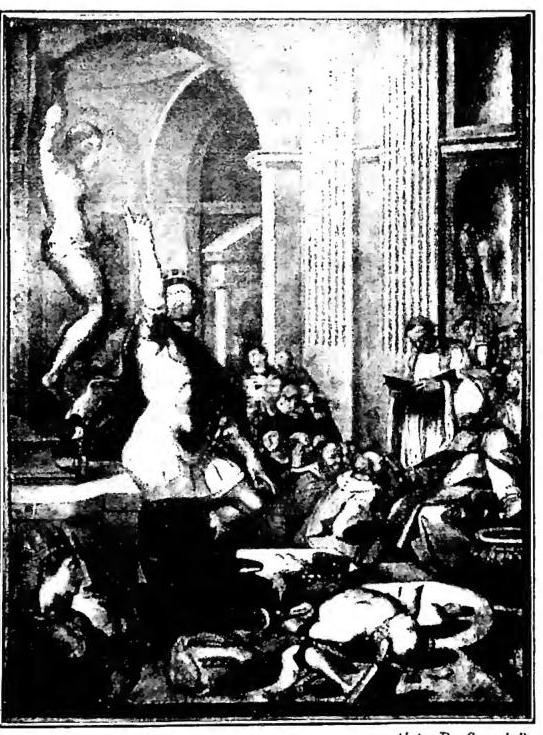
IDOLATRY. — Clovis points out to Christ the pagan idols which he has caused to be destroyed, and St Remigius baptizes his companions. Painting by Jacopino del Conte (1510–98) — Rome, church of S. Luigi dei Francesi.
Among the Greeks, the flesh of sacrificial victims was eaten either by the faithful offerer within the sacred precinct or was taken to market for sale.
Already Ex. 34:15 forbade the eating of meat sacrificed to idols so as to avoid contracting the “impurity” (zānah) of idolatry (cf. Apoc. 2:14, 20); a supposed connection was established between the idol and those who ate its meat (cf. Ex. 23:32). According to 4 Macc. 4:26 and 5:2, the use of such meat was practically an act of worship of the idol. The rabbis prohibited its sale (even to pagans) and any use or profit derived from II. At the Council of Jerusalem (Acts 15:21, 23, 29; 21:25) Gentile Christians from Antioch, Syria, and Cilicia were enjoined to abstain from it out of consideration for Jewish Christians.
In 1 Cor. 8:1–11:1 St Paul sets forth and resolves the moral issue: the faithful are often invited to pagan banquets; how should they behave when meat sacrificed to idols is served at table? At Corinth the controversy was rife: the “strong,” appealing to an exaggerated notion of Christian liberty (10:2; cf. 6:2) and to their own knowledge, rightly understood that eating such meat was in itself a matter of indifference (chaps. 1–3) and, even at the risk of scandalizing the “weak,” they attended even sacrificial banquets (8:10). The “weak,” on the contrary, attributed a certain cursed reality to the idol (10:19) and went so far as to exclude even that use of the meat which was not part of a cultic act. They lacked (fortunately, not many: 8:7) a strong and enlightened faith that would preserve them from scandal and sin. St Paul calls the “strong” to a charity that avoids scandalizing the “weak” (8:1–13), but condemns the use of such meat when it forms part of an idolatrous ceremony, thereby associating the eater of the meat with demons, inasmuch as the act of eating was then invested with a religious significance (10:14–22). To this the Apostle adds a practical casuistry (10:25 ff., 27–28), after first confirming his appeal to the “strong” by an example from his own life and from the history of ancient Israel (9:1–10:13).