
In the 4th century, the Itinerarium Burdigalense holds particular importance as a common guide for a journey from Bordeaux to Jerusalem, compiled by or for a merchant or pilgrim, whether Jewish or Christian, around 333. The indications are those of a normal itinerary, but here the name of a city is linked to a historical memory, and these notes become more frequent when one arrives in Palestine. At this point, the Christian material becomes abundant, and the itinerary turns into a summary description of the Holy Places. Around 390, St. Jerome translated into Latin a pamphlet by Eusebius of Caesarea, Hebraicorum nominum, which enjoyed great success. The same Jerome, in a letter to Eustochium, expressed his astonishment that Palestine did not arouse greater interest in Christian hearts than the Tarpeian Rock; and he invited the noble Marcella to the East to see the places where our religion was born (Ep. ad Paulam et Eustochium).
The first account of a journey to the East is associated with the name of Etheria, or rather Egeria (q.v.), a vivid and lively narrative of travels through Palestine, Egypt, and Mesopotamia.
On the other hand, the letter attributed to Eucherius of Lyon and addressed to the priest Faustus is almost negligible: a patchwork from St. Jerome and Hegesippus. The author lacks firsthand knowledge of the places described. Nor does the De situ Terrae Sanctae compiled by an African from the north, Theodosius, around 530, seem to deserve a better assessment. Much more important, even if it includes popular tales and legends, is the itinerary falsely attributed to St. Antoninus, martyr of Piacenza. The writing is full of important information, provided by one of the martyr’s traveling companions. The account, dictated from direct impressions, was written around 570.
Exactly a century later, Adamnan of Hy (623–704) wrote the De Locis Sanctis libri tres based on oral accounts by the Frankish bishop Arculf, a keen observer and meticulous narrator of what he had seen during a nine-month pilgrimage. Adamnan is a diligent and scrupulous compiler, and his narrative arouses warm interest. Bede is a mere compiler relying on Adamnan, the Pseudo-Eucherius, and others. St. Willibrord, between 727 and 729, recounted to a nun of Heidenheim, who recorded them, his impressions of a journey made many years earlier. Some inaccuracies in the account should be attributed less to the negligence of the recorder than to the fading memory of the traveler. The nun participates so vividly in the narrative that, in recounting it, feeling almost like the protagonist, she inadvertently shifts from the third to the first person: the text constitutes a notable complement to the Arculf–Adamnan narrative.
The Commemoratorium de casis Dei contains little more than a remarkable statistical survey of churches, monasteries, and priests officiating in the various temples of the Holy Land in the pre-Crusade period.
Far more informative is the itinerary of Epiphanius of Hagia Polis; his account proceeds from direct impressions, “for whoever writes otherwise deceives himself, ignoring the truth,” as he himself states. Around 867, a French monk, Bernard, having obtained the approval of Nicholas I, set out in the company of an Italian and a Spaniard for the Holy Places. After visiting Palestine, the three returned to Rome by sea, stopping at the Lateran, and concluding their pilgrimage at the sanctuary of St. Michael on Mount Gargano.
In the itineraries examined, frequent mention is made of the vexations suffered by pilgrims at the hands of officials at border crossings or customs offices. From the 11th century onward, such journeys, undertaken individually, became risky: to ensure safe arrival, pilgrims had to organize in groups and, if necessary, be well-armed. However, the Liber de Locis Sanctis by Peter the Deacon, dedicated to Abbot Wibald of Montecassino, does not stem from such pilgrimages. It is a compilation assembled around 1137 from Bede’s homonymous treatise and the Peregrinatio Aetheriae, which can be supplemented, in its missing initial part, precisely with extracts drawn from these sources and recorded by Peter the Deacon.
John of Würzburg, around 1165, sets out to describe the state of Jerusalem as it appeared to him after the recent destructions. He records the metrical and prose inscriptions displayed in various monuments. Another who focused on the actual state of the Holy City was John Phocas, who left a description of it in Greek in 1177.
A brief mention should be made of the itinerary of Benjamin of Tudela, a Jew from Navarre who visited the entire East as far as the borders of China during a journey that lasted thirteen years. His account, translated into various languages, constitutes a substantial source for the history of 12th-century Judaism.
In the post-Crusade period, notable itineraries include those of Burchard (q.v.), with good geographical information, Ricoldo of Monte Croce, Pipino and P. Faber (1480–83), Dominicans; James of Verona (1335), an Augustinian; A. De Reboldi (1327 and 1330); Niccolò da Poggibonsi (q.v.), the first, as far as is known, to have written in Italian; F. Suriano (q.v.); Boniface of Ragusa; and especially F. Quaresimo (q.v.) of the Franciscans. Since Father Quaresimo conducted an in-depth study of traditions, the subsequent itineraries, in this respect, merely build upon his work.
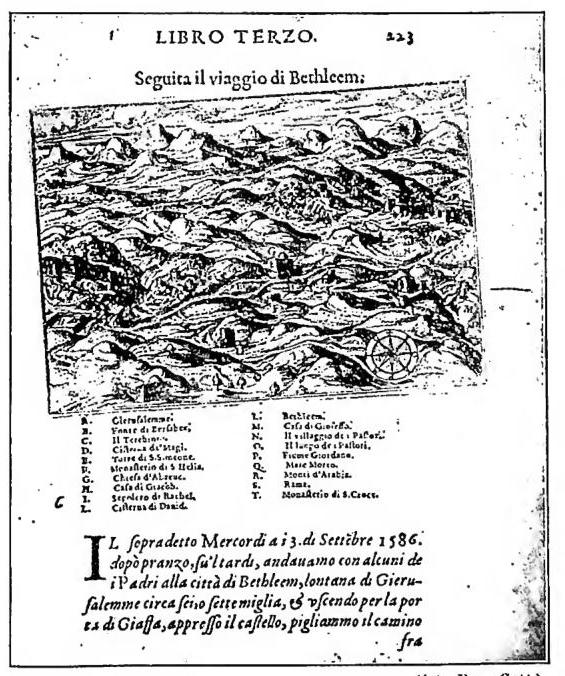
From a literary and historical standpoint, mention should be made of those by Mariti (1767), Chateaubriand (1806), Bassi (1846), Cassini da Perinaldo (1846), Matilde Serao (1893), E. Battaglia (1906), and the more recent works by G. Venturini, S. D’Amico, C. Angelini, and M. Sticco. For their illustrative value, the woodcuts in the itinerary of von Breitenbach (1483), the freehand drawings of Zuallardo (1586), the scaled plans of B. Amico (q.v.), and the fine views of C. Le Bruyn (1714) deserve special mention.
III. ITINERARIES OF THE CITY OF ROME
The veneration of the apostles Peter and Paul, as well as of the martyrs, intensified and strengthened with the persecutions. After the conversion of the various European peoples to Christianity, traveling as a pilgrim came to be regarded as one of the most meritorious means of gaining indulgences; hence, there was a greater frequency of pilgrimages ad limina Apostolorum.Once the pilgrimage reached Rome, the vastness of the Urbe and the dispersion of Christian monuments obliged the visitor, who had to perform acts of devotion, to obtain guides—almost internal itineraries—that would point out the places to visit.
At one time, the Notitia and the Curiosum, pre-Constantinian documents, were considered itineraries of this type. But if these documents are stripped of the later additions whose dates were not yet defined, and of the centuries-long elaboration and anonymous collaboration that, having lost sight of their original purpose, sought to refashion them as guides for pilgrims, and if they are restored to their primitive form, one will easily recognize in them nothing more than a spatial delimitation of the jurisdictions of the 48 *vicomagistri* who, in each of the 14 regions, regulated the life of the city, safeguarding public interests. However, in the first half of the 7th century, or according to others in the second half of the 8th, a true Roman itinerary for pilgrims was formulated: the *Notitia ecclesiarum urbis Romae*. The pilgrim begins at the basilica of SS. John and Paul, the only urban church that housed the bodies of martyrs; from there, he proceeds along the Flaminian Way, then follows the Via Salaria vetus and nova, the Via Nomentana, Latina, Appia, Ardeatina, Ostiensis, Aurelia, Portuensis, Cornelia, as far as the tomb of St. Peter. The main roads are sometimes abandoned to follow byways, but everywhere the basilicas and the locations of the various hagiographical groups are precisely indicated. The opuscule concludes with a detailed description of the Constantinian Vatican Basilica. According to De Rossi, the itinerary dates to before 650. According to Sickel, it was written in 799 by an unknown author who accompanied Bishop Arno of Salzburg to Rome.
Another itinerary, slightly later in date, is the *Liber de locis sacris martyrum*. Unlike the previous one, this begins with St Peter’s and proceeds along the Via Cornelia, the Via Aurelia, the Via Portuense, the Via Ostiense, the Via Ardeatina, the Via Appia, the Via Latina, the Via Labicana, the Via Prenestina, the Via Tiburtina, the Via Nomentana, the Via Salaria nova and the Via Salaria vetus, ending at the church of St Valentine on the Via Flaminia.
To be precise, this is not so much an itinerary as a record of the churches and shrines situated along each road, with indications of proximity or distance and other spatial references. The arrangement is not always orderly or clear, since the *Liber* is probably an epitome of a martyrology and saints’ calendar. It is not easy to understand why a list of intramural churches has been appended to this itinerary or by what principle it is ordered. As it stands, the itinerary may be dated to the first three decades of the seventh century.
A different type of itinerary, perhaps only slightly later, is the one inserted by William of Malmesbury in his *Gesta regum Anglorum*, with some variations whose nature is not clearly determinable but which relate solely to the wording. Like the *De locis*, it also begins at the Vatican and continues, on the right-hand side, in the same direction as the *Notitia*. There are also references to the tombs of the saints within Rome.
Far more important is the Einsiedeln itinerary, which belongs to the Carolingian age. Its author drew up itineraries, extending even beyond the city. The text is informed by this principle: to give the pilgrim a clear representation of the spatial relationships between the individual entries. The compiler intended to point out to the pilgrim, with the utmost realistic precision and tangible clarity, where he would find the monuments to visit. Setting out along a road and using this kind of guide, the author indicates the places to the right and left, and not only that, but the distances between individual entries are highlighted by the position occupied by the names of the individual monuments. This skilful arrangement of the original, once the compiler’s awareness of it had faded, disintegrated as knowledge of these initial guiding principles was lost, so that later copies, in the best cases, were reduced to lists of names placed without any spatial relationship to right or left of a given route. Despite the entirely arbitrary conjectures of scholars, who progressively altered its nature, this valuable document remains a witness to surviving pagan Rome and to the Christian Rome that arose beside it, down to the Carolingian age.
The itineraries are: from St Peter’s to St Paul’s; from Porta San Pietro to Santa Lucia in Orfea; from Porta San Pietro to the Via Salaria; from Porta Nomentana to the Roman Forum; from Porta Flaminia to the Via Lateranense; from Porta Tiburtina to the Subura; from the Via Tiburtina to San Vito; from Porta Aurelia to the Via Prenestina; from Porta San Pietro to the Via Asinaria; from the Seven Roads to Porta Metronia; from Porta Appia to the Schola Graeca and then, by way of a portico, to the aqueduct and along the Seven Roads.
The distances could be appreciated from the placement of the entries and the intervals that separated them on the map. All these itineraries are so accurately drawn that it seems entirely possible the author knew the places at first hand and had taken the most careful note of them—a conjecture confirmed by the collection of profane and Christian inscriptions found in the same Einsiedeln Codex. The place-names of the roads and Roman monuments still (eighth century) retained their classical appellations. Nor did the compiler derive this information from any source other than Rome itself; their extraordinary diffusion is to be seen as proportional to the influx of pilgrims.
Last in chronological order must be considered the itinerary left by Sigeric, Archbishop of Canterbury, after his journey to Rome in 990. It consists of two parts: the first is a list of the stations (mansiones) on the overland route from England to Rome; the second is a list of the Roman churches visited by Sigeric and his retinue on different days, important for the toponymy of those churches.
After the year 1000, itineraries take the form of descriptions of monuments accompanied by poetic legends, approaching in a certain way some of the descriptions of monuments in the Holy Land mentioned above. They are compiled under the title *Mirabilia* or *Indulgentiae ecclesiarum urbis Romae*. Later, after 1500, there appear treatises of scientific topography.