
ISIS (Isis; Egyp. s.t. [« seat »]; Gr. Ἰαΐς).
I. GENERAL FEATURES
The best-known Egyptian female deity. Her original cultic center was the Delta, perhaps the city of Buto. Ancient testimonies reveal her character as a cosmic divinity, personifying the sky, and she was soon assimilated to Hathor and to the star Sirius (Sothis).Yet these primitive aspects faded before what may be called the fortune of Isis, namely, that she was introduced into the legend of Osiris (v.) as his faithful spouse and mother of Horus (v.). The triad Isis–Osiris–Horus is the most celebrated in the Egyptian pantheon. How this association of Isis with Osiris came about cannot be established with certainty; it may have been due to the accidental proximity of their respective sanctuaries (cf. K. Sethe, Urgeschichte und älteste Religion der Ägypter, Leipzig 1930, § 63). According to the legend, Isis lovingly reassembled the dismembered body of Osiris slain by Seth, then, transformed into a bird, restored life to her spouse by fanning him with her wings. Later, having become the mother of Horus, she protected the child from Seth’s persecutions by secretly rearing him amid manifold dangers. The vitality and popularity of Isis’s cult are precisely connected with her aspects as an exemplary wife and mother.
With the advent of the Hellenistic age, while on the one hand Isis was syncretistically linked to Greek goddesses (Isis–Aphrodite; Isis–Tyche; Isis–Demeter; Isis–Artemis; Isis–Hecate), on the other she acquired the character of a universal divinity: “the fair essence of all the gods” (Pap. Oxyr., XI, 1381, line 126). Alexandria became the radiating center of Isis’s cult, to which Serapis (the deified Apis) was joined as a national deity adopted by the Ptolemies. As patroness of Alexandria’s harbor and protector of sailors (Ἰαΐς πειλάγος), she gradually won the ports of the Mediterranean, where Egyptian merchant colonies resided, and also gained favor among local populations.
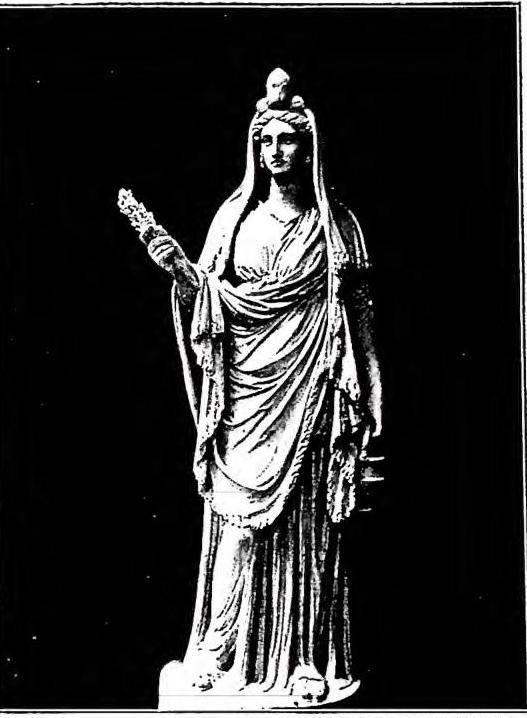
I. A. In Crete, Rhodes, Smyrna, Greece, and southern Italy, communities of Isis’s and Serapis’s devotees arose. At Rome the Isiac cults reached such development that the Senate, between 59 and 48 B.C., was compelled to issue severe repressive measures against a movement threatening the state religion. The persecution intensified under Tiberius after a scandalous incident in A.D. 19. Caligula, however, promoted the construction of a grand sanctuary to Isis in the Campus Martius, later enlarged by Domitian and adorned with monuments imported from Egypt. The cult of Isis extended even farther north, being attested in Britain, Gaul, and Germany. The last public festivals in honor of Isis were celebrated at Rome in A.D. 394, while in Egypt the last temple of Isis still officiated was that on the island of Philae, near the first cataract.
II. RITES AND MYSTERIES
In the Pharaonic age Isis appears in the so-called mysteries (sacred representations of a liturgical character) at Abydos and in certain genuine theatrical dramas performed by lay actors. The fundamental subject was the legend of Isis and Osiris, with particular emphasis on the pathetic episodes. Yet the fragmentary nature of the texts prevents any concrete knowledge of this ritual-dramatic aspect of the Isiac cult.During the Hellenistic period Isis became the center of a mystery cult in the countries of the Mediterranean world, whose ritual elements are described in veiled form by Apuleius of Madaura (2nd century A.D.) in Metamorphoses, Book XI. Disguised under the name of Lucius, he recounts the initiation ceremony to which he was admitted at Corinth by the Isiac priesthood after a series of fasts, abstinences, and prayers to the goddess. He describes descending into Hades, traversing the elements of the cosmos, gazing upon the blazing Sun, and greeting the gods above and below. The following day, clad in a robe adorned with twelve stars and seated on a throne, he received the homage of his fellow initiates. He thus underwent a rite of