
KARMA-MARGA. — Already in the Black Yajurveda one finds, mingled with prayers and formulas, those “ritual explanations” (brahmāṇa) which were not collected in the homonymous liturgical treatises, the most important of which is the Brāhmaṇa called, from its hundred chapters, “of the hundred paths” (Śatapatha-brāhmaṇa). Brahmanic religion is governed by sacrifice (yajña), which is no longer understood as a means to propitiate the gods so that they may grant men prosperity on earth and beatitude in heaven. These goods are produced by the sacrifice itself, by its mysterious power, which is of a magical nature. The gods are summoned to contribute to the sacrificial rite only as instruments; they too made use of the sacred word to obtain immortality (Śat. Br., X, 4, 3, 3, 8). The yajña resembles a mechanism, of which the gods, the officiating priests with their instruments, the sacred fires, the offerings, the acts and ritual words, represent the constituent parts. If these parts fulfill their function exactly, there is produced the brahman, the mystical power which the magician-priest knows how to turn to the advantage of his wealthy patron, at whose expense the ceremony is performed. In the Ṛgveda, III, 53, 12, the priestly family of the Viśvāmitra boasts of protecting with their brahman the Bhārata. Sacrifice exists from eternity and is an emanation of the Father of creatures (Prajāpati), the supreme Being of sacerdotal speculation. The most orthodox theologians of the Vedic age, the Mīmāṃsāka, maintain that the only purpose of revelation was to teach the doctrine of sacrifice.
JĀNA-MARGA. — But to this source of well-being in this and the other life, only the privileged by birth and wealth could draw. To the others was open the path of knowledge, which required no other sacrifice than that of oneself in the desire for the Supreme Truths. The muni, “the ecstatic,” who already appears in the Ṛgveda, X, 126, was usually an innovator, a rival of the Brahmans, who, disregarding the sacrificial rite, sought within himself the power capable of working miracles and conferring clairvoyance. This power is tapas, the ascetic ardor, aroused by methods among which chastity, fasting, and regulation of the breath take first place. And since moral conduct was an indispensable condition for success in ascetic exercises, there arose, with asceticism, the first ethical precepts. The conciliatory attitude of the Brahmans toward the ascetics is demonstrated by the fact that even the Āraṇyaka or “forest treatises,” works of hermits, came to be included in revelation. They substituted for the external cult of sacrificial ceremonies, impossible for those living in solitude, the interior cult of meditation on the symbolic meaning of the rites and on the relationships that obtain between psychic forces and cosmic forces, seeking thereby to grasp the principle from which all proceed. From these liturgical meditations, thought then rose to speculations of a metaphysical nature, which constitute the “arcane doctrine,” the upaniṣad. The texts ana-
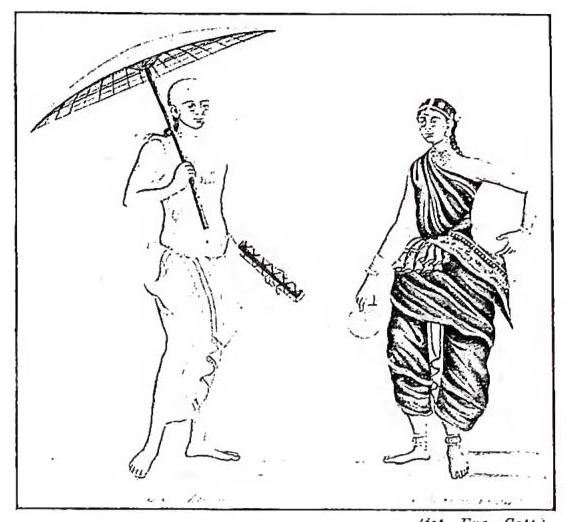
Brahmanism – Pair from the Brahman caste. Miniature from the 17th century – Rome, Pontifical Missionary Ethnological Museum of the Lateran.
The **coretici**, who belong to the first three Vedas, act as a link between the Brāhmana texts and the Upaniṣads, also called Vedānta, "the end of the Veda," since they represent the final Vedic product. Through comparisons between the microcosm of man and the macrocosm of the universe, the philosophers of the Upaniṣads arrive at a new doctrine: that of the unity of the cosmic principle (brahman) with the subject of knowledge within us, the Self (ātman). Cosmic powers correspond to psycho-physical powers; yet both are manifestations of the immanent divinity, the All-One, which cannot be known because, being the subject, it cannot simultaneously be the object of knowledge. The mutual relationships between the world and the Absolute, conceived at once as immanent and transcendent, are the subject of Upaniṣadic speculation. Since the teachers of the new doctrine in the Upaniṣads include princes and kings, it was thought that philosophical speculation had begun in the warrior caste in opposition to the sacrificial science of the Brahmans. However, there is insufficient evidence for this. In any case, the credit for elaborating the doctrine belongs to the Brahmans, who are the authors of the Upaniṣads.
**Eschatological Doctrines.** – Formerly, it was believed that the righteous, upon dying, ascended to heaven to feast in the company of Yama beneath leafy trees, while the wicked were immersed in the darkness of deep abysses. No return to this world was envisaged. But the *Brāhmaṇa of the Hundred Paths* speaks of a "second death" beyond the grave when the religious merit acquired in life is exhausted. Escape from this fate is sought either through extraordinary ceremonies of great power, capable of rendering sacrifices and good works inexhaustible, or through various notions designed to preserve one from the second death. The belief in an afterlife and in the dependence of the deceased’s fate on deeds performed in life laid the groundwork for the pan-Indian doctrine of the transmigration of souls, which already appears fully formed in the oldest Upaniṣads. Life is no longer conceived as a brief journey from birth to death, but as a wandering (samsāra) through existence after existence across infinite births and deaths, until liberation (mokṣa) from this long travail. At death, the psyche dissolves, but the transcendent force of merit and demerit reconnects its elements into a new psychic organism, capable of receiving, in another existence—human or animal—the retribution of deeds in the form of joy or suffering. After a period of uncertainty regarding the means of achieving liberation from rebirth, the authors of the Upaniṣads ultimately identified this means in the union of the ātman with the brahman, the cosmic principle. Whether, in this theocracy, the individuality of the liberated persists or is lost remained a question resolved only later by the philosophers of the Vedānta. The former view was upheld by Rāmānuja (11th–12th century), who seems to represent the oldest opinion, while the latter was defended by Śaṅkara (9th century).
**Rituals.** – Ancient India, unlike ancient Rome, did not have a public cult. Priests performed their duties for wealthy private individuals, princes, and kings, conducting elaborate ceremonies known as *śrauta*, i.e., those based on revelation, whether periodic or extraordinary. The annual spring sacrifice of Soma was a major ritual, involving the preparation of the sacred drink and requiring the use of three sacrificial fires and the presence of sixteen priests. Among the extraordinary ceremonies are the consecration of a king and the horse sacrifice. The officiating priests in the major sacrifices are: the *Hotṛ* or invoker, who recites the laudatory verses of the Ṛgveda at the beginning of the ceremony; the *Udgātṛ*, the chanter, who accompanies the rites with song; the *Adhvaryu* or executor of the sacrifice, who murmurs exorcisms and prayers to ensure the success of the rite; and the *Brahman*, the overseer of the sacrifice, whose role is to correct any errors through appropriate expiations. For domestic sacrifices, performed by the head of the household, a single fire—the domestic hearth—suffices, receiving obligatory offerings of milk in the morning and evening, and at midday, food offerings for the Manes and all the gods. The principal sacraments or *saṃskāras*, which consecrate the transition from one stage of life to another, number about ten, but it will suffice to mention, without describing them, the most important, beginning with birth rituals, the last of which is the naming ceremony. The *upanayana* or initiation into spiritual life holds particular solemnity; it is conferred upon the twice-born castes between the ages of eight and twelve, after which the initiate wears the sacred thread and takes the name *dvija*, "twice-born." This marks the beginning of the student period, particularly arduous for future priests, who must memorize the Veda, dedicating nine or more years to this study. Women and non-Āryan castes are excluded from the *upanayana*. Upon completing their studies, the young man enters the householder stage through marriage, assuming its onerous duties. Old age is suited to the contemplative life, and thus the Brahmanical theory of the *āśrama* or "stages" of the perfect life, codified in the *Manu-smṛti* (v. Dharmaśāstra), prescribes abandoning family and home and retiring to the forest once one has seen the children of one’s children. This is the third stage, following the student and householder stages. The fourth is that of "renunciation of all things" to live as a wandering ascetic, living on alms in order to attain union with the brahman. This theory, whose actual practice remains uncertain, was a clear compromise between the observance of Vedic religion, founded on sacrificial rites, and the life of the ascetic.
**Mythology.** – The gods of the Ṛgveda are personifications of natural phenomena or the mysterious forces that determine them. The sun god is called Sūrya, "sun," and the Vedic seer celebrates his splendor and power; the dawn reddens the sky, dispelling darkness, and is invoked as Uṣas, the goddess of the dawn. However, in the Brāhmaṇas, the Vedic deities are overshadowed by others that were secondary in the Ṛgvedic age. Prajāpati, mentioned only once in the Ṛgveda and perhaps in an interpolated passage, is identified in the Brāhmaṇas with the sacrifice and made the father of the gods. Indra, Agni, and Soma continue to be venerated. Viṣṇu, a minor solar deity, and Rudra, under the euphemistic name of Śiva, "the auspicious one," prepare to assume supremacy over all the gods in neo-Brahmanism. Alongside them, Brahmā is associated in a "trinity" (*trimūrti*), dating from the 5th century, which has nothing to do with the Christian doctrine of the Trinity. According to the *Mahābhārata*, the three deities are three forms of Prajāpati.