
### HUGO VON LANDENBERG
HUGO VON LANDENBERG, Bishop. Born in 1457 at Hegi Castle near Winterthur (Switzerland), died at Meersburg in 1532. Between 1477 and 1480 he was canon and dean of St. Bartholomew’s in Friesach (Carinthia); in 1482 he became a papal familiaris and prior of Trent; he held the same office in 1484 at Erfurt, where he was also able to study. In 1487 he was simultaneously canon of the churches of Constance, Basel, and Chur; in 1492 he became an apostolic protonotary and dean of the Constance Chapter; on 7 May 1496 he was unanimously elected bishop of the city, was ordained priest on 18 July, and by the end of the month was confirmed by the Pope; he was consecrated bishop in the second half of December.
### LANCIANO, ARCHDIOCESE OF
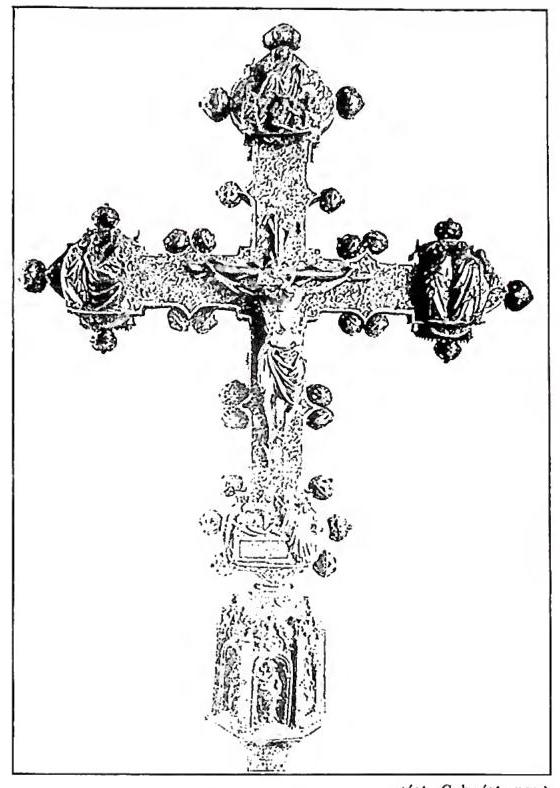
Silver cross. Work by Nicola di Guardiagrele (1422) – Lanciano, church of Santa Maria Maggiore.
It was elevated to a bishopric. The first bishop, Angelo Maccafani, vigorously opposed the reaction from the archbishops of Chieti. In 1526 Clement VII elevated the church of Chieti to a metropolitan see, making the bishop of Lanciano its suffragan. The struggle continued unabated. It was not enough that the second bishop was Cardinal Egidio Canisio of Viterbo, who died barely eight months later; Lanciano claimed independence and succeeded in obtaining it in 1562, thanks to its learned bishop Leonardo Marini, a Genoese Dominican who, protected by Philip II of Spain, obtained from Pius IV the dignity of archbishop, though without suffragans. Thus all disputes were settled and peace returned between the two cities. Among the subsequent prelates there were figures distinguished for virtue and learning, including Fra Antonio of Saint Michael of the Minors, who was sent as a delegate to Spain during the war against the Turks, and the munificent Fra Francesco Romezio, a Spanish Carmelite. In 1818 Pius VII suppressed the diocese of Ortona and united it with Lanciano, but later Gregory XVI, on 15 February 1834, restored its see, though assigning its administration to the archbishop of Lanciano, who took the title of Lanciano and Ortona.
The cathedral is dedicated to the Assumption of the Blessed Virgin Mary. Since 1834 the archbishop of Lanciano has been perpetual administrator of Ortona, which has been united with Lanciano since 24 November 1945.
Monuments. – Gothic influence is strongly evident in Lanciano’s churches. The cathedral, begun in 1389, preserves almost nothing of its original form beneath the neoclassical alterations made during the restorations of 1785–88; its façade remains unfinished, its bell tower is Baroque, and its single-nave interior is neoclassical. More intact, however, is the church of Santa Maria Maggiore (1227), despite the remodellings of the 14th and 16th centuries. The finest part is the façade with its two portals surmounted by rose windows, of which the left one is especially noteworthy (a work by F. Perrini dating to 1317), featuring deep-relief carvings within a triangular tympanum and sculptures of excellent craftsmanship. Two of the three internal naves preserve traces of
Portrait of A. Canova (1806). Rome, Galleria Borghese.
In 1488 the Swabian League was founded at Esslingen to maintain order within the Empire. The League naturally showed a propensity in favour of Emperor Maximilian I against the Swiss, who refused to submit to the jurisdiction of the imperial court. H. von Landenberg, when the Swabian War broke out between the Swiss and the League, sided with the latter, often obtaining from the Emperor the role of his delegate at the federal diets. Rigid and upright, he worked diligently to reform the episcopate and carried out scrupulous visitations in convents from 1497 to 1522. But owing to his weakness and goodness he was unable to oppose the enemies of the Church, especially Zwingli, to whom he had initially shown benevolence. H. von Landenberg was unable to assert himself even in his own episcopal see and took refuge at Meersburg in 1526; on 7 January 1529 he resigned from directing the diocese, whose administration he continued to oversee in 1531.