
THE ANCIENT DIOCESE OF L. — In 314 the first mention is found of Christian L., with the participation of its bishop Restitutus in the Council of Arles. After the Anglo-Saxon invasion, St. Augustine restored the diocese of L. in 604, appointing St. Mellitus as its bishop; he was later transferred to Canterbury in 619. He founded the cathedral of St. Paul and, outside the city, the abbey of St. Peter at Westminster. Among his more illustrious successors were St. Erconwald (675–93), St. Dunstan (958–61), Robert of Jumièges (1044–51), William the Norman (1051–75), Gilbert Foliot (1163–1189), Simon of Sudbury (1362–75), William Warham (1501–1504), Cuthbert Tunstall (1522–30), and the last, Edmund Bonner (1553–69), deposed by Elizabeth in 1559, when the diocese became Protestant. The Catholic diocese never extended across the Thames, but when in 1688 Innocent XI divided England into 4 apostolic vicariates (or districts), that of L. included south of the Thames the counties of Surrey, Kent, Sussex, Hampshire, Berkshire, the islands of Wight, Jersey, and Guernsey, and, north of the river, Middlesex, Essex, Buckinghamshire, Bedfordshire, and Hertfordshire, as well as the British possessions in North America (until American independence). Among the apostolic vicars of the district was the great Richard Challoner (1758–81). In 1840 Gregory XVI raised the districts to eight, removing Bedfordshire, Buckinghamshire, and Berkshire from that of London. In 1850 Pius IX restored the hierarchy, and L. north of the Thames, with Middlesex, Hertfordshire, and Essex, Westminster (v.), while south of the river the diocese of Southwark was established, with the counties of Kent, Sussex, and Surrey. In 1882 the diocese of Portsmouth was formed by removing from Southwark Berkshire, Hampshire, the Isle of Wight, and the Channel Islands. In 1917 the county of Essex was removed to form the diocese of Brentwood.
As early as 1174 the city of L. had 126 churches, in addition to several monasteries and convents. Most were lost in the fire of L. in 1666 and in Wren’s Baroque rebuilding, but one of the ancient churches (not parish churches), St. Etheldreda’s, Ely Place, passed to the Spanish ambassador Gondomar (1620–24) and was subsequently acquired by the Rosminians in 1876 and opened as a Catholic church.
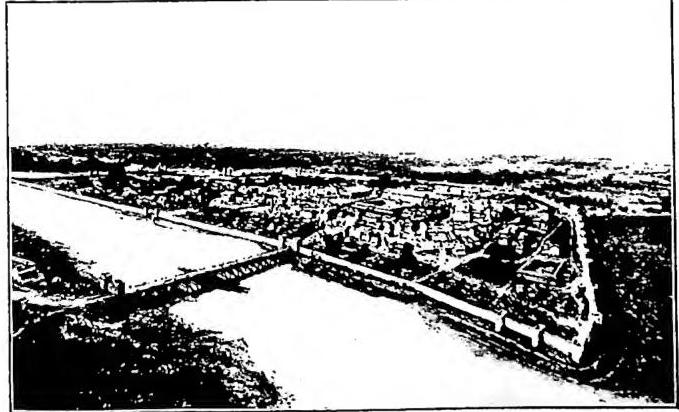
(photo: Mostra Augusta della Romanità)
LONDON - Panoramic reconstruction of the Roman city.
and 71 private ones, in Southwark 52 public and 22 conventual.
L. has very numerous Catholic societies for the defense and propagation of the faith and culture, for charitable works, etc. It is impossible to mention them all, but among the principal ones are: Catholic Association (for pilgrimages), Catholic Record and Catholic Truth Societies, Catholic Prisoners' Aid Society, Catholic Union, Pontifical Court Club, Newman Association, Aged Poor Society (founded in 1708); Benevolent Society for the Aged and Infirm Poor (1761), Catenian Association, the Associations of Catholic Trade Unionists and that of Catholic Managers and Employers, and the Catholic Nurses Guild, Cath. Parents Association, Cath. Social Guild, Cath. Police Guild, Cath. Scout Guild, Cath. Teachers Guild, Cath. Young Men's Society, the Crusade of Resue (to prevent Protestant proselytism), Knights of St. Columba, and the Society of St. Vincent de Paul, and that of St. John Chrysostom (to provide legal advice, especially to the indigent), as well as the Legion of Mary, the Union of Catholic Mothers, the Catholic Doctors Guild, Young Christian Workers, etc., as well as the University of London Catholic Association and the Catholic Guild of Israel.
The well-known Dublin Review (quarterly) is published in L., as are the periodicals Mouth, Clergy Review, Blackfriars, Catholic Gazette, Westminster Cathedral Chronicle and Southwark Record, Duckett's Register (monthly), and the Tablet, Catholic Times, Universe and Catholic Herald (weekly).
The Catholic publishers Burns and Oates, Sheed and Ward, Sands, Douglas Organ, Hollis and Carter should also be mentioned. - Vedi tav. CIV.