
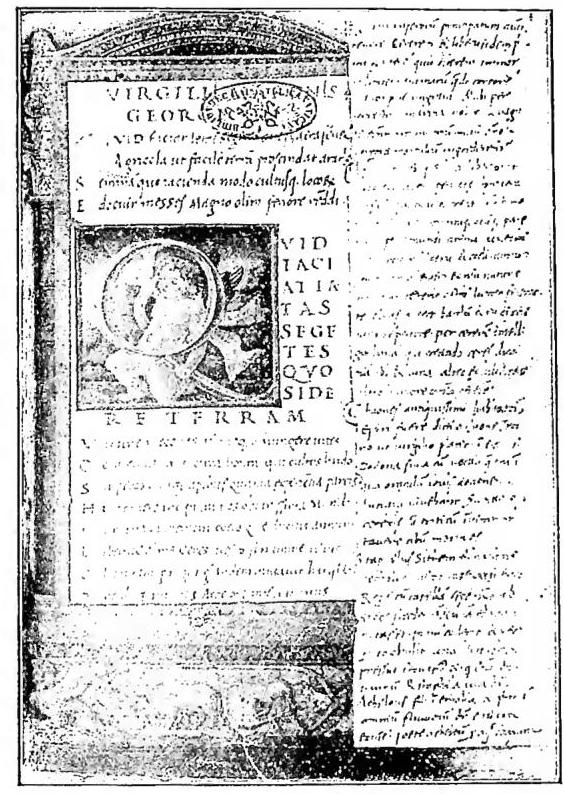
LETO, Giulio Pomponio. – Incipit of the *Georgics*. Manuscript containing the minor works of Virgil, written by a pupil and annotated by P. L. – Vatican Library, ms. Vat. lat. 3255, f. 1.
and La Pedrera, where two orphanages run by Franciscan Tertiary sisters operate.
---
LETO, Giulio Pomponio. – Humanist, b. 1428 at Teggiano in Cilento, d. 1497 at Rome. He is one of the most enigmatic (or indeterminate) figures of Italian Humanism. A fanatic for antiquity, he founded a Roman Academy with some friends; in 1466 he received from Paul II the chair of eloquence at the Studium. That he later took part with Platina and others in a conspiracy against Paul II is more than doubtful, especially if one considers that the conspiracy itself probably never existed.
Yet in L.’s work there is no trace of paganism, Epicureanism, or immorality. Whatever their faults may have been, those alleged conspirators were soon pardoned and forgotten. L. is perhaps the only Renaissance humanist whose love of antiquity resulted less in moralism than in aestheticism, with a decadent note that calls to mind figures of modern neo-humanism. Yet his image remains pale, despite the noble effort made by Zabughin in a broad and loving work to give it concreteness and human vividness. He could least of all be placed among the rebels of Catilinarian stamp. As a philologist he belonged to the school of Valla and worked extensively in archaeology, epigraphy, textual criticism, and interpretation. Even of his philological work, however, Sabbadini gave an extremely severe judgment.
---
LETO, Giulio Pomponio. – Humanist, b. 1428 at Teggiano in Cilento, d. 1497 at Rome. He is one of the most enigmatic (or indeterminate) figures of Italian Humanism. A fanatic for antiquity, he founded a Roman Academy with some friends; in 1466 he received from Paul II the chair of eloquence at the Studium. That he later took part with Platina and others in a conspiracy against Paul II is more than doubtful, especially if one considers that the conspiracy itself probably never existed.
Yet in L.’s work there is no trace of paganism, Epicureanism, or immorality. Whatever their faults may have been, those alleged conspirators were soon pardoned and forgotten. L. is perhaps the only Renaissance humanist whose love of antiquity resulted less in moralism than in aestheticism, with a decadent note that calls to mind figures of modern neo-humanism. Yet his image remains pale, despite the noble effort made by Zabughin in a broad and loving work to give it concreteness and human vividness. He could least of all be placed among the rebels of Catilinarian stamp. As a philologist he belonged to the school of Valla and worked extensively in archaeology, epigraphy, textual criticism, and interpretation. Even of his philological work, however, Sabbadini gave an extremely severe judgment.