
LIBER PONTIFICALIS. — This is the collection of biographies of the bishops of Rome from St. Peter to Pius II. Martino Polono was the first to attribute its authorship to Damasus (cf. Chronicon summorum pontificum imperatorumque ac de septem aetatibus mundi, up to 1247, Turin 1477), an attribution that is also found in some fifteenth-century manuscripts, which bear in the margin, or in the text of the biography of Martin V, the annotation: "Liber iste intitulatur Damasus de gestis pontificum." Onofrio Panvinio, in his Fastorum libri V a Romulo rege usque ad imperatorem Carolum V (Venice 1558), believed that the biographies of the popes should be attributed to the following authors: to Damasus, those from Peter to Liberius; to Anastasius the Librarian, from Damasus to Nicholas I; to William the Briton, from Nicholas I to Stephen IX.
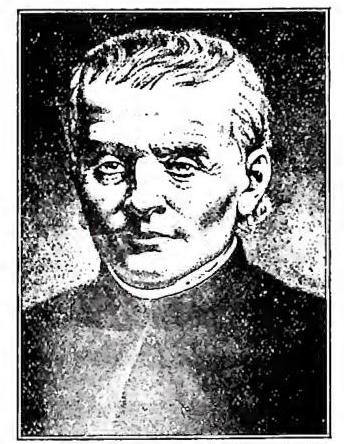
L. Ibermann, François-Marie-Paul, venerable — Portrait.
He made admirable use of the documentation provided by other literary and monumental sources.
At the initiative of H. Pertz, the MGH society, wishing to include the L. P. in its collection, had already begun a series of studies as early as 1822, published in Archiv and Neues Archiv and elsewhere; e.g., J. M. Waterich, Pontificum Romanorum, qui fuerunt inde ab exeunte saec. IX usque ad finem saec. XIII vitae ab aequilibus conscriptae (Leipzig 1862) and R. A. Lipsius, Chronologie der römischen Bischöfe (Kiel 1869). But it entrusted the task of the first edition to Pabst and then to Th. Mommsen, who began its publication in the series: Gesta pontificum Romanorum of the MGH: L. P., pars prior (1898). Preceded by a laborious introduction but without commentary on the text, the volume extends to the entire life of Pope Constantine (708–715); the continuation, entrusted to W. Lewison, has not yet been published.
In 1911 Fr. J. M. March discovered and published in the Biblioteca capitolare of Tortosa a manuscript of the L. P. that is older, more complete, and more correct than Vat. lat. 3764, which contains the biographies of the popes up to Honorius II: L. P. prout exstat in codice manuscripto Dertusensi textum genuinum complectens hactenus ex parte editum Pandulphi scriptoris pontificii (Barcelona 1925).
Finally, R. Valentini and G. Zucchetti, in Codice topografico della città di Roma (II, Rome 1942, pp. 209–340), reproduced from the L. P. the topographical information relating to the city of Rome up to Honorius II, omitting, however, the topographical indications of the donations attributed to Constantine inserted in the biography of Pope Sylvester.
II. Date of Composition
Duchesne placed the first compilation of the L. P. before 530, probably under Hormisdas (514–23). It is known only in the two epitomes "Felician" and "Cononian," the first so called because it stops at Felix IV (526–30), the second because it reaches Conon (686–87). The complete revised text would date to the mid-sixth century (L. Duchesne, Le L. P., I, p. LVII ff.).Mommsen, on the other hand, emphasized the diversity of the two epitomes, indicating their derivation from two different texts; he placed the date of a first recension in the first decades of the seventh century and of a second in the middle of the same century; he believed that the author of the life of St. Peter had taken into account the letter of Gregory the Great to Patriarch Eulogius and saw confirmation of his thesis in the silence of Gregory of Tours (538–94), Isidore of Seville (d. 636), and in the attribution to Clement of the fast that institutions of a later date than 604. In any case, the date of composition is prior to the end of the seventh century, to which the Neapolitanus IV, A, 8 codex belongs. Against Mommsen’s thesis, Duchesne replied in La nouvelle édition du L. P. (in Mélanges d'arch. et d'hist., 18 [1898], pp. 381–417).
III. Sources
Already in the second century, Hegesippus and Irenaeus had before them a list of the bishops of Rome; another was inserted shortly afterward by Hippolytus in his youth; in the fourth century, the Chronography of 354 contains the Liberian Catalogue, which stops at the election of Pope Liberius (352). The author, besides the Liberian Catalogue and those that followed, knew the De viris illustribus of St. Jerome, the Pseudo-Clementine Recognitiones, the Constitutum Silvestri, the Passio Marcelli, the Gesta Liberii, the Gesta Xysti (Sixtus III), the De purgatione; the pseudo-Council of Sinuessa and the Passiones of the Roman martyrs; from these come the apocryphal notices, to which are added manifest historical errors.Duchesne also examined many later catalogues, and some in particular in the article Serge III et Jean XI (in Mélanges d'arch. et d'hist., 33 [1913], pp. 25–55); in an appendix he then reported on the catalogue of Pomposa or Estense H. 4, 6, because it comes from the Este Library in Modena (ibid., pp. 56–64). It is interrupted at the life of Adrian I, but is completed by a catalogue up to the 9th year of Gregory VII (1082).
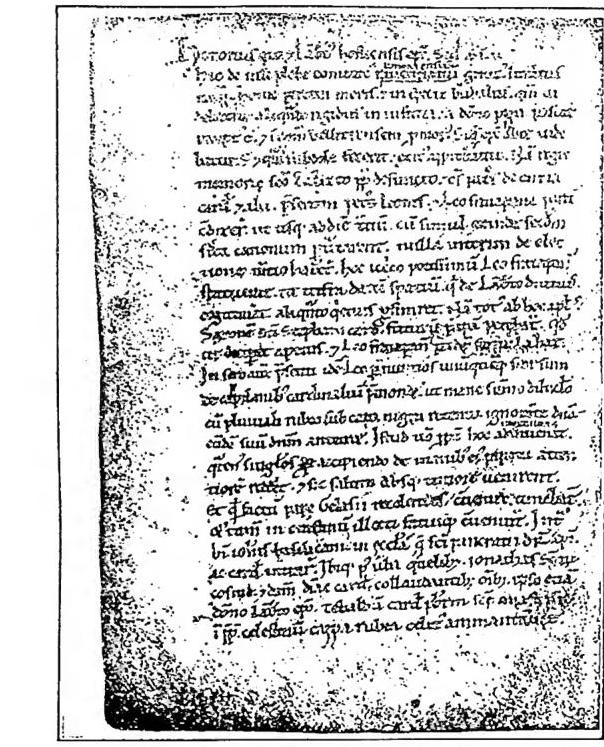
(from J. M. March, L. P. prout exstat in codice manuscripto Dertusensi, Barcelona [pl. I] Liber Pontificalis — Beginning of the biography of Honorius II. Codex Dertusensis, f. 170r (12th century) — Tortosa, Biblioteca capitolare.
O. Holder-Egger published the catalogue contained in the Cassinese manuscript, unknown to Duchesne (Neues Archiv, 26 [1901], pp. 548–55); B. Albers that of ms. Vat. Urbinate 585 (Ein Papstkatalog des XI. Jahrhunderts, in Römische Quartalschrift, 15 [1901], pp. 103–14); B. Pesci illustrated that which Sigeric, archbishop of Canterbury, brought to England in 900 and which went from John X to John XIV (L'itinerario romano di Sigerico arcivescovo di Canterbury e la lista dei papi da lui portata in Inghilterra, in Riv. di arch. crist., 13 [1936], pp. 43–60).
The anonymous author of the L. P. declares in his preface to have known the Liber Canonum written by Dionysius Exiguus at the end of the fifth century. Among the sources, Mommsen added the Chronica Italica for the lives of Liberius, Felix II, and John I.
IV. CONTINUATIONS
After Felix IV, according to Duchesne, the lives from Boniface II (530-32) up to the beginning of that of Silverius (536-37) are the work of the same person who was present at the Gothic siege (537-38), hostile to Silverius and devoted to Dioscorus, the rival of Boniface II. The lives from Vigilius to Benedict I (575-79) were written in the time of Pelagius II, whose biography was composed together with that of Gregory I after 604; from Pelagius I to Boniface V (556-625) the lives are of homogeneous composition; after Honorius I (625-38) they were compiled by individuals; but from Adeodatus II to Conon (672-87) they return to a uniform style. The life of Gregory II (715-31) was written while the Pope was still alive, and Bede was able to use II. The narratives of Zacharias, Stephen II and III (741-57) are genuine; that of Paul I (757-67) is brief. The life of Adrian I (772-95) was first written up to the capture of Pavia (774); for the second part, extensive use was made of the archives of the Lateran patriarchate, particularly regarding donations, church restorations, diaconates, walls, aqueducts, and agricultural colonies; it contains notices of the Second Council of Nicaea and the flooding of the Tiber in 791. The life of Leo III (795-816) is also compiled from archival extracts, to which are added the account of the revolt of 799, the Pope’s flight, his return, and the coronation of Charlemagne. The life of Eugenius II (824-27) is very brief, and that of Valentine (827) is incomplete. Two versions exist of the life of Sergius II (844-47). The life of Leo IV (847-55) is arranged chronologically, while those of Benedict III (855-58) and the first part of that of Nicholas I (858-67) are of different style and contain valuable details; Duchesne attributes these to Anastasius Bibliothecarius or one of his circle. The life of Adrian II (867-72) breaks off in 870; those from John VIII (872-82) to Adrian III (885) are missing; the biography of Stephen V (885-91) stops at 886. The lives are dry and uninformative until Gregory VII (1073-85); then we know of authors such as the Roman cleric Pandulf (c. 1137) and Peter William of St-Gilles (1142); Cardinal Boson continues in the style of the ancient lives up to Alexander III (1159-81), but his work remains unfinished due to his death. Isolated biographies follow, from Innocent III to Gregory X (1198-1276). The lives of Boniface IX (1389-1404), Innocent VII (1404-06), and Gregory XII (1406-15), found in Codex Vallicellianus C. 79, come from a chronicle different from that used in Codex Vallicellianus C. 25, which contains differing assessments of Urban VI (1378-89), Boniface IX (1378-1404), Eugenius IV (1431-47), and Nicholas V (1447-55) up to the living Pius II (1458-64).
V. CONTENT AND VALUE
In its earliest part the content is generally uniform: the name of the pope, his birthplace, his parentage, the duration of his pontificate in years, months, and days, sometimes with the synchronism of emperors or Gothic kings of Italy and the two extreme consular dates of the pontificate. Then come the pope’s decrees on discipline or liturgy, the founding and endowing of churches, and historical events. Finally, there is a list of ordinations of priests and deacons for the churches of Rome and the consecrations of bishops. The place and date of the pope’s burial are also given.
The notices, very brief at first, begin to expand in the 4th century; but there are discrepancies in the order of the popes. Even the figures for ordinations in the early part are fictitious: the dates are obscured, and from Zephyrinus to Felix III they do not agree with those provided by other documents; exactness begins only with Anastasius II (496-498). Even the vacancy of the See and its duration, as recorded in the L. P., do not correspond with the actual facts from Pontian to John I (514-23). Disciplinary and liturgical decrees in force at the time of composition are distributed without foundation in the lives of the early popes and must therefore be treated with caution. Both the author of the first redaction and the anonymous continuators belong to the lower clergy of the Lateran patriarchate, and their language is the popular idiom of the time, as are the topographical indications, which, however, are accurate.
For the subsequent period the historical value varies according to the different authors.
Duchesne compares the importance of the L. P. in medieval historical literature with that of the papacy in the political world of that time. Despite its errors, omissions, and great imperfections, it remains and will always remain one of the principal sources for the history of the popes and above all for the history of Rome in the Middle Ages, of its monuments, its internal crises, and its religious and political institutions (L. Duchesne, L. P., I, Paris 1886, preface).