
**MIDIAN AND THE MADIANITES** (Hebr. *Midhijān*; Septuagint *Mādāvax*).
Name of a region south of Palestine (Ex. 2, 15) and of its inhabitants (Ex. 3, 1; 4, 19; 18, 1; Num. 24, 47), sometimes indicated by the variant "Madinati" (Gen. 37, 38; Num. 25, 17).
The name, not hitherto found in assured documents, was given by Ptolemy (*Mādājāz*: *Geogr.*, VI, 7, 27), by Flavius Josephus (*Antiq. Ind.*, II, 11, 1), by Eusebius (*Mādāvāḥ*: *On.*, 124, 8) and by the *Qur’ān* to denote a region and city in Arabia along the eastern coasts of the Elanitic Gulf (el-‘Aqabah). According to the indications of Arab geographers, Midian corresponds to the ruins of Hawrah, near the oasis of el-Bed‘ or Mōgā‘ir Šu‘a‘jab, where the cave is shown where the prophet Šu‘a‘jab, identified with Jethro, prayed, and the spring where Moses led his father-in-law’s flock to drink.
From the central region, whether original or at least the most important, Midian extended into neighboring lands: into the peninsula of Sinai and into Transjordan. The area straddling the Elanitic Gulf, where Moses took refuge after fleeing the Egyptian court (Ex. 2, 15) and of which Jethro was chief and priest (ibid. 2, 15; 3, 1), called Midian, is bounded not far from Sinai, between Edom and Pharan, along the road from Egypt to the north. The nomadism of the Midianites is indeed clearly attested in biblical tradition. Presented as descendants of Midian, son of Abraham and Keturah (Gen. 25, 2).
---
**MADISON, Diocese of.** — City and diocese in the State of Wisconsin (United States of America).
It comprises the counties of Columbia, Dane, Grant, Green, Green Lake, Iowa, Jefferson, Lafayette, Marquette, Rock, Sauk, all in the State of Wisconsin, for a total area of 8,070 square miles. Of a population of 442,182 inhabitants, there are 88,626 Catholics.
It has 131 parishes, served by 140 diocesan priests and 33 religious; 3 seminaries and religious schools; 6 male religious communities and 69 female; 1 college, diocesan and parochial high schools, 54 parochial schools; in 1949 there were 672 conversions.
The diocese was created by Pope Pius XII with the apostolic constitution *Ad animarum bonum* of 22 December 1945, by separation
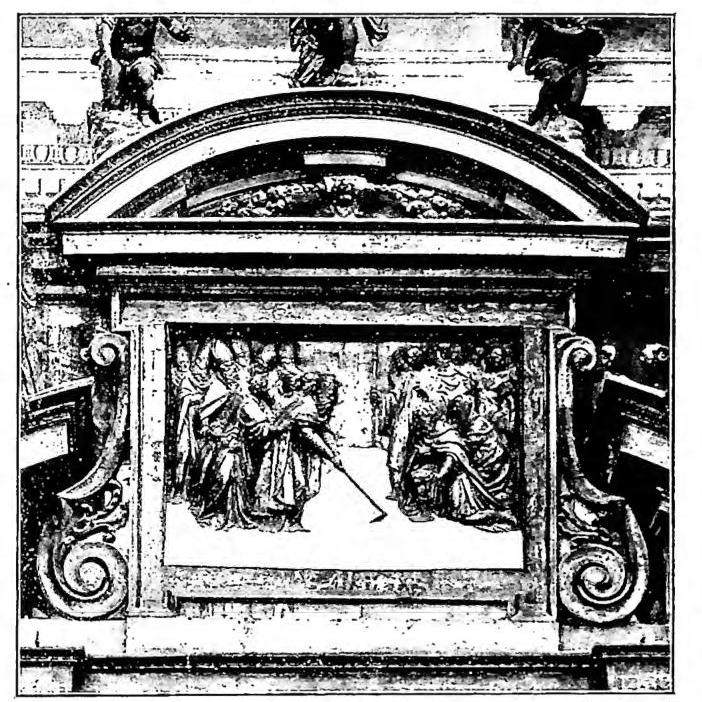
**Maderno, Stefano** — Pope Liberius marks the plan of the basilica in the snow. Bas-relief — Rome, basilica of St. Mary Major, Borghese Chapel.
though already interpreted with personal flair (v. MODERATI).
In the works of these painters the subject of the Madonna with the Child prevailed at first (whence the name *m.*), but later also the Saviour, the saints and the principal scenes of the Old and New Testaments. To these icons, not only in the Orthodox world but also in the Catholic West, a special religious value and even miraculous powers were often attributed, perhaps thinking that they went back to archetypes of somehow prodigious origin. The tradition of the portrait that St. Luke is said to have made from life of the Madonna and sent to Theophilus was especially strong. Thus the legend, but there must certainly have existed a prototype with the Virgin in a rigid, frontal pose, holding the Child on her arm who blesses and holds the scroll of the Law in his left hand: this is the type known as *h’Οδηγήτρια*, from which the others derived with few variations (e.g., the Glykophilousa and the Eleousa, in affectionate attitude, the Galaktotrophousa, who nurses the Child, etc., and finally the Madonna of the Passion with two half-figures of angels bearing the signs of Christ’s martyrdom).
Thus too for the other images iconography generally remained tied to traditional models. Christ was mostly depicted as the blessing Saviour or as King of Kings, enthroned and wearing the mitre. The saints were naturally those most venerated in the Eastern Church. From the Gospel were preferred the episodes corresponding to the “great feasts” or those recurring in the Sunday liturgy, in conformity with the usage of the Orthodox Church of exposing to the veneration of the faithful during the sacred rites the icon referring to the Gospel passage read or to the feast being commemorated. The religious value and use of such icons, which were also hung on the screen, called iconostasis, separating the Holy of Holies from the rest of the church, greatly favored their diffusion; and now they are found here and there in museums, private houses and convents. In particular, in the Vatican Picture Gallery, the National Museum of Ravenna, Florence, among the community of Greek Orthodox in Venice; in the Byzantine, Benaki and Loverdos Museums of Athens; in the monasteries of Patmos, Athos and Sinai (where, moreover, their production still continues); in the museums of Moscow and Leningrad.
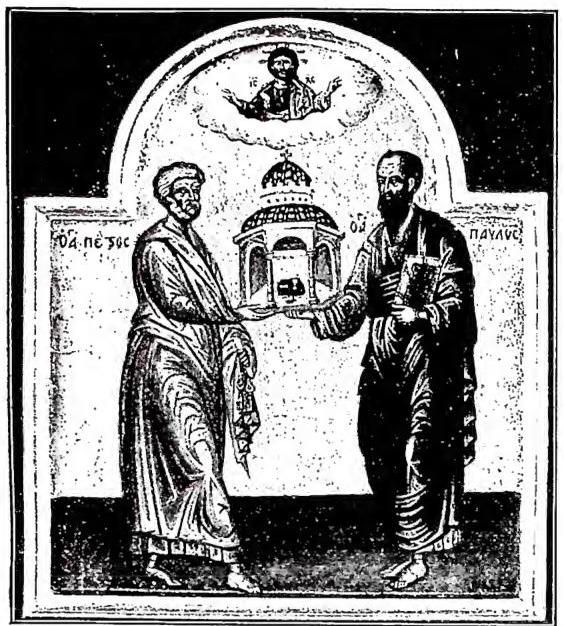
**MADONNERI** — SS. Peter and Paul. Panel by Vittore (Idi Bar-tomeo?); 16th cent.) — Vatican Picture Gallery.