
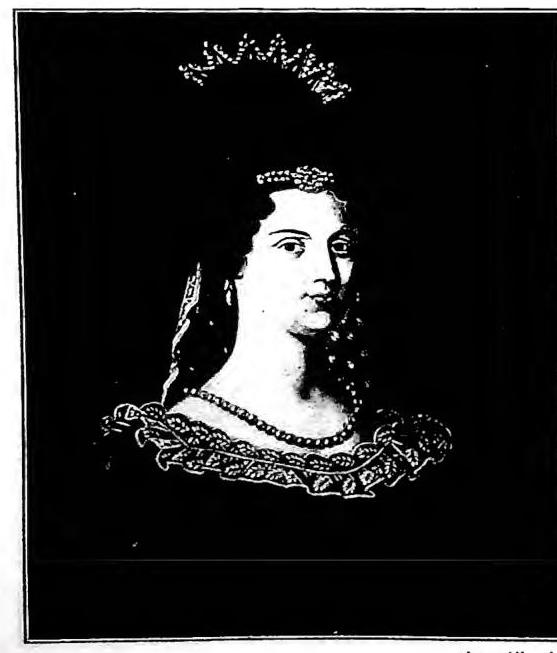
MARIA CLOTILDE of Savoy-Napoleon. – Daughter of Victor Emmanuel II and of Maria Adelaide of Austria, born in Turin on 2 March 1843, died at Moncalieri (Turin) on 25 June 1911.
At the age of fifteen she was sought in marriage by Prince Jerome Napoleon, then forty years old. She freely accepted the sacrifice imposed on her by reasons of state and the Franco-Sardinian alliance, although she knew that she had nothing in common with him in feelings or ideas. Thus becoming a French princess, she maintained her rank nobly in Paris, though with great reserve, devoting herself entirely to the education of her three children: Victor, Louis Napoleon, and Maria Letizia. When the Napoleonic dynasty fell in 1870, she refused to flee; but when she did decide to leave, she departed the city with head held high, amid the respectful greetings of the people. She retired to Switzerland, to the castle of Prangis (Nyon), where she remained until 1878, when the divergence of principles and convictions compelled her honour and conscience to separate from her husband. She withdrew to Piedmont, to the castle of Moncalieri, dedicating herself entirely to prayer and works of charity, and was hailed by the people as “the saint of Moncalieri.” In 1891 she hastened to Rome to attend her husband in his final days, when he had returned fully to God. She was a Dominican tertiary from 1871, and is buried at Superga.
MARIA CRISTINA of Savoy, Queen of the Two Sicilies, Venerable. – Youngest daughter of Victor Emmanuel I, King of Sardinia, and of Maria Teresa of Habsburg-Este, born at Cagliari on 14 November 1812, died at Naples on 31 January 1836. As a young girl she distinguished herself in her family for her piety and virtue. After her father’s abdication in March 1821, she left Turin and lived with her family in Modena, then in Moncalieri where her father died (1824), and in Genoa where her mother died (1832).
She had wished to consecrate herself to the religious life, but from 1817 negotiations were underway between the courts of Turin and Naples for her marriage to Ferdinand of Bourbon. This took place on 21 November 1832 at Voltri (Nostra Signora dell’Acquasanta), and by sea the new Queen travelled with Ferdinand II to Naples. On 14 January 1836 Maria Cristina gave birth to the long-awaited heir to the throne of Sicily, later Francis II (q.v.), but she died within the same month. She was buried in Santa Chiara. The four years of her marriage and life at the court of Naples brought to light in southern Italy the qualities of sanctity in Maria Cristina. Many rumours circulated about ill-treatment inflicted on the bride by Ferdinand II, but these are fabrications that belong to the liberal antibourbon legend. For her virtues she was declared Venerable in 1853, and the cause of her beatification is under way.
MARIA CRISTINA of Bourbon, Regent Queen of SPAIN. – Born at Naples on 27 April 1806, died at Sainte-Adresse on 23 August 1878. Daughter of Francis of Bourbon-Sicily, later Francis I of Naples, Maria Cristina became in 1829 the fourth wife of King Ferdinand VII of Spain, by whom she had a daughter, the Infanta Isabella. Ferdinand, who had no male issue, altered the law of succession to leave the throne to Isabella, who upon his death (1833) was proclaimed queen under her mother’s regency. This led to the civil wars against the late king’s brother, Don Carlos, who proclaimed himself king of Spain with the support of the absolutist powers. The Carlist crisis lasted until 1839, when the pretender was defeated by General Espartero and forced to take refuge in France.
The following year Espartero seized power in a coup d’état, forcing Maria Cristina to abandon Spain. She was able to return only in 1843, after Isabella was declared of age and had assumed sovereign powers. Nonetheless Maria Cristina continued to direct Spanish politics, limiting the authority of Parliament and arranging her daughter’s marriage to her cousin Don Francis of Assisi (1846). In 1854 a new uprising banished her a second time on charges of having squandered public finances to enrich her morganatic husband Agustín Muñoz, to whom she had granted the rank of duke and by whom she had three children. Reinstated in Spain after two years of exile, she played no further part in political affairs and spent the rest of her life in obscurity, surviving by ten years the deposition of Isabella. She died in France, having witnessed the republican interlude, the new Carlist attempt, the brief reign of Amadeo of Savoy, and the Bourbon restoration in the person of her grandson Alfonso XII. During the years of her predominance occurred the Spanish military intervention against the Roman Republic of 1849.