
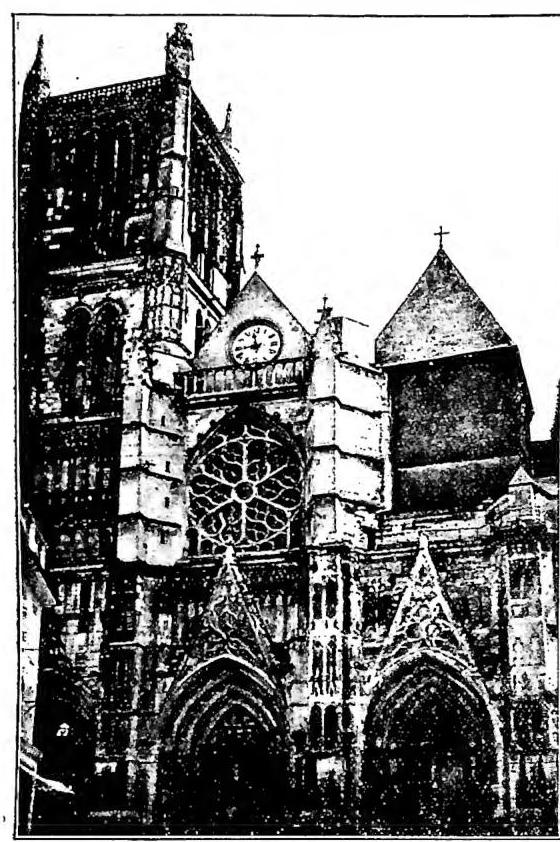
MEAUX, DIOCESE OF — Cathedral (14th–15th centuries).
Among its bishops were J. du Drac (1459–73); G. Briçonnet (1516–33); D. Segnier (1637–59); and Cardinal De Ligny (1659–81). Bossuet (q.v.) was bishop of M. from 7 February 1682 until his death in 1704.
One of the most venerated shrines was the abbatial church of St Faron, bishop, now destroyed, though its plan is known from Villard de Honnecourt.
M. formed part of the Kingdom of Austrasia and was sacked by the Normans in 887, who burned the city and took Bishop Sigimondo captive. In the 10th century, Thibaud, Count of Troyes, also became Count of M.; his son O. Idone I incorporated it into the County of Champagne, after which M. acquired commercial importance. It was later reunited with the French crown by Philip the Fair in 1285. In 1385 it suffered during the Jacquerie revolt. In 1422 it was taken by Henry IV of England; recaptured in 1439, it endured further hardship during the religious wars, and in 1562 the Huguenots plundered the churches.
The cathedral is dedicated to St Stephen. Bishop Hildegar, in the mid-9th century, in his Life of St Faron, mentions the church of M., though its origins remain obscure. By the 12th century there were already canons in residence. In 1723 Cardinal de Bissy, while excavating to build a bishops’ sepulchre, discovered beneath the cathedral a crypt with columns and a capital from the 11th century; further remains of similar columns were found in 1840, together with traces of burnt materials and ashes suggesting the Norman fire. It is certain that in 1198 Mary of France, daughter of Louis VII and wife of Count Henry I of Champagne, was buried there. Between 1225 and 1235 the architect Villard de Honnecourt drew up plans for “the presbyterium Pharanonis in Mias” and the bindings of the church of St Stephen in Mias. The building was, however, rebuilt in 1253 during the episcopate of
---
Is there any truly fixed system? To such a question it is logical to reply with another: fixed with respect to what? At this point it suffices to recall the evolution of the notion of a fixed body to see that no answer is possible. For a very long time the Earth was held to be fixed, then the Sun was considered fixed; later astronomical observations showed that even the Sun, with its entire planetary system, moves at a speed of some 30 km/sec toward the distant constellation of Hercules, and that the vast galactic system itself is in motion relative to the most distant stars, which no one can seriously suppose to be fixed. Even optical wave theories and Maxwell’s electromagnetic theory presupposed the existence of a fixed ether, yet experience demonstrated the absolute untenability of that hypothesis (q.V. RELATIVITY). In conclusion: physics, and kinematics in particular, must now avoid making the slightest use of the equivocal and fallacious notion of an absolute system.
Motion of a Point. — In geometry and in everyday life the notion of a point and of the position of a point is frequently employed. This is an abstract notion insufficient for a complete definition of the position of a real body, since it disregards any consideration of orientation, which has no meaning for a point but is well defined for any real body, however small. Yet in many practical cases this incomplete indication is sufficient. For example, the position of a ship at sea is generally given by its longitude and latitude, without reference to its orientation. Hence physics often treats the bodies involved in its considerations as concentrated at points, sometimes attributing to them non-contradictory material properties, and distinguishes them from purely geometric points by calling them material points. In such cases the notion of the motion of a body reduces to that of the succession of spatial points occupied by the representative point as time passes; these spatial points cannot be isolated but must form a line, the trajectory of the moving point. This trajectory may be straight or curved. Yet even the knowledge of the trajectory is not enough to define the motion of the point completely. It is also necessary to establish in some way an exact correspondence between the positions of the point—that is, between the points of the trajectory—and time. This can be done in various graphical and analytical forms. An essential element in the study of motion is velocity. We now have a sufficiently exact notion of velocity, since modern life continually brings us into contact with the most varied speeds. Ultimately, the velocities of any object are always expressed by the ratio of the distance covered to the time taken: v = l/t. This leads to the physical dimension of velocity v = LT⁻¹. A point may move with constant velocity along its entire trajectory, or its velocity may vary from place to place. In the first case, the length of the path s covered in any time t, measured from the instant when t = 0, is given by the simple equation s = s₀ + vt, where s₀ is the position of the point at the initial instant. When velocity varies, however, it is useful to introduce the highly useful notion of acceleration a, that is, the increment of velocity per unit time, so that a = Δv/Δt, where Δv denotes the change in velocity over the interval Δt. Consequently, acceleration is assigned the physical dimension a = vT⁻¹, and taking into account the dimension of v, a = LT⁻². As with velocity, acceleration may be constant throughout a path, yielding uniformly accelerated motion; or it may vary from place to place, yielding variably accelerated motion. By perfect analogy with what was said earlier, in the case of constant acceleration the variable velocity at any instant is given by v = v₀ + at, where v₀ is the velocity at the initial instant.
In the case of retarded motion, that is, when velocity decreases, acceleration is assigned a negative sign. At this point it is interesting to ask what the expression for the path s of the material point is in the case of uniformly accelerated motion. Simple mathematical considerations lead to the expression s = s₀ + v₀t + ½at², where s₀ and v₀ are respectively the position and velocity at the initial instant. As will be seen later, this expression has notable importance in the history of mechanics. By fundamentally analogous but necessarily more complex considerations from the physical standpoint, kinematics studies all other types of motion, not only of points but of any bodies. The difficulties that may arise in such studies are merely of a mathematical nature.
II. GEOMETRY OF FORCES
Even the notion of force is sufficiently intuitive for everyone to make a preliminary partial analysis. The force most familiar to us, that which manifests itself as the weight of material bodies, was recognized from ancient times as variable from body to body, or more precisely as possessing its own intensity, direction, and sense, the latter two being a priori respectively vertical and downward, though they can be deviated by suitable devices. For example, the force required to raise a bucket of water evidently has an intensity equal to the total weight of the water, and normally a vertical direction and downward sense; but with the rope-and-pulley device used in wells, direction and sense can be arbitrarily deviated while the intensity remains the same. From the evident fact that the effect on a straight taut rope of a force of the same direction is independent of the point of application, it follows that forces can in general be arbitrarily shifted along their line of action.
**Composition of Forces.** — As early as the 13th century, G. Nemorario qualitatively recognized the possibility of decomposing forces, considering the case of a downward vertical force corresponding to the weight of a body suspended from a more or less taut rope between two fixed points; this force was in fact balanced by the two tensions, and hence by the two forces, directed along the two segments of the rope. But despite this recognition, no one dared to affirm the analogous possibility of composing forces. Only Leonardo da Vinci, about two centuries later, determined those two tensions and demonstrated that their rational composition was quantitatively equivalent to a force equal and opposite to the weight of the suspended body, thereby elevating the general notion of composition and decomposition of forces. On the basis of this notion and its law, later formulated with the well-known parallelogram rule, all the most interesting problems concerning forces themselves were solved, beginning with Galileo. Considering first coplanar forces, i.e., those whose directions lie in the same plane, it should be noted that any number of them can in general be composed into a single resultant in that plane, except when, in the course of this attempted composition, two forces of equal intensity F, parallel, of opposite sense, and having lines of action at a non-zero distance d apart, result; for in that case any further composition is impossible. In other words, the particular system just described represents a new physical quantity, which is customarily called a couple. A simple analysis shows that couples are characterized by their moment, i.e., the product Fd. Two couples of equal moment are equivalent. It is very important to bear in mind that if a force is translated parallel to itself rather than along its line of action (as has been assumed up to now), a couple always arises. With this in mind, the following conclusion can be drawn for the plane: any number of coplanar forces can always be composed into a single resultant force or into a couple.
In space, analogous considerations lead to the conclusion that two skew forces are in general equivalent to a force and a couple; it follows that any number of forces in space is likewise equivalent (reducible) to a force and a couple.
III. GENERAL DYNAMICS
Of the three elements whose mutual relations determine the laws of the motion of material bodies—motion, forces considered extrinsic to the bodies, and that which is said to be intrinsic to them—only the first two could be studied separately in advance because of their easy intuition, giving rise to the so-called geometries of motion and of forces. The third, however, being entirely implicit in the theory of motion itself, could not be subjected to any reliable preliminary study, also because in the broad field of the motion of material bodies there are, as will be seen, various quantities that individually might represent the aforementioned intrinsic element. This is perhaps the most recondite reason that, aggravated by the lack or, worse, the fallacy of easy intuitions, made it so difficult to extract from the observation of the phenomena of motion a coherent system of laws capable of interpreting them all.
1. **The Principle of Inertia.** — The first real result in the various attempts to extract the fundamental laws of motion was the attainment of the notion of the inertia of material bodies and the formulation of its law, first by Leonardo da Vinci and then, independently, by Galileo. In Newton’s later systematic formulation of the fundamental laws of motion, it constitutes LEX I: “Corpus omne perseverare in statu suo quiescendi vel movendi uniformiter in directum, nisi quatenus a viribus impressis cogitur illum mutare.” And no doubt it was the ignorance of this fundamental basis that was the principal cause of Aristotle’s erroneous interpretation of many phenomena of motion, and in particular of that of the fall of material bodies near the surface of the earth, which, as will be seen, later became the touchstone between Aristotelian and Galilean views.
At this point it is worth noting the fact that it was precisely the founders of the experimental method who elevated to the rank of a fundamental principle a phenomenon that in the realm of our experimental possibilities can never be completely realized and can only be recognized as a limiting case, since we cannot observe a motion absolutely free from the action of some external force. Those who held the contrary view, that bodies could not remain in motion unless acted upon by some force, could delude themselves into thinking they were in accord with everyday experience, which shows that every body not maintained in motion by ascertainable external forces comes to rest.
2. **The Fundamental Principle of Dynamics.** — Having obtained the law of the motion of bodies in the absence of external forces, it is logical to ask what effects the possible presence of such forces would produce on the bodies themselves. But here too pure intuition is insufficient to address the question, and recourse to well-conceived and rigorously interpreted experience becomes necessary. The first question that arises is whether it is permissible to speak of the action of a force on a given body independently of the state of motion in which it may happen to be. The question is extremely delicate because, since direct experience is impossible, it must be resolved indirectly and also through abstractions and idealizations to be carried out with great care. Only Galileo succeeded in posing the question in the proper terms and in solving it, summarizing its essence in the principle that a force acts on a body in the same way always, whether it be in motion or whether it be subject or not to the action of other forces. Only on the basis of this principle can experience with bodies initially at rest relative to the observer be conclusive. The law that Galileo derived from the results of his experiments was formulated by Newton as LEX II: “Mutationem motus proportionalem esse vi motrici impressae et fieri secundum lineam rectam qua vis illa imprimitur.”
Now it should be borne in mind that the asserted proportionality between force and mutatio motus (which is nothing other than a positive or negative acceleration) refers to the effects of various forces on one and the same body: in other words, that the ratio between the impressed force F and the acceleration obtained, a, is a constant of the body under consideration. But since the accelerations obtained by applying equal forces to different bodies are themselves different, or, what amounts to the same thing, since different bodies offer different resistances to changes in their state of motion, the idea naturally arises of ascribing to each body its own inertial or dynamical mass m. This is precisely what Newton did, further taking as the measure of mass, without further ado, the ratio F/a; that is, he expressed his Second Law in the form F = m·a.
This fundamental law can also be given various other forms, which are very useful in different cases. Observing that the (average) acceleration during a time interval Δt can be written as a = Δv/Δt, the preceding law takes the form FΔt = mΔv, or, given the constancy of m, also FΔt = Δ(mv). This form becomes very expressive if two new physical concepts are introduced: that of the product of a force by the time during which it acts, i.e., the impulse of that force, and that of the product of a mass by its velocity, i.e., the momentum of that mass (or of the body possessing it); the equation then expresses that the impulse of a force is always equal to the change in the momentum of the body to which it is applied. Often the terms are reversed and it is said: the change in the momentum of a body is always equal to the impulse that produced II. Again, by dividing by Δt, the same equation tells us: the change in momentum per unit time is equal to the acting force. All forms of the fundamental law that may be useful.
The magnitude mass thus introduced is eminently of a physical nature, independent of the fundamental magnitudes length L and time T; it must therefore be considered as a new fundamental magnitude proper to dynamics, whose physical dimension is usually denoted by M. From the preceding equation, taking into account the dimensions of acceleration, we obtain the dimensional characterization of force: F = L T⁻² M.
3. The principle of action and reaction
The two preceding principles are already sufficient to solve satisfactorily many of our dynamical problems, but not all, and in any case never in their fullness. Indeed, to apply a force to a body it is necessary to make use of another body. And then one cannot claim to know a dynamical phenomenon completely unless one also takes into account what happens to that second body.Newton’s principle meets this need; he enunciates it as LEX III: actioni contrariam semper et aequalem esse reactionem: sive corporum duorum actiones in se mutuo semper esse aequales et in partes contrarias dirigi. Like the two preceding principles, this one cannot be demonstrated, but can only be illustrated and clarified by suitable examples. A body that, for whatever reason, exerts for a certain time on another body a force of a certain magnitude and direction is always inevitably subjected, for the same time, to a force of equal magnitude and direction, but opposite in sense. Even when the force is exerted only for a very short time and thus its effect reduces to an impulse on the body that receives it, the acting body inevitably receives an equal and opposite impulse. It should be noted, to avoid misunderstandings, that the action and the corresponding reaction, as Newton himself calls them, always occur on two different bodies.
4. Developments of dynamics
The preceding principles are sufficient to solve conceptually any mechanical problem that may arise in reality. The reservation is meant to indicate that to this theoretical possibility there does not always correspond our ability to derive those solutions formally. Hence, from Newton’s time onward, many expressions perfectly equivalent to those principles but formally more suited to the practical solution of various types of dynamical problems have been sought and discovered. Among these, of the greatest importance are d’Alembert’s principle, Lagrange’s equations, Hamilton’s principle with its various formal transformations, etc. Given the impossibility of considering in detail these advanced formulations of dynamics and the ingenious criteria devised for their application to various problems—which together constitute one of the greatest resources of theory, analytical dynamics—it need only be noted that the greatest difficulty that almost always presents itself is that of properly taking into account the so-called constraints. These are in general closely linked to the conditions to which the various masses participating in the phenomenon may be subjected; conditions that can sometimes be extremely complex and possibly also vary with time. For example, a railway carriage is generally constrained by the condition of having to remain on its rails; such a constraint, when the track is straight, can be considered practically non-existent, but when it is curved it can give rise to very considerable reactions because the carriage, endowed with a certain velocity, by reason of its inertia tends to maintain its velocity and hence its straight-line motion, whereas one of the rails will instead force it onto a curved path by exerting on it (through the wheels) an action to which the carriage will react, by Newton’s principle, with an equal and opposite reaction on the rail. Of such or other more complex constraint reactions, which can be exactly foreseen by the Third Principle and of which it may be difficult to take account solely on the basis of the fundamental principles, the aforementioned analytical formulations can instead take account almost automatically, except, of course, for any computational difficulties.A further necessary observation is the following. Although it is now known that in practice every motion always encounters various passive resistances tending to bring it to a stop, for simplicity, in what precedes, these have been tacitly abstracted away. Yet even their consideration, which may be necessary in various important cases, can in principle be provided for by the Second and Third Laws of dynamics; but a more practical consideration of them is achieved through the aforementioned analytical dynamics.
Finally, let it be recalled that the expression dynamical equilibrium is often used, which clearly does not coincide with the familiar static equilibrium. Evidently a material point is in static equilibrium when it is acted upon by two equal and opposite forces; a stationary balance is in static equilibrium because then the resultant of all the parallel forces (weights) acting on it and directed vertically downward, passing through the fulcrum, is balanced by the equal and opposite reaction of its support. A train moving in a straight line with uniform velocity, on the other hand, will be said to be in dynamical equilibrium because in this case the propelling force of the locomotive and the resultant of all the passive resistances, as well as its weight and the reaction of the rails, are in equilibrium, so that the train moves, in accordance with the First Principle, as if no force were acting on II.
IV. DYNAMICS OF MATERIAL POINTS
The particular case of the dynamics of bodies which, for any reason, can be rigorously or at least with great approximation, be assimilated to material points according to the preceding conception, is very useful because it allows one to see the dynamic principles in action in their simplest possible form, as well as to establish certain concepts and demonstrate certain laws that follow from the fundamental principles and which can later be advantageously used in their place. In other words, what happens here is what has occurred since ancient times in the field of geometry; namely, that although its fundamental axioms and postulates contained everything necessary to solve every geometric question, it was almost always more convenient to resort, in those treatments, to theorems that were their logical consequences and, in a certain sense, their equivalent.5. Motion of a free point
If no force acts on a free material point of mass m, then by the First Principle its acceleration a will be zero, and its velocity will therefore be constant and equal to the initial velocity \(v_0\); its displacement s after a time t will be given by the equation \(s = s_0 + vt\), where \(s_0\) denotes its position at the initial time \(t = 0\). But if a constant force F acts on the point, then by the First and Second Principles we will have: its acceleration \(a = F/m\), and its velocity \(v = v_0 + F/m\). In the case where the force \(F\) has acted for a period of time \(t\) starting from rest (\(v = 0\)), the impulse theorem gives us \(F = mv\), and thus allows us to calculate the velocity \(v\) attained by the body without passing through consideration of the acceleration.6. Uniform circular motion
Passing from the simplest case of the motion of a free point to the still particularly simple case of the motion of a point constrained to move uniformly on a circle of radius r, we observe: 1) that elementary kinematic considerations show that, by virtue of the circular motion rather than rectilinear motion, the point is subject to a continuous and constant acceleration toward the center, which is therefore called centripetal acceleration, whose value is easily calculated as \(a = v^2/r\), where \(v\) is the velocity of the point on the said circle; 2) that by the Second Principle this centripetal acceleration can only be produced by a force acting on the point and directed at every instant radially toward the center of rotation, which we will therefore denote by \(F\); its magnitude, by the same principle, is given by \(F = ma = mv^2/r\), and this independently of any particulars regarding its application to the point. The centripetal force may be constituted by the reaction of the constraint, as happens, for example, with the ball launched in a roulette wheel, or it may be a force directly applied to the point, such as the tension of a thread stretched between the point and the center, or even a force of gravitational attraction such as that exerted by the Sun on a planet (v. GRAVITATION).7. Centripetal force and centrifugal force
Even this simplest case of circular motion leads to consideration of important concepts that now also have significance in ordinary life, and which therefore must be well understood in order to avoid facile misunderstandings. Consider again the ball moving in the circular groove of the roulette wheel. It is continuously subjected by the groove to a centripetal force against which it reacts with an equal but opposite force, applying it to successive points of contact with the groove. If this force were to disappear for an instant, the ball would escape along the tangent, proceeding with rectilinear and uniform motion, and, no longer experiencing any force, would naturally no longer exert any reaction. Now suppose one places an identical ball on a rotating horizontal platform. One would immediately observe that the ball, like any other material body, would be subject to a centrifugal force tending to move it away from the center unless it were located precisely at the center, until it encountered a support to which it could apply its force, experiencing the consequent reaction in the opposite direction, and thus being able to remain fixed relative to the platform. This centrifugal force, which is felt and experienced even by one who participates in the rotation, is, for such a person, a real force, whereas the same force does not exist at all for one who does not participate. In other words: a motor vehicle that, attempting a sharp turn, skids on the ground, in the judgment of one who is in the vehicle, skids because of the centrifugal force generated by the turn and not sufficiently counteracted by the friction between the wheels and the ground; in the judgment of one who is on the ground, the vehicle skids because the natural tendency of the vehicle to continue its rectilinear motion by inertia (First Principle) was not sufficiently overcome by the centripetal force automatically imparted to it by the friction between its wheels and the ground. Every misunderstanding can, however, be avoided by imposing the rule of speaking and treating of centrifugal forces only from the standpoint of one who participates in the rotation, and, conversely, of speaking and treating of centripetal forces only from the standpoint of one who does not participate.8. Theorem of the conservation of momentum and impulse
On the basis of the correlation between momentum and impulse of forces deduced above, one can arrive at other theorems of great utility. Let external forces \(F_1\) and \(F_2\) act on masses \(m_1\) and \(m_2\) respectively for a time interval \(\Delta t\). Applying the previous theorem separately and summing, we have \((F_1 + F_2) \Delta t = \Delta(m_1v_1 + m_2v_2)\), an equation which tells us that the sum of the impulse of the external forces is equal to the variation of the momentum of the masses. In the absence of external forces, the variation of momentum will be zero, and therefore the momentum itself must be constant. This holds no matter how many masses there are, so that one can affirm that the momentum of an isolated system does not vary, or, as is often said, is conserved. This is the first theorem and law of conservation that highlights a useful and general dynamic law doubtless virtually contained in the fundamental principles, but in a form very useful for applications. When external forces act, one always has, of course, the more general theorem of impulse.the form \( t = \text{const.} \sqrt{\frac{1}{g}} \). The constant is naturally determined by a single experiment and is found to be equal to \( 2\pi \).
subject to any rotational impulse; for then, since its weight is balanced by the reactions of the supports of the axis, it can only move by inertia, rotating with constant velocity.
For building constructions, the conditions of equilibrium of bodies (towers, columns, etc.) resting on the ground are of interest. Among other things, it is essential that the verticals dropped from the center of gravity of these bodies fall within the area of their contact with the ground, in order to avoid the production of uncompensated rotational moments by the corresponding reactions. For the same reason, a homogeneous sphere cannot be in equilibrium on an inclined plane, even if only slightly inclined, because the said condition is not in fact satisfied. For equilibrium to be stable, it is necessary and sufficient that any small displacement of the bodies corresponds to a raising of their center of gravity; if, instead, there is a lowering, the bodies are in unstable equilibrium and, once moved, will tend not to return to their previous position but to move further away; if, finally, the height of the center of gravity does not vary, as in the case of a sphere on a horizontal plane, we have neutral equilibrium.
VI. MECHANICS OF FLUIDS
The phenomena considered in this chapter are of the greatest importance, both theoretically and practically. They are still mechanical phenomena, and therefore ultimately subject to the fundamental laws of Galileo and Newton; but their treatment must take into account the particular characteristics of the bodies under consideration, namely their extension and fluidity, just as previously consideration was given to the extension and solidity of solid bodies.To establish this study, it is not necessary to descend to the hypothesis of the molecular and atomic constitution of matter; it suffices to admit that every smallest element of fluid matter is not rigidly connected with the surrounding elements and can therefore move, more or less freely, with respect to them. Moreover, even a cursory observation of phenomena had, from the earliest times, led to a fairly accurate understanding of that great category of fluids which, like solid bodies, offer very great resistance to any variation in their volume, while being easily and readily deformable (e.g., by simple transfer from one vessel to another of different shape); fluids which we now briefly call liquids. On the other hand, a similar understanding of fluids which, besides being deformable, are also easily compressible and have a marked tendency to expand and thus to occupy entirely the spaces offered to them—fluids which we call aeriform—could not be achieved because of long-standing prejudices until the establishment of the school of Galileo.
The knowledge of the mechanics of fluid bodies, of evident theoretical interest, is also very important from the point of view of its now innumerable practical applications. It suffices to recall that all hydraulic and naval constructions are essentially based on the laws of the mechanics of liquids, and that all pneumatic constructions, such as ventilation and compressed-air systems, and all aeronautical constructions are essentially based on the laws of the mechanics of aeriform bodies. It is therefore not surprising that for the exposition of the mechanics of fluids, very different methods have been followed and are still being used, particularly suited to the various applications. But given the nature and the restricted scope of this exposition, we shall follow the path that seems simplest and most expressive, distinguishing between considerations of the statics and dynamics of fluids, and recalling for each of them the relevant lessons and the most general laws that apply to both categories of fluids, and then, complementarily, those more specific to liquids or aeriform bodies.
9. Statics of fluids
Considering any fluid in a vessel, one readily arrives at the notion of the pressure it exerts on the walls. This pressure, generally defined as a force per unit area, can be measured in the case in question by making, for example, a small hole in the wall and determining what minimum force must be exerted on a plug applied externally to the hole to prevent the fluid from escaping. That force (expressed, for example, in kilograms) divided by the area of the hole (expressed, for example, in square centimeters) will give the pressure of the fluid at that point on the wall, expressed in kilograms per square centimeter (kg/cm²). Experience shows that in any fluid this pressure is constant at equal heights. Evidently this pressure is not exerted only on the walls, but at every point within the fluid; it is therefore a pressure within the fluid itself. Moreover, it is easy to realize that the differences at various heights are due to the Earth’s gravitational field near its surface, and that therefore, denoting by \(p_0\) the pressure of the fluid at the level taken as zero level, its pressure \(p\) in the same vessel at height \(h\) must be equal to that at zero level, increased by the weight of the column of fluid above it; hence, denoting by \(\rho\) the density of the fluid and by \(g\) the acceleration due to gravity, \(p = p_0 + \rho g h\). Evidently, where the gravitational field is absent, the pressure would be uniform throughout the extent of the fluid (Pascal).10. Complements relating to liquids
The consequences of the above properties of all fluids manifest themselves in different ways in liquids and in aeriform bodies.The preceding law on the distribution of pressures has the immediate consequence that the maximum level of a liquid at rest in communicating vessels is always equal, regardless of their particular shapes. Similarly, the uniformity of pressure (except for differences due to height variations, which are almost always negligible) throughout the mass of liquid enclosed in two communicating vessels is the basis for the construction of the now very numerous types of hydraulic presses capable of developing practically unlimited forces by simple multiplication of even very slight efforts.
Another important and immediate consequence of the behavior of pressure in fluids is the famous law discovered by Archimedes: any solid body immersed in a fluid at rest loses as much of its weight as is the weight of the fluid it has displaced; for its great importance, this is usually given the improper name of principle rather than the more appropriate one of theorem. Even today, after nearly two thousand years, this law is used to determine, by means of a simple weighing, the specific weight of solid bodies when a liquid of known density is available, or conversely to determine the density of a liquid when a solid body (standard) of known specific weight is available.
11. Complements relating to aeriform bodies
The fact of the compressibility and especially of the expansibility of bodies in the aeriform state makes the study of their particular laws of equilibrium and their applications more varied but also more difficult. Almost always aeriform fluids must be considered as being in closed vessels, in which they undoubtedly have pressures not only subject to the preceding general laws, but also dependent on their volumes. Because of these difficulties, but above all because of a series of strange prejudices which, for brevity, we must pass over, ideas on the subject only began to become clear in the 17th century, after Galileo had shown that air (and therefore aeriform bodies) had weight like all other material bodies, and that his school, especially through the work of E. Torricelli, the inventor of the barometer, had clarified that mercury in barometric tubes and water in suction pumps rose not because of the ancient physics’ horror vacui, but because of the pressure of the atmospheric air; and that both rose only to a certain height strictly related to that pressure.The relation between the volume of an aeriform body (in particular, air) and its pressure, now known as Mariotte’s law or Boyle’s law, was discovered independently by the said physicists shortly after 1660. Formally it is expressed, for a given quantity of air maintained at the same temperature, by the well-known formula \(pv = \text{const.}\), where \(p\) denotes the pressure and \(v\) the volume occupied by that quantity of air. Today it is known that the law, substantially valid for all aeriform bodies, is not strictly exact but only approximate; the lower the pressure, the more approximate it is. Aeriform bodies that are in the conditions for which this law is valid are briefly said to be perfect.
### Fluid Dynamics
The motion of fluids in reality is almost always very complex and practically unobservable in detail. One need only observe the course of a river or even a small stream to be convinced of this. Yet there are cases in which the motion appears notably regular, such as the slow overflow of water from a broad basin that has had time to settle, or the tranquil vertical fall of a thin stream (vena) of water from a properly regulated spout. In these cases, the flowing mass appears calm and transparent, almost as if it were still, while in others it appears disturbed and opaque. By slowly injecting, without disturbing the course of the flowing mass, a small amount of the same fluid previously colored, it can be seen that in the aforementioned special cases the fluid proceeds in continuous filaments without mixing with the rest of the fluid, as generally occurs. Adjacent filaments form layers, whence the term laminar is derived for such regular motion. More often, however, turbulent motions occur.
In the study of numerous cases of fluid motion—such as fluids in conduits of all types, objects immersed in fluids, or objects floating on liquids—it is necessary to take due account of the possible laminarity or turbulence of the motion, as demonstrated by many recent and profound studies. In any case, it can be affirmed that the remarkable achievements of aeronautics today are, to a large extent, the result of a deeper understanding of the motion of air according to the aforementioned principles.
The first and most elementary laws of fluid motion, immediate consequences of the concepts of pressure and the fundamental laws of dynamics, date from the second half of the 17th century. Torricelli formulated the law of the velocity \( v \) of efflux of water from an orifice in a vessel as a function of the height \( h \) of the free surface above the orifice, in the simple form \( v = \sqrt{2gh} \), independent of the direction of efflux. A few decades later, D. Bernoulli established the law of fluid motion in pipes, which is still used today for both liquids and gases.
In the 18th century, particularly through the work of D'Alembert, a complete formal theory of fluid motion was developed based on the concepts then available. However, while this theory corresponded to reality in many cases, it was in complete contradiction with reality on one essential point. Everyone knows that any body encounters resistance when moving through a fluid, or, equivalently, that it experiences a thrust when a fluid flows past II. A parachute falling through the air encounters resistance that greatly limits its speed; a tree can be uprooted by the wind blowing against II. Yet D'Alembert's theory, though fully based on fundamental dynamical laws, concluded that neither such resistances nor such thrusts should exist. This is what is known as D'Alembert's paradox. In other words, the theory excluded, among other things, the possibility of sustaining forces and thus of flight, even though birds have always flown and mechanical devices have done so since 1903.
The introduction into the theory of the effects of fluid viscosity, initially neglected to avoid serious formal complications, did not eliminate but rather aggravated the difficulty, for instead of predicting useful sustaining forces, it led only to even more detrimental passive resistances. Finally, in the second decade of this century, the situation was better understood: as long as the fluid can be considered in laminar motion relative to an obstacle—whether in pure translational or rotational motion—the discrepancies between theoretical predictions and reality are fairly minor; they become severe, however, when, as almost always occurs, the fluid is in turbulent motion, or even when many laminar translational and rotational motions are superimposed, for such a combination gives rise to a strong thrust in the direction perpendicular to translation, a thrust that, with an appropriate choice of the direction of rotation, can be sustaining.
Once this was understood, the most important problem for the advancement of flight was the search for shapes and other characteristics of wings that, by enhancing the production of appropriate circulations around them, would generate ever greater sustaining forces. Thus, the impressive capabilities of modern aircraft were achieved. More generally, this led to the refinement of the shapes of all mechanical devices that must move rapidly through the air, including locomotives and automobiles, which now generally feature the so-called aerodynamic profile that minimizes the passive resistances they encounter.
Even in the field of liquid motion, a better understanding of fundamental phenomena has led to significant improvements in the construction of numerous types of hydraulic machinery.
BIBL.:
Brus, R. Marcolongo, *Lo sviluppo della via di discepoli di Galileo*, in *Mem. d. Accad. dei Lincei, Cl. sc. fis. e mat., s. VI*, 13 (1919);
E. Mach, *Die Mechanik in ihrer Entwicklungen*, 8th ed., Leipzig 1921 (Italian trans., Bologna 1909);
R. Marcolongo, s.V. in *Enc. Ital.*, XXII, pp. 660-63;
Paolo Straneo.