
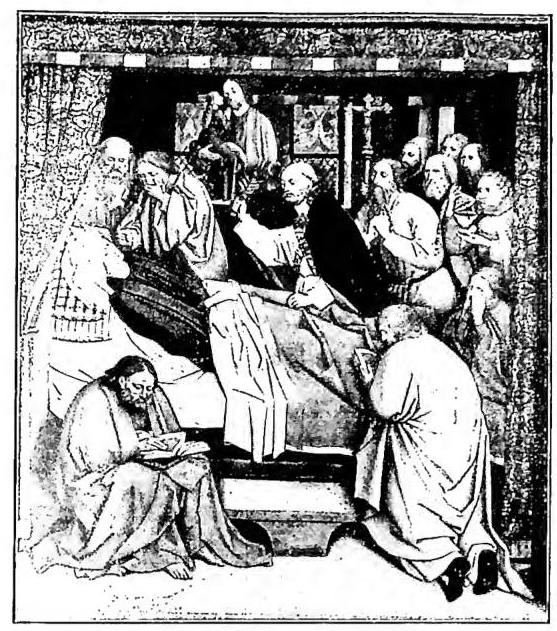
HANS MULTSCHEER. — Sculptor and painter, born shortly before 1400 in Reichenhofen in the Allgäu, died in the early months of 1467 in Ulm. Having moved to the latter city, he participated in the construction of the Cathedral and the Town Hall.
His most notable work is the high altar of the parish church of Vipiteno, completed and inaugurated in 1458–59, unfortunately dismantled and partially destroyed in the Baroque period. Its reconstruction was attempted by Bossert, and four curtain-holding angels, two crown-holding angels, the statue of the Virgin, four saints besides St. George and St. Florian, and four large painted panels are preserved. Other important sculptures include the altar or *Ecce Homo* of the western portal (Ulm monastery [c. 1430–35]), the relief with Emperor Charles the Fat and his retinue (Town Hall of the same city); the model for the tomb of Louis the Bearded (National Museum in Munich); numerous wooden statues, such as the *Crucifix* (cloister of Wiblingen), the *Virgin in Majesty* (Klosterswald), the *Mary Magdalene* (Germanic Museum in Berlin), the altar of Wurzbach, with statues and paintings.
A man of profound artistic culture, M., though living in the late Gothic period, fully renewed its ideals, establishing himself as the founder of Swabian monumental realism and presenting himself as the foremost representative of local art. His personal contribution lies in the harmony between the geometrization of masses and the naturalism carried even to extremes, particularly in the study of anatomical structures.