
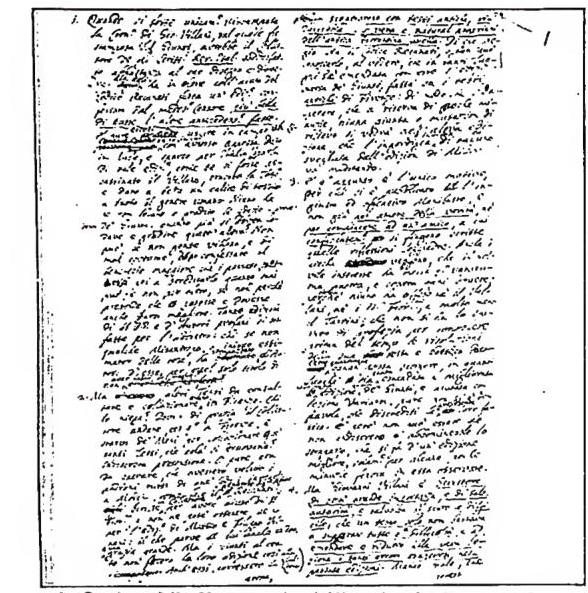
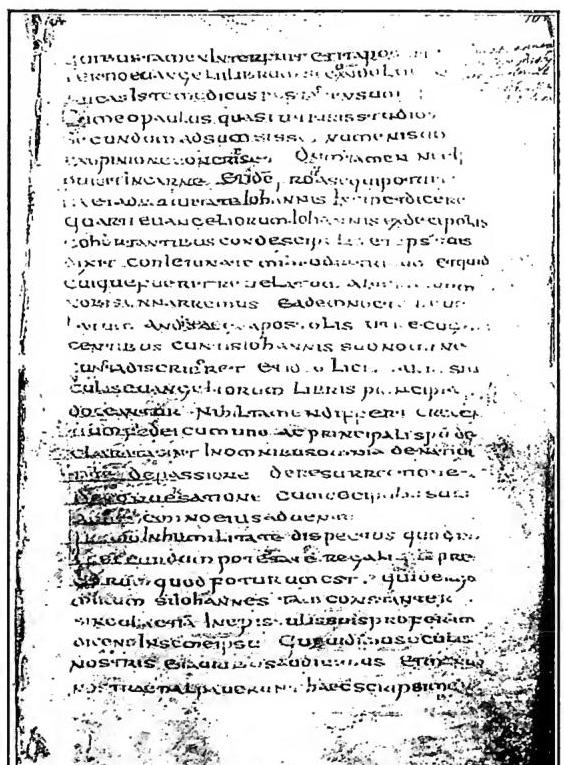
MURATORIAN CANON. - A fragment discovered by L. A. Muratori in an eighth-century Latin codex from Bobbio, preserved in the Ambrosian Library in Milan (I 101 sup.), and published by him in *Antiquitates Italicae Medii Aevi* (III, Milan 1740, pp. 851-54). It contains a list of the books of the New Testament (see Bible). The opening lines, now lost, must have dealt with the Gospels of Matthew and Mark. The fragment then provides information on Luke (referred to as the third Gospel), John, the Acts, the Epistles to the Corinthians I-II, Ephesians, Philippians, Colossians, Galatians, Thessalonians I-II, Romans, Philemon, Titus, Timothy I-II, Jude, John I-II (III?), Revelation, and Peter I (?). The Epistle to the Hebrews, the Epistle of James, and 2 Peter are missing.
The fragment permits the private reading of the *Shepherd of Hermas*, of which it says: *«Nuperrime, temporibus nostris, in Urbe Roma Herma conscripsit, sedente cathedra urbis Romae Ecclesiae Pio episcopo fratre eius»* (lines 74-76). From this chronological reference, it follows that the document was written toward the end of the second century A.D., probably in Rome (called simply *«urbe»* in lines 35-36) or its vicinity (P. Baffi, O. Bardenhewer, R. Cornely-A. Merk, P. H. Höpf-B. Gut). However, this does not imply that it is an official document of the Roman Church, as A. Harnack believes. According to many scholars (J.-B. Lighthoet, T. H. Robinson, Th. Zahn, S. Ritter, M.-J. Lagrange, etc.), its author would be St. Hippolytus of Rome (see), while others (L. A. Muratori) propose Caius Romanus. Other suggestions include Melito of Sardis (v. Bartlet), Polycrates of Ephesus (G. Kuhn), or Clement of Alexandria (J. Chapman). C. Erbes (*Die Zeit des Muratorischen Fragmentes*, in *Zeitschrift für Kirchengeschichte*, 35 [1914], pp. 331-62) argues that its author was the anti-Gnostic Rhodon (c. 220), mentioned by Eusebius (*Hist. eccl.*, V. 13: PG 20, 460 sg.).
The original language would have been Greek, according to A. Hilgenfeld, S. P. Tregelles, Th. Zahn, M. Schanz, and A. Merk.