
NABONEDUS (Babylonian "Nabū-nā'id = 'Nabū is exalted'") — The last king of Babylon, whose reign (556–539 BC) tragically concluded the nearly century-old history of the Neo-Babylonian Empire and the millennia-long dominance of the Semitic-Akkadian peoples in the Near East.
Relatively numerous are the cuneiform inscriptions concerning him and his reign: among others, one on a foundation inscription and the much-debated one dealing with his mother, a priestess of the god Sin at Haran, in the temple E-ḥul-ḥul, which greatly influenced his piety. However, the inscriptions narrating the history of his reign are openly partisan, composed by the priests of Marduk and by Cyrus, who in 539 BC entered Babylon to tumultuous applause. Moreover, Greek sources are difficult to use. Serious exegetical problems arise when attempting to apply passages from the Book of Daniel to NABONEDUS.
The figure of NABONEDUS has been distorted, even by modern historians, in encyclopedias and textbooks. According to these, he was a distracted scholar indifferent to the duties of kingship, an archaeologist, a strange leader obsessed with the idea of promoting the cult of the Moon, and, for some unknown whim, absent from Babylon for years, vacationing in the oasis of Tejmāʾ in Arabia. Recent studies, particularly that of R. P. Dougherty, have restored a truer image of him. NABONEDUS was the son of a noble prince of Babylon, "Nabū-balātsu-iqbi," with some likelihood of Aramaic descent, and of the aforementioned priestess (whose name is unknown), who also had Aramaic connections. From this priestess, NABONEDUS received a scientific and religious education superior to that of Nebuchadnezzar and inherited a deep devotion to the god Sin. This was joined in him by a keen historical sense, which was not foreign to other Neo-Babylonian kings. Deeply religious in spirit, NABONEDUS perceived the inferiority of the aging religion of his empire compared to the new Yahwism and the Iranian religion, one monotheistic and the other at least tending toward monotheism. Thus, a reform program matured within him: to restore the most ancient, most original phase of Mesopotamian religion, namely the evolved Sin, the Sumerian name of the Moon god. Statues, rituals, and even temples themselves had to be reformed according to more ancient models or plans. This explains his interest in archaeology and his esteem for dreams and visions. Yet he was not an ahistorical reformer, unlike Akhenaten (see AMENOPHIS IV), with whom he shared a similar fate: the hostility of a powerful priestly party, being regarded in part as "heretical" and "evil-doer," and the cruel *damnatio memoriae*. His historical sense also led him to engage in political affairs. He understood the inherent problem of the Neo-Babylonian Empire: externally, the unstable tetrarchy of Media, Babylon, Lydia, and Egypt, inherently fragile and liable to fall at any moment before the well-trained Median troops; internally, the continuous rivalry among the various elements of the Neo-Babylonian state—Chaldeans, Arameans, Babylonians—and especially the different clienteles of the temples. Moreover, he lacked the physical vigor, fresh blood, and martial spirit of the Medes.
It may be considered that NABONEDUS was born around 610 BC. The account by Herodotus may hold some truth: the Cilician Siennesian and NABONEDUS are said to have demonstrated their political skill in negotiating a peace treaty between Ištumegu (Astyages) of Media and Alyattes of Lydia in 585 BC, establishing the famous Halys frontier. Thus, the document published in the north, which records their involvement, would not be surprising.
---
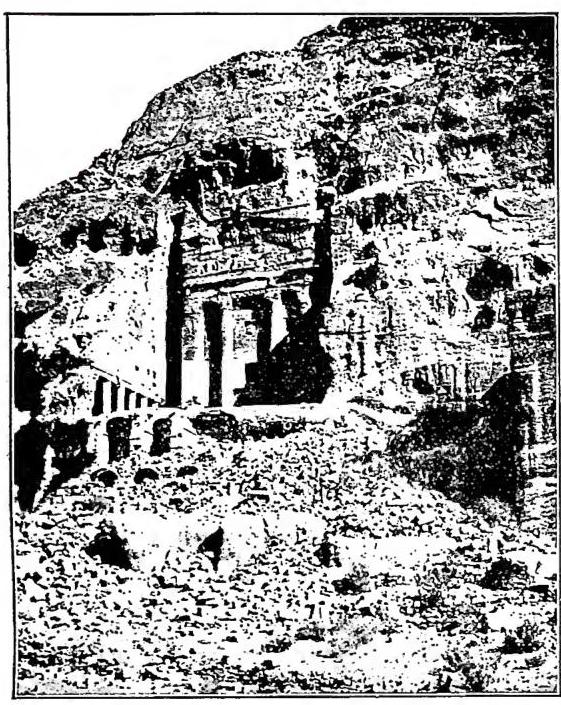
NABATEANS — Roman tombs in the valley of Petra.
Descendants of the Edomites, who, expelled from their lands by the Jewish Maccabees, invaded the Edomite region and took refuge in Petra, which became their capital.
Having achieved independence, by 312 BC they were strong enough to resist two expeditions by Antigonus, king of Syria. The center of their trade was the city of el-Ḥijr (Madāʾin Ṣāliḥ), rich in rock-cut monuments adorned with Nabataean inscriptions and where the routes from the Persian Gulf, Yemen, and the Red Sea converged. From there, caravans supplied the depots of Petra, from which goods were distributed via Gaza, both to Egypt, Greece, Italy, and the ports of Syria. The power of their kingdom grew as that of the Seleucids and Ptolemies declined, and at the height of their development they dominated from the Gulf of Elath to Damascus. In their well-organized and populous territory, they restored all the roads of Transjordan, equipping them with forts and guard posts to protect trade and also to levy taxes on goods. They extended the boundaries of cultivable land into the desert through judicious irrigation and the construction of cisterns, dams, and aqueducts.
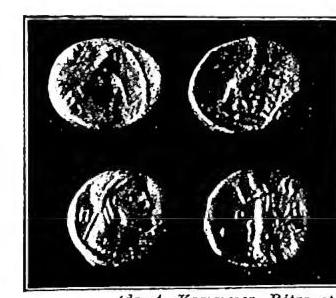
In addition to the accounts of classical writers (Diodorus Siculus, 19, 94; Strabo, 16, 4), the civilization of the NABATEANS is known from coins, important for establishing the chronology of their kings, and from numerous inscriptions written in Aramaic but full of Arabisms, so much so that Roman writers regarded them as Arabs. The kingdom fell under the new political organization of the East established by Trajan, who destroyed it in 106 AD, reducing it to a province under the name of Arabia. Many rock-cut monuments and temples remain in various locations in Transjordan: ʿAbde (see), Hjirbet Tannūr, Petra, Kerak, Qasr Rabbah, ʿAjneh. Their national god was Dushara, with the goddess Allāt as his consort. Little is known of their civil and military organization.
from Dougherty, according to whom his son Belshazzar (see BALTASSAR) was "a principal officer of the king," prepared to participate in the kingdom of his father almost from the beginning, as indeed happened.
The account of the revolution of 556 is incomplete due to the loss of three precious lines. Labâti-Marduk, the underage son of Neriglissar, was then killed, and N. was acclaimed by all. However, N. was conscious of his usurpation, insisting that his rival had been destined for the throne «against the will of the gods» and considering himself as the «representative» of Nabuchodonosor and Neriglissar in the Kingdom. Immediately after his accession to the throne, N. made an expedition to the west, as far as Gaza in Palestine, establishing himself throughout the vast territory of the Empire, which had not yet diminished. In the third year he received a vision of Sîn, who encouraged him to conquer Haran, then in the possession of the Medes, and to rebuild the famous temple of Sîn in that city. To his concerns the vision replied that three years later the King of Media would be defeated by a «his little servant», the King of Ansan. Then, following the example of Nabopalassar and Cyaxares, N. formed an alliance with Cyrus, king of Persia, occupied Haran and rebuilt the famous temple in a very short time. Cyrus, however, king of Persia, succeeded in conquering Hangmatana in 550, and Media was incorporated into his Empire, in a favorable position. N. was alarmed by such an international imbalance and formed an alliance with Cyrus of Lydia and with Egypt. Wishing to extend his Kingdom and establish a counterbalance to Cyrus’ fierce soldiers, he turned towards Arabia, where he established himself at Tejmâ, a point controlling many caravan routes since the northern and eastern routes were blocked by the now hostile Media; he also controlled the eastern coast of the Red Sea. Some mystery remains regarding the complex reasons for his prolonged absence, at least from the seventh to the eleventh year of his reign. The situation became even more disastrous when Cyrus, relying on the oracle of the Pythia of Delphi, crossed the Halys, and when, through Cyrus’ unexpected march on Sardis, he lost his Empire and his life in 546. Haran seems to have been lost even earlier, for N.’s mother died in the army camp in the ninth year of his reign.
The final hour of the Neo-Babylonian Empire had then struck. N., no longer content that Balthasar should reign in Babylon with the bulk of the army, returned. But Cyrus succeeded in winning over the powerful governor of Gutium, Gubaru, and in preparing the conquest from within with his partisans, the priests of Marduk. The Jews were also conspiring, feeling themselves oppressed by N.’s religious reforms. Remembering, moreover, the massacres of the Medes, who destroyed so many statues of deities, N. gathered in Babylon all the statues from the threatened provinces, another reason for propaganda against him by the aggrieved priests. The decisive war of 540-539 ended quickly: Cyrus, having forced the fortifications of Opis, took Sippar. Then the way was open for the city of Babylon, into which Gubaru entered without battle. N. fled but was captured and, most likely, executed along with his son Balthasar.
N.’s memory was systematically obscured by the victors. Yet, despite this sad fate, N. remained an attractive figure, and the Babylonian usurpers, at the accession of Darius, called themselves «sons of Nabuchodonosor and of N.».
E. Dhomme, *Le mère de N.*, in *Rev. d’assyriol.*, 41 (1947), pp. 1-21 (*Recueil E. Dhomme*, Paris 1951, pp. 325-50). Pietro Nober