
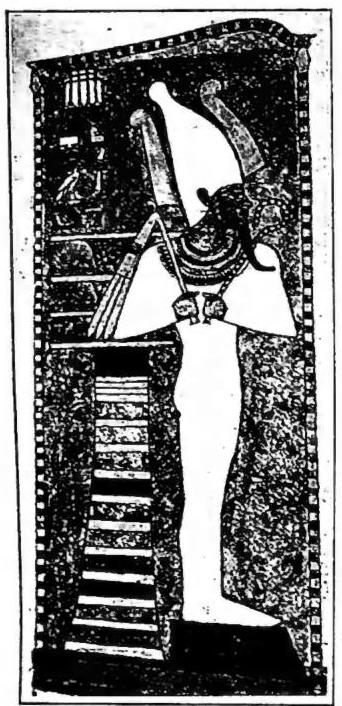
OSIRIS (Osiris; Egyp. Wýr; Gr. Ὄσιρις). A divinity of primary importance in the Egyptian pantheon, revealing multiple and complex aspects. Originally, he was almost certainly an ancient deified king whose cult replaced that of the local god of Busiris, a city in the Delta. The tradition of Osiris’s violent death gave rise to two of his most characteristic aspects: one as a deity of the dead, the other as an agrarian deity.
The first aspect is linked to the well-known legend (cf. HORUS; ISIS) of his treacherous murder by his brother Seth and his subsequent resurrection in the afterlife, where he eternally reigns over the dead and presides over the judgment of their souls (cf. BOOK OF THE DEAD). From the Middle Kingdom until the end of pharaonic civilization, the preeminence of Osiris over all other netherworld deities is consistently documented in funerary texts. Osiris was invoked with the epithet Wm-nfr (Gr. Ὄνουφρις), “the most beautiful Being,” i.e., eternally incorrupt; another frequent title was “Lord of the West,” that is, of the underworld, which the sun illuminated each night with a path opposite to its diurnal course. The possession of a tomb, a cenotaph, or at least a stele in the great necropolis of Abydos—Osiris’s ancient sacred city, where a reliquary containing his head was preserved—was considered a guarantee and pledge of a happy afterlife. In the same city, the annual “Mysteries of Osiris” were celebrated to commemorate his death and resurrection.
The agrarian aspect of Osiris is also connected to a passage in the legend, since the immersion of his corpse in the Nile was linked to the annual beneficial inundation. Thus Osiris, “the new water of the Nile,” determines the periodic renewal of vegetative life. Significant in this regard is the rite in which barley was made to sprout from an earthen model image of Osiris. The character of Osiris as a cosmic and celestial deity is the result of the speculations of the Heliopolitan theologians, who felt compelled to integrate Osiris into their universal system due to the god’s ever-growing popularity. At times, Osiris appears identified with the moon, since the phases of the lunar cycle were associated with the murder of the god by Seth and his subsequent rebirth.
Iconographically, Osiris is represented in mummiform, tightly wrapped in bandages, sometimes stylized into an actual garment that leaves only the hands and head free—a clear allusion to the embalming of the corpse performed by Anubis. His other attributes—a flail and scepter flanked by two ostrich feathers—are connected to his kingship. His flesh is green, a symbol of eternal youth.
At Busiris, the emblem of Osiris consisted of a kind of pillar (gd) of uncertain derivation.