
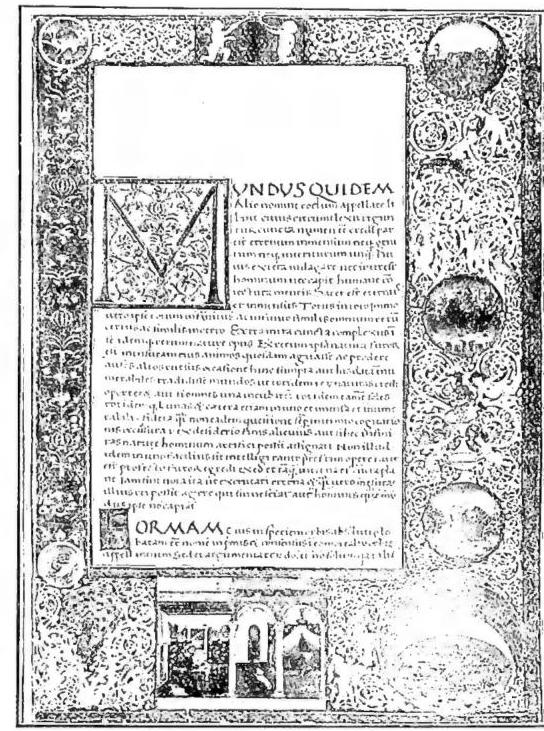
PLINY THE ELDER (Gaius Plinius Secundus). — Scholar, born in Como in 23 AD, died near Misenum on the 24th of August 79 AD during the eruption of Vesuvius that buried Stabiae, Herculaneum, and Pompeii. He studied in Rome at the school of the rhetorician and tragedian Pomponius Secundus, fought in Germany, held various positions in public administration, and was ultimately prefect of the fleet at Misenum.
A typical representative of the Flavian age, he was averse to political strife, a devoted official to authority, and a spirit enamored of erudition. He wrote on the most varied subjects: military technique (*De iaculatione equestri*), rhetoric (*Studiosi libri* III and *Dubii sermonis libri* VIII), history (*De vita Pomponii Secundi* [his teacher]; *Bellorum Germaniae libri* XX and *A fine Aufidii Bassi libri* XXXI [an work that connects to the lost one of Aufidius Bassus, perhaps from the end of Tiberius' reign until at least 71 AD]; but his most important work, and the only one preserved, is the *Naturalis historia*, dedicated to the emperor Titus, published in 36 books in 77 AD and then republished posthumously by his nephew Pliny the Younger in 37 books (this is the edition transmitted to us). It is an immense apparatus of information, drawn, according to Pliny himself, from 2,000 volumes (scrolls, i.e., books: the works would have been just over a hundred), by a hundred different authors (Pliny, however, cites about 500, evidently second-hand): it treats cosmography and astronomy (Books I-II), geography (Books III-IV), anthropology (Book VII), zoology (Books VIII-IX), botany (Books XII-XIX), medicine (Books XX-XXXII), mineralogy and the figurative arts in relation to the materials they use (Books XXXIII-XXXVII).
Pliny excels his predecessors (Cato, Varro, Cornelius Celsus) in the mass of material collected, but lacks organic systematization: in him there is the curiosity of the scholar, not the genius of the thinker (indeed, different doctrines converge in him without blending), so that his work, far from the powerful synthesis of Aristotle’s encyclopedia, is valuable essentially as a source of information, even if one cannot deny the author a certain personality, especially of style. Despite his professed disdain for transcendence, the *Naturalis historia* exerted, more or less directly, a very broad influence on ancient culture from Solinus (late 3rd century) to the anonymous author of the so-called *Medicina Plinii* (4th century), and throughout the Middle Ages, perhaps on Cassiodorus (v.), certainly on Isidore of Seville (v.) and on the various *Tesori* of the following centuries.