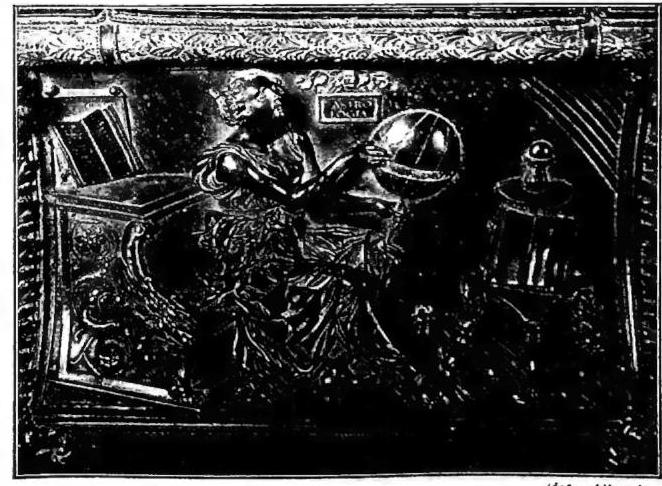
ANTONIO POLLAIUOLO, called del Pollaiuolo (Antonio di Jacopo BENCI) — Painter, sculptor, goldsmith, architect; born in Florence ca. 1431 (according to others 1426, 1429, or 1433), died in Rome, where he is buried in S. Pietro in Vincoli, on 4 February 1498. He was considered by his contemporaries to be among the greatest artists.
Most likely his earliest training took place in the workshop of a goldsmith; the goldsmith’s character, more or less vividly, echoes in all his works. The connections with goldsmiths such as Sali and Finiguerra (to whom he often supplied designs for nielli), and the very fact that Antonio maintained a goldsmith’s workshop in via Vacchereccia for a longer period, confirm this. On the other hand, technically they are works of goldsmithing: the silver cross for S. Giovanni (Florence, Museo dell’Opera del Duomo), to which P. contributed, together with Betto di Francesco Betti and Miliano Dei (1475); and, later (1478), the silver altarpiece where he executed the Nativity of the Baptist, also for S. Giovanni (now in the aforementioned museum), a work divided among Verrocchio, Antonio di Salvi, Francesco di Giovanni, and Bernardo di Cenni. This activity, with the goldsmith’s sensitivity in the incisive precision of the expressive medium that is line, does not conflict with, but rather contributes to, the development of Antonio’s plastic language.
As a painter, in 1460 he executed three large canvases depicting the Labors of Hercules for Piero de’ Medici, now lost. At the same time and afterward (1466), he supplied designs for the cathedral vestments (the famous embroideries, now in the Museo dell’Opera). Other goldsmith works are recorded in documents between 1460 and 1465. The fresco decoration of the chapel of the Cardinal of Portugal in S. Miniato began in October 1467. Alongside Antonio worked also Baldovinetti. At the beginning of that year, together with Verrocchio and Luca della Robbia, P. was part of the commission charged with placing the ball on the lantern of the dome of S. Maria del Fiore.