POMPEII (Gr. Πομπηία). - Situated on the great coastal road from Naples toward southern Italy, it was founded by Oscan peoples of Campania near the lower valley of the Sarno. At first it was under the hegemony of the Greeks, who dominated the region from Cumae to the Punta della Campanella and who prevailed in political influence over the area.
Toward the end of the 5th century B.C., the Samnites subdued it and impressed upon it their Italic character. During the Hannibalic War, Pompeii remained neutral between Rome and Carthage, but in the Social War it took the side of the Italians against Rome and was subdued by Sulla and reduced to a Roman colony, with the title Colonia Cornelia Veneria Pompeianorum, without, however, losing its old regional spirit. In A.D. 63 it was seriously damaged by an earthquake (Tacitus, Annals, XV-XXII) and in 79 it was destroyed by the eruption of Vesuvius, described by Pliny the Younger (Epist., VI, 16, 20), who recounts the death of his uncle Pliny the Elder. The city was buried under a mass of ash and lapilli to a height of four to five meters. Its economic and maritime function was inherited by Stabiae and in modern times by Torre Annunziata. Archaeological excavations, begun in 1748 under King Charles of Bourbon, received a great impetus in the first half of the 19th century and a rational organization from 1860 onward under the direction of Giuseppe Fiorelli and his successors, the last of whom, Amedeo Maiuri, is responsible for the present revival of the ancient city’s appearance and the most recent and complete description of II.
P. AND THE CHRISTIANS. - The question of Christianity in Pompeii has often been debated, not in the sense that there were Christians there at the time of its catastrophe, but whether any monumental traces of them have come down to us. Indeed, it would be difficult to doubt that by A.D. 79 Pompeii already hosted a certain number of Christians. St. Paul landed in the early months of A.D. 60 at Puteoli and found there a community of Christians, with whom he stayed about a week (Acts 28:14). This means that the new faith spread very quickly to the towns of the Neapolitan gulf, and thus also to Pompeii.
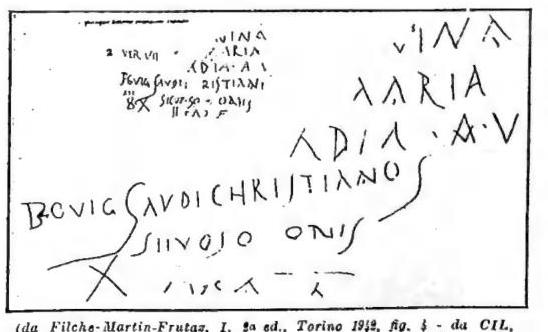
But has the excavation of the city buried by Vesuvius yielded any tangible evidence of the existence of these Christians? Many indications have been gathered in this regard, but they are so tenuous that they hardly withstand even moderately rigorous criticism. Greater significance seems to attach to a charcoal inscription seen on the wall of a large room situated along the street that runs beside the Stabian Baths and, unfortunately, vanished long ago, in which, even if one does not accept De Rossi’s reading _audì christianos saevos olores_, it is nonetheless difficult to deny that the name of the Christians was present.
Recently the question was revived by the discovery of three specimens of the famous _versus recurrens_ or cryptogram:
ROTAS
OPERA
TENET
AREPO
SATOR
which had hitherto been regarded as a work of Christians. Naturally, doubts began to be cast also on the Christian character of this word puzzle, and the question of Christians in Pompeii remained substantially at the same point.
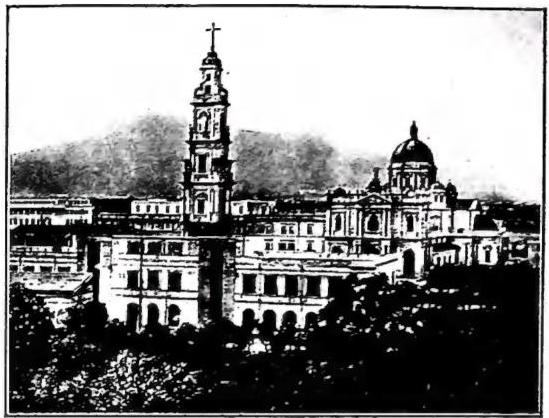
POMPEII, PRELATURE OF. - The Prelature of Pompeii is an ecclesiastical jurisdiction erected by Pope Pius X on May 8, 1901, with the Apostolic Constitution _Pompeii sacra_. It is a territorial prelature _nullius dioecesis*, with ordinary jurisdiction over the territory of the ancient city of Pompeii and the surrounding area. The prelates, who hold episcopal dignity, are assisted in the exercise of their duties by vicars general, appointed by the Sacred Consistorial Congregation. The first prelate was Msgr. Carlo Cremonesi, papal almoner and later cardinal. The care of the basilica was initially entrusted to the Dominicans, then from 1934 to the Redemptorists, with the assistance of the secular clergy, who have recently taken over its direction, while the Redemptorists remain as Penitentiaries.