
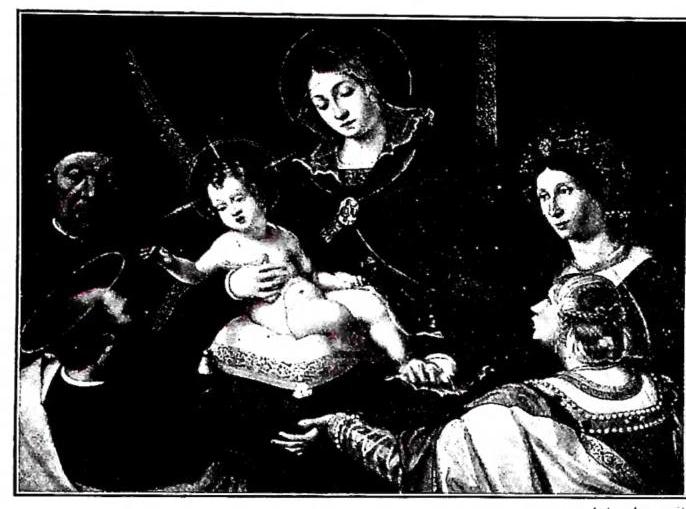
In numerous works he signs himself “disciple of Giovanni Bellini,” but his temperament as an easy and rapid assimilator led him to be associated from time to time with various other artists: in his youthful period, the happiest, with Cima and Carpaccio, from whom he took a clarity of plastic structure and a freshness and luminosity of colour that are among the chief merits of his works. To these years belong a *Madonna with Donor* of 1502 (Civic Museum of Padua), a *Sacra Conversazione* in Berlin, a *Marriage of St Catherine* in the National Gallery in London (another very similar one in S. Giobbe in Venice) and the beautiful *Annunciation* of the Sanctuary of Mesch’io (Vittorio Veneto), whose luminous landscape confirms the attraction felt by Previtali for the pastoral scenes of the National Gallery, once thought to be by Giorgione. From 1510 until his death Previtali was in Bergamo, where he was very strongly influenced by Lotto, who had settled in that city shortly after him. Works of this period include the *Baptist and Other Saints* in the church of S. Spirito (1515), still akin to the Bellinesques, such as Catena and Basaiti, the *Madonna with the Casotti Family* in the Carrara Academy, decidedly Lottesque, rich in colour but with an unpleasant pomposity of form that is found again, increased, in later works: the *Crucifixion* of 1523, in S. Alessandro della Croce, the *St Benedict and Saints* in the Cathedral (1521). Other works: a youthful *St Sebastian* in Aix (Longhi), the *Trinity* of Alzano Maggiore (1517), etc.
PREVITALI, ANDREA, DETTO ANCHE CORDEGLAGHI
BIBL.: G. B. Cavalcaselle, *A history of painting in North Italy*, ed. Borenius, I, London 1912, pp. 267-87; Venturi, VII, IV, pp. 592-95; A. Scrinzi, A. P., in *Emporium*, 54 (1921), p. 93; S. G. Fiocco, s.V. in Thieme-Becker, XXVII, p. 389; R. Longhi, *Un dipinto giovanile del P.*, in *Arte veneta*, 1947, p. 190.