
RELIQUARY. — The current term for the object chosen to contain relics; but from antiquity onward it has exhibited a great variety of names according to its form.
The most common names found in texts are: *reliquiarum*, *vas*, *vasculum*, *buxis*, *theca*, *lipsanotheca*, *hierotheca*, *staurotheca*, *philacterium*, *chrismarium*, *conditorium*, *conservatorium*, *custodia*, *gestatorium*, *sanctimonium*, *repositorium*, *jocale*, *phiala*, *ampulla*, *acerra*, *arca*, *cista*, *coffrus*, *coffinus*, *ladula*, *scrinium*, *locus*, *loculus*, *sarcophagus*, *sepulcrum*, *tumba*, *grypha*, *feretrum*, *capsa*, *capsela*, *capsula*, *scatula*, *trucha*, *domus*, *castrum*.
The materials used in making reliquaries are extremely varied. Already St Jerome speaks of relics contained in a precious little vessel wrapped in linen (*Contra Vigilantium*, 4: PL 23, 357); from early times there have been reliquaries in gold (Lib. Pont., I, pp. 179, 261, 374; Martin of Tours, *De gloria martyrum*, 11: PL 71, 716, etc.), in silver (De miraculis s. Stephani, I, 8: PL 41, 839; G. B. D. Rossi, *La capsela reliquiaria argentea africana*, Rome 1888), then in bronze, copper, lead, crystal, stone, clay, glass, bone, ivory, wood; in silk, brocade, mud.
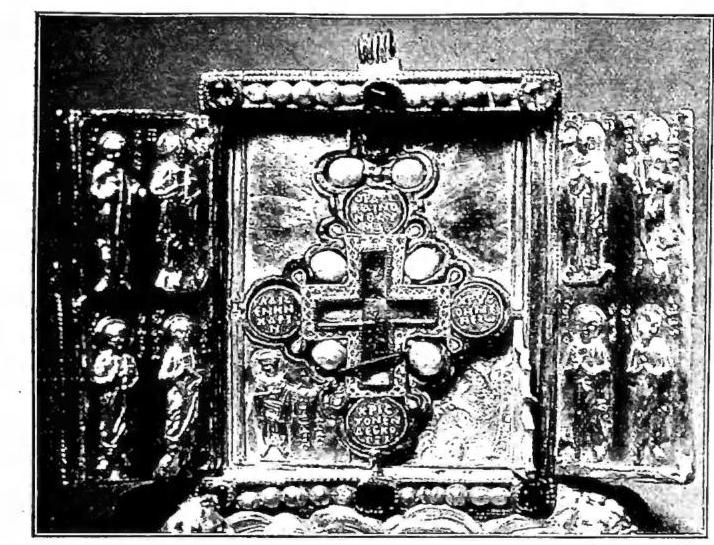
These reliquaries were used to enclose particles of the Holy Cross or earth from the Holy Places or to hold relics *ex ossibus* or those that had touched holy martyrs; they were placed beneath altars, as shown by those found in the ancient churches of Roman Africa (many reproduced in P. Monceaux, *Enquête sur l'épigraphie chrétienne d'Afrique*, Paris 1907, nos. 262, 275–78, 280–84, 321), while others were exposed for veneration. Among the latter, the most notable ancient group is represented by the treasury of relics collected by the popes in the chapel of the deacon-martyr St Lawrence in the Lateran patriarchate, now in the Museo Sacro of the Vatican Library. These relics were kept in a cypress chest bearing the inscription: “Leo indignus tertius episcopus, Dei famulus, fecit (795–817)”; at the time of Innocent III the words *Sancta Sanctorum* were added. It contained relics of the Holy Cross, such as the gold-enameled cross discovered in the time of Pope Sergius I (687–701) and its historiated case, a jeweled cross, a wooden cross with silver cases made under Paschal I (817–24); likewise silver shrines containing one the head of St Agnes and the other that of St Praxedes with their respective cases; caskets of copper, brass, cedar wood, ivory chapels, silk bags, crystal vases, glass ampullae, wooden pyxes in color. All this was illustrated by H. Grisar (*Il Sancta Sanctorum ed il suo tesoro sacro*, Rome 1907).
Also noteworthy are the silver chapels of the 5th–6th centuries discovered in 1871 in the foundations of the high altar in the cathedral of Grado (G. B. De Rossi, *Le insigni capsela reliquiaria scoperte in Grado*, in *Bull. arch. crist.*, 2nd ser., 3 [1872], pp. 155–58 and pls. 10–12; 3rd ser., 3 [1878], pp. 49–52; P. L. Zovatto, *La capsela argentea di Grado con le immagini clipeate*, in *Aquileia nostra*, 23 [1952], cols. 17–26) and the reliquaries of the Treasury of St-Maurice d’Agaune (M. Besson, *Antiquités du Valais [V.–Xᵉ siècle]*, Fribourg 1910; V. AGAUNO).
In the Romanesque period reliquaries assumed the form of the relic they housed: shaped like a head with precious stones for eyes, a firm and striking modeling (the reliquary head of Pope St Alexander by the goldsmith Godefroid de Huy, Brussels, Musées royaux d’art et d’histoire), or like an arm (Messina, Cathedral, reliquary of St Marziano), or a rib (Namur, monastery of Notre-Dame, reliquary of the rib of St Peter made by Hugo d’Oignies, 1228). At this time there were also casket reliquaries in the form of a coffer with rich champlevé enamel decoration on figural motifs, such as that of St Servais at Maastricht (11th–12th c.) of Mosan workmanship or the Limousin examples (Agrigento, Cathedral; Aosta, parish church of Villanova Baltea [reproduced at V. LIMOGES]; Florence, Bargello). Various forms of reliquary can be seen in the Treasury of the basilica of St Francis of Assisi, including the famous reliquary of the saint’s habit and that of his sandals and the veil of the Virgin in the cathedral of Padua, one of which is of grand proportions with Gothic spires, as was much favored in Spain and Sicily after the example set by Juan de Arpha. During the same Gothic period the use continued of bust reliquaries in silver and gilded silver, often with richly ornamented bases with enamels (Florence, Duomo, reliquary of St Zanobi; Gorizia, Duomo, reliquary of St Hermagoras), often with enamel applied to the cheeks for realistic effect, as the famous goldsmith Giovanni di Bartolo did for the bust reliquary of St Agatha, the only one remaining, in the cathedral of Agrigento, the other two for the Lateran Basilica having been lost.
Yet in the Gothic period a constant type of reliquary emerged, also used for the exposition of the Eucharist, composed of three elements: a base with a lobed contour, often decorated with enamels, a shaft interrupted by a hexagonal knot, and the reliquary proper, in which a chapel housed the relic. The artists’ imagination added motifs of adoring angels, softening the verticalism of the ascending line with the horizontal cut of their outstretched wings (Pistoia, Duomo, gilded-silver reliquary; Monreale, S. Martino delle Scale, reliquary of St Gregory, etc.), or within niches, statuettes of saints, giving the arches pointed or heart-shaped forms according to Catalan fashion; this occurred in Italy in the workshops of Sardinia (Cagliari, church of St James) and Sicily (Castelbuono, Cathedral), later gradually adopting Renaissance forms (Florence, S. Maria del Fiore, reliquary by the goldsmith Salvi; Spoleto, reliquary of St Eutychius).
Some examples in gilded silver or chased gold, decorated with enamels, can be seen in the cathedral of Cosenza, the Bargello, and the Accademia in Venice (the famous reliquary of the Holy Cross at S. Martino delle Scale, Monreale); at other times they took the form of a double cross with filigree and fleur-de-lys terminals, as in French examples, which were also produced in Italy.
During the Baroque period relics multiplied and every church possessed an extraordinary number of reliquaries executed in gilded and carved wood, and bust reliquaries followed the fortunes of sculpture with soft and lively modeling of garments and hair. Entire chapels were adorned with reliquaries of every shape—caskets with spires, busts, palm-leaf forms—arranged in various orders so as to cover entire walls (Veroli, Duomo). In the following century, the 19th, this fervor for reliquaries abated, and when new ones were commissioned their form tended to imitate that of monstrances, incorporating the new Neoclassical and Romantic decorative repertories.
— See plates XXXVI–XXXVIII.