RELICS. – In Greek λειψανα. Etymologically, it refers to what remains, understood as the human body or part of it; in a broader sense, objects that have been in contact with a person are also called relics because they have seemingly absorbed some of his outstanding virtues.
I. CULT OF RELICS
From the earliest times, the Church accepted and permitted the veneration of the relics of martyrs as a sign of Christian piety toward those brethren who had shed their blood for Christ. If the relic consists of the entire corpse, it is commonly called a *corpus*; if it is part of it, *ex ossibus*. Relics obtained by contact were termed by the ancients *brandea* (q.v.), *memoria* (q.v.), *nomina*, *pignora*, *sanctuaria*. The Church of Smyrna regarded the remains of its martyred bishop Polycarp as more precious than gold and resolved to celebrate the anniversary at his tomb (Martyrium Polycarpi, 18, 1, 2). In the second half of the 2nd century, the presbyter Caius, refuting the Montanists, pointed to the trophies, i.e., the tombs of Peter (q.v.) and Paul, on the Vatican and the Ostian roads (Eusebius, *Hist. ecc.*, II, 25), indicating that they were frequented, that is, venerated. From antiquity, the Church placed the altar above the tombs of martyrs. The Apocalypse speaks of “the souls of those slain for the word of God” beneath the altar (Rev 6:9), and St. Jerome exclaims: “Does the Roman bishop then act wrongly who offers sacrifices to the Lord upon the bones of Peter and Paul, which we venerate as holy, but which you regard as mere dust, and considers their tombs as altars of Christ?” (*Adv. Vigil.*, 8: PL 23, 361–62). Prudentius describes the table set up at the tomb of St. Hippolytus, though he notes that it is dedicated to God (*Peristephanon*, XI, vv. 169–74). St. Augustine, however, expresses the thought more clearly. Speaking of Bishop Theogenes, who occupied the see of Hippo in 255–56, he says: “But when we offer the Sacrifice at the tombs of the martyrs, is it not to God that we offer it? Doubtless the holy martyrs hold an honored place. Note this: in the readings before the altar of Christ, they are duly commemorated. Yet they are not worshipped in the place of Christ. Have you ever heard anyone at the memorial of St. Theogenes—whether from me, one of my brethren or fellow priests, or any priest at all—say: ‘I offer the Sacrifice to you, O St. Theogenes’? Or: ‘I offer the Sacrifice to you, O Peter’? Or: ‘I offer the Sacrifice to you, O Paul’? You have never heard such expressions, because they are not done and are not permitted” (*Sermo*, 273). In his treatise against Faustus, he repeats the same idea: “We erect altars not to the martyrs but to God. Which bishop would dare, in the presence of holy bodies, to say: ‘We offer to you, Peter or Paul or Cyprian’? What we offer is offered to God, who crowns the martyrs” (*Contra Faustum*, 20, 21: PL 42, 384). The basilica erected in Milan by St. Ambrose near the Porta Romana, called the Apostles’, bore the following dedication: “Ambrosius built the temple and consecrated it to the Lord in the name of the Apostles, by the gift of relics” (G. B. De Rossi, *Inscriptiones christianae*, II, 1, Rome 1888, pp. 161, 3; 177, 1). Paulinus notes that the basilica of St. Felix at Nola was dedicated “in the name of the Lord Jesus Christ God” (*Ep.*, 32, 10, ed. CSEL, XXIX p. 286). St. John Chrysostom affirms that the tombs of the servants of the Crucified are more resplendent than palaces—not only for the grandeur and splendor of their construction, which surpass them, but, more importantly, for the fervor of the devout who frequent them (*In ep. II ad Cor. hom.*, 26, 5: PG 61, 582). All these buildings erected over the tombs of martyrs may be called *basilicae* or *ecclesiae ad corpus*, that is, erected precisely on the spot.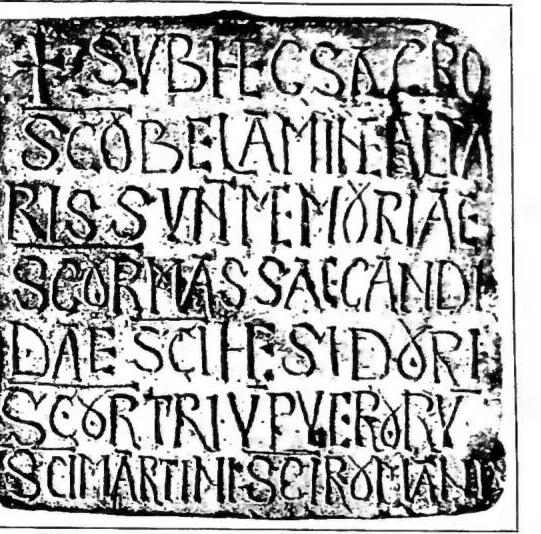
Reliquie – Lastra marmorea con iscrizione ricordante r. poste sotto l'altare a Calama (Africa) – Parigi, museo del Louvre.