
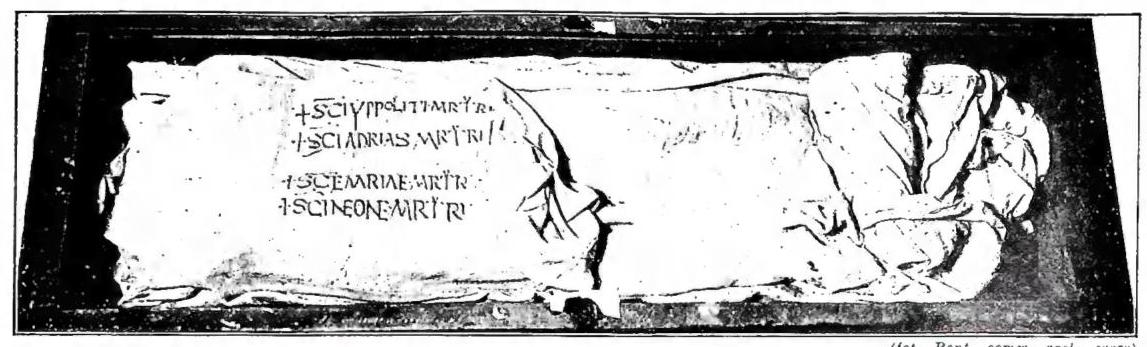
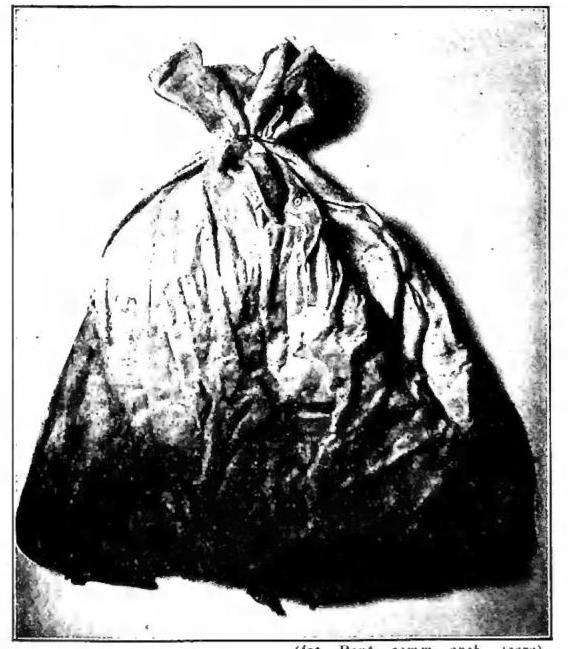
RELICS — Sack containing relics of the so-called Greek martyrs, with an inscription from the 8th–9th century, discovered in 1932 — Rome, church of S. Agata dei Goti.
of the sepulchre of the witness of Christ and therefore situated beyond the inhabited enclosure; the faithful even loved to be buried near them, and the basilicas were therefore cemeterial.
But sometimes the place of the martyr’s burial is not the original one, as occurs in several cases. Duchesne, Profumo, and many others accept the tradition of a translation in 258 of the relics of the apostles Peter and Paul to the Catacombs. The Liber Pontificalis attests that the bodies of Pope Pontian and of the learned priest Hippolytus, who died in exile in Sardinia, were brought back to Rome; indeed, the Depositio martyrum indicates their respective liturgical stations in the Catacomb of Callistus for the first, where his epitaph is found on the Via Tiburtina for the second. The bodies of the popes Cornelius and Lucius, who died in exile, were also translated to the Catacomb of Callistus, where G. B. De Rossi discovered their sepulchral inscriptions, the first in 1849 and 1852 and the second in 1854; later, the body of Pope St Eusebius, who died in exile, was brought from Sicily to the Catacomb of Callistus, as documented by Pope Damasus (A. Ferrua, *Epigrammata Damasiana*, Città del Vaticano 1942, pp. 129 ff., no. 18). In 555, likewise from Sicily, the remains of Pope Vigilius were brought to Rome in the catacomb of Priscilla; he had died at Syracuse while returning from Constantinople (Lib. Pont., I, p. 299). Moreover, Pope Damasus testifies to the translation carried out by a pious woman named Lucilla of the relics of the martyrs Marcellinus and Peter to the cemetery *inter duas lauros*; they had been cast into two pits that the executioner had caused the saints themselves to dig.
In Rome, Pope Damasus sought out and discovered many bodies of holy martyrs, adorned their sepulchres, and promoted their veneration (Lib. Pont., I, p. 212). He himself recalls the discovery of the relics of St Eutychius (A. Ferrua, *Epigrammata Damasiana*, cit., pp. 145 ff., no. 21). In the 5th century, the relics of St Quirinus, bishop, and of the Four Crowned Martyrs were translated from Pannonia to Rome to save them from the profanations of the barbarian invaders. In Rome, to avoid disturbing the martyr’s body in its sepulchre, Constantine built the basilica of St Lawrence outside the Walls above ground; sometimes architectural norms were sacrificed, as is seen in the basilica of St Alexander (v.) on the Via Nomentana, where the sepulchre and the altar from the beginning of the 5th century are not aligned with the building, just as occurred at St Pancras, where the martyr’s sepulchre, until the time of Pope Honorius I (625–38), lay *ex obliquo aulae* (G. B. De Rossi, *Inscriptiones Christianae*, cit., II, I, p. 24, no. 28). At Ravenna, too, the body of the martyred bishop St Apollinaris was placed within the basilica dedicated to him during the episcopate of Bishop Mauro (642–71). St Ambrose discovered in Milan the bodies of the martyrs Gervasius and Protasius and transferred them first to the basilica of Fausta and then to his own, the Ambrosian Basilica (Ep., 22, 2: PL 16, 1063).
The cult of relics led to the spread of the cult of the saints; the place where the relics were deposited was considered as the tomb, which led to the multiplication of shrines; moreover, the belief that objects placed in contact with the sepulchres of the saints became themselves like so many holy bodies greatly facilitated the possibility of obtaining relics, and these were especially sought for the dedication of churches. H. Grisar points out that the dedication
of churches to saints was often conditioned by the possession of relics. The practice of considering objects placed in contact with martyrs’ sepulchres as relics is already attested in the 4th century in Roman Africa and Gaul, particularly for basilicas erected in honour of SS Peter and Paul. In Africa, cloths and flowers placed near the martyrs’ tombs, earth, wax, fringes from altar cloths, fragments of wood taken from the doors of basilicas (St Augustine, *De civitate Dei*, 22, 8). St Gregory the Great wrote to the Empress Constantina, who had asked him for the head of St Paul or at least some other relic of his body, that “it is not the Roman custom, when giving relics of the saints, to presume to touch anything of the body. But only a brand is sent in a box and placed near the most sacred bodies of the saints. When this is lifted, it is reverently enclosed in the church that is to be dedicated, and such great virtues are thereby obtained there as if their bodies themselves were specially brought there” (*Registrum*, IV, 30, in *MGH, Epist.*, I, pp. 26–65). The same Pontiff sent *sanctuaria*, that is, cloths that had touched their relics, to Paul, bishop of Rieti, who had requested relics of the martyrs Hermes, Hyacinthus, and Maximus (Registr., IX, 49); he sent other *sanctuaria* to Constantius, bishop of Milan, who had asked for relics of St Paul, St Pancras, and St John (Registr., IX, 83). A great impetus to the veneration of relics came from the discovery of the Holy Cross, of which most venerable particles were diffused throughout the Christian world; from the identification of the places sanctified by the Redeemer in Palestine, from which pilgrims brought back as precious relics earth, stones, and oils that burned there; and again from the discovery of the bodies of martyrs, especially in the East and from the East.
An African inscription from the year 359 attests that the great native chieftain Alavius Nubel, formerly commander of the *equites armigeri iuniores*, had brought from Palestine to the church of Rusguniae, near Cape Matifou in Algeria, which he had built by vow, “de ligno crucis de terra promissionis ubi natus est Christus, apostoli Petri et Pauli” (CIL, VIII, 9255; P. Monceaux, *Enquête sur l’épigraphie*, cit., no. 317). The division of relics was such that Theodoret declares that in the basilicas not the entire body of a martyr is preserved, but only *quinquotatorum levavovocorè* — relics of little importance (Ep., 130); elsewhere he adds that the relics, though divided and dispersed in several places, retain their full efficacy; Gregory Nazianzen affirmed that a few drops of blood had the same efficacy as the entire body (Contra Iulianum, 1, 69; PG 35, 589). Paulinus of Nola likewise wrote that “magna est in exiguo sanctorum pulvis virtus” (Carm., 27, V. 447). Bishop Gaudentius of Brescia (d. c. 410) received a little of the blood found by St Ambrose in the sepulchre of the martyrs Gervasius and Protasius and declared: “we hold the blood which is a witness to their passion” (Sermo, XVII: PL 20, 693). The same prelate, after obtaining relics of St John the Baptist, the apostles Andrew and Thomas, the evangelist St Luke, the martyrs Gervasius, Protasius, Nazarus, Sisinnius, Martyrius, and Alexander, and the Forty Martyrs of Sebaste, erected a basilica which he called “the assembly of the saints” (PL 20, 959–71). At Rome, pieces of cloth that had touched the martyrs’ sepulchres were distributed, as were ampullae containing oils from the lamps burning (v. AMPOLLA; MONZA) at these tombs, keys of the gates placed to close the sepulchre of St Peter, and filings from the chains or the gridiron of St Lawrence. St Gregory of Tours reports that whoever managed to reach the sepulchre of St Peter would insert a piece of cloth there, which he then kept as a relic (In gloria martyrum, 28).
---
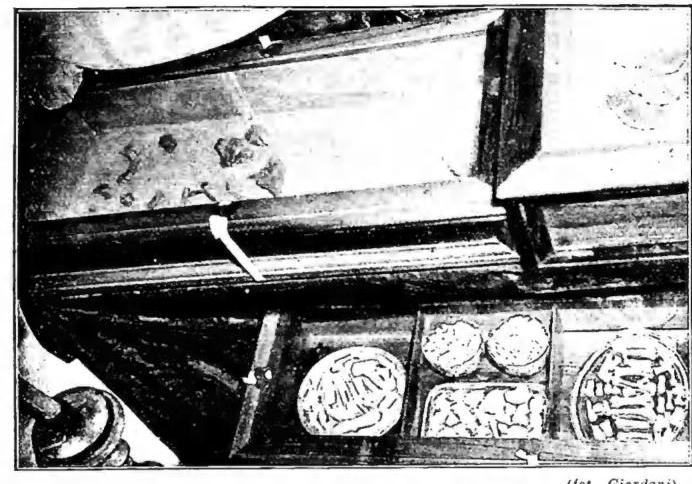
RELICS — Sack containing relics of the martyr Dominanda with the inscription “Sca Dominanda” (8th–9th century), discovered in 1932. The sack was sealed with virgin wax seals, still preserved — Rome, church of S. Agata dei Goti.
RELICS — Dominanda, the martyr of S. Agata dei Goti.
RELICS — Small strip of parchment, added in the 11th century to the large sack of relics in which was also the sachet of St Dominanda — Rome, church of S. Agata dei Goti.
The translation of relics — The practice of translating and distributing the relics of martyrs is of Greek origin; “secundum morem Graecorum” wrote in 519 Pope Hormisdas to Emperor Justinian (Hormisda epist., 77, in A. Thiel, Epistulae Pontificum Romanorum [Braunsberg 1868], pp. 873-75). Constantine himself, however, in the church dedicated to the Apostles in Constantinople, was content with cenotaphs (Eusebius, Vita Constantini, IV, 60, 13). The first recorded instance of the translation of relics is that of the relics of St. Babylas to Daphne near Antioch in the time of Caesar Gallus (351-54; Sozomen, Hist. eccl., V, 19; Gregory of Nazianzus, Contra Iulianum, I, 25; PG 35, 552; P. Franchi de' Cavalieri, In Note agiografiche, fasc. VII, pp. 147-48). This was followed in 356 by the translation of the relics of St. Timothy to Constantinople; in 357 those of the Apostle St. Andrew and the Evangelist St. Luke (A. Heisenberg, Grabeskirche und Apostelkirche, II, Leipzig 1908, p. 112); then that of the martyr St. Phocas (St. John Chrysostom: PG 50, 799); under Theodosius (379-95) those of Bishop Paul, who died in exile at Cucusus (BHG, 1172), and of the martyrs Terentius and Africanus (Theodore the Reader, Hist. eccl., II, 62; PG 86, 213), and the head of St. John the Baptist (Sozomen, Hist. eccl., VII, 21). Under Arcadius the body of the Prophet Samuel was brought to Constantinople (St. Jerome, Contra Vigilantium, 5; PL 23, 332). In 438, in the time of Theodosius II, the body of St. John Chrysostom (Socrates, Hist. eccl., VII, 45; Theodore, Hist. eccl., V, 36); under Leo I the body of St. Athanasius (Theodore the Reader, Hist. eccl., II, 64; PG 86, 216); and again in the 5th century the relics of St. Thyrsus (Sozomen, Hist. eccl., IX, 2). In 550, under Justinian, these sacred relics were brought into the basilica of Constantinople; the emperor wished that Patriarch Menas carry the reliquaries through the city on an imperial chariot adorned with precious stones (G. B. De Rossi, La cappella africana, Rome 1888, p. 32). The Martyrologium Hieronymianum records on September 3 the arrival of the relics of Andrew, Luke, and John, who together with John the Baptist were also in the basilica of Concordia (P. Paschini, Note sull'origine della chiesa di Concordia, in Memorie storiche forogiuliesi, 7 [1911], pp. 9-24). The relics of the martyr St. Euphemia of Chalcedon were translated to Milan, Nola, Aquileia, and Rouen. From the East came the relics of the Apostles Andrew, Thomas, and Luke, obtained by Bishops Gaudentius of Brescia, Victricius of Rouen, and Paulinus of Nola; the relics of SS. Andrew and Luke were brought to Fondi (St. Paulinus of Nola, Ep., 32: CSEL, XXIX, pp. 292-93). At Milan were the relics of Luke, Andrew, and John. Paulinus of Nola obtained for the basilica of St. Felix relics of St. John the Baptist (Carm., 27, V. 403). Relics of the same John came to Emesa from the anonymous pilgrim of Piacenza at the end of the 6th century (Itinera Hierosolymitana, ed. Geyer, in CSEL, 39, p. 120). It is unknown when the body of St. Ignatius of Antioch was brought back from Rome to his see, where St. Jerome saw it in 392 outside the Gate of Daphne (De viris illustribus, 16). In Constantinople translations were performed with great solemnity, attended by a multitude of the faithful, including the Emperor himself (St. John Chrysostom: PG 50, 799; Socrates, Hist. eccl., V, 9; Sozomen, Hist. eccl., VII, 10). For the translation of the relics of the Prophet Samuel, St. Jerome wrote that the crowd thronged without interruption from Palestine to Chalcedon (Contra Vigilantium, 5: PL 23, 358). St. Gregory of Nyssa attested to possessing part of the ashes of the Forty Martyrs of Sebaste and beside them deposited the bodies of his loved ones (Homilia in XL martyres: PG 46, 784). The relics of St. Babylas were returned to their original tomb at Antioch in 362 and again, a few years later, to the basilica erected by Bishop Meletius beyond the Orontes. Antioch received in 459 the relics of St. Simeon Stylites (H. Delehaye, Les saints stylites, Brussels 1923, pp. 33-34) and in 482 those of Bishop St. Eustathius (BHG, 644). At Caesarea in the time of St. Basil the relics of the martyr St. Saba were brought (St. Basil, Ep., 164-65: PG 32, 633-40); at Alexandria in 396 the relics of St. John the Baptist; at Menuthis, near Canopus, those of SS. Cyrus and John.
The ivory plaque, reproduced in col. 749, from the 6th century preserved in the Treasury of the Cathedral of Trier depicts the solemn translation of relics carried in a casket on a richly adorned carriage preceded by a procession in which the Emperor himself participates amid a throng of people who have even climbed onto the roof of the basilica, at whose door awaits the Empress (F. X. Kraus, Die Geschichte der christlichen Kunst, I, Leipzig 1872, p. 501). L. Duchesne proposed to recognize in it the transport of the relics of St. Irene to Galata which took place in 551, and the two figures on the carriage would be the two patriarchs Menas of Constantinople and Apollinaris of Alexandria (Les origines du culte chrétien, 5th ed., Paris 1920, p. 437, n. 3). The bodies of the Forty Martyrs of Sebaste were cast into the sea and then their ashes into the water, but many took possession of them, as appears from the homily of St. Basil (PG 31, 521); Gaudentius of Brescia indeed received from two nephews of St. Basil himself some of their relics (Serm., 17: PL 20, 965). The relics of St. Stephen were discovered in 415 at Caphargamala near Jerusalem by the priest Lucian and deposited in the church of Lydda (PL 41, 809-15). Already in 417 they arrived on the island of Minorca (BHL, 7859-60: PL 41, 833 sqq.); and soon after they were found spread throughout Africa, at Uzalis, Calama, Hippo, Aquae Thibilitanae, and Castellum Sinitense near Hippo (St. Augustine, De civitate Dei, XXII, 8; 20-21). They were soon also at Ancona (id., Sermones, 322-23: PL 38, 1444-45). The head of St. John the Baptist was deposited at Constantinople by Emperor Theodosius in the church of the Hebdomon which he had built (Sozomen, Hist. eccl., VII, 21).
RELIQUIE — Recognition of the bones of St. Benedict (1951) — Monte Cassino.
In Rome the first recorded translation of entire bodies of martyrs, as noted in the *Liber Pontificalis* (I, p. 342), is that of the bodies of the martyrs Primo and Feliciano, which Pope Theodore (642–49) placed in the basilica of St Stephen on the Caelian Hill; a few years later, Pope Leo III (682–83) extracted the bodies of the martyrs Simplicio, Faustino, and Beatrice from the Portuense cemetery and placed them in the church of St Paul near St Bibiana (ibid., I, p. 349). When the invasions of the Lombards and later of the Saracens began, the popes expanded the translations of relics of the martyrs from their tombs within the city. Paul I (757–67) transported them not only to the basilica and monastery he had built in his own house in the Campus Martius (now St Sylvester in Capite) but also to the titular churches, deaconries, monasteries, and other churches (Lib. Pont., I, p. 464); Paschal I (817–24) placed them in St Praxedes and St Cecilia (ibid., II, pp. 54, 56); Gregory IV (827–47) in St Peter’s (ibid., II, p. 74); Sergius II in St Sylvester’s, and St Martin’s on the Mountains and the Lateran (ibid., II, p. 91); Leo IV (847–55) to the Four Crowned Martyrs (ibid., II, p. 115). But at the same time the popes were transferring to the Lateran Patriarchate, specifically to the chapel dedicated to the deacon martyr Lawrence, the heads of the most illustrious Roman martyrs, namely the apostles Peter and Paul, the martyrs Lawrence, Agnes, Sebastian, Pancras, Praxedes, etc., which were preserved in the large cypress reliquary offered by Leo III (795–816; V. RELIQUARIO).
However, from the catalogues of relics still found in not a few ancient churches of Rome, dated from 1072 to 1196, it is not possible to gain an exact idea of the translations of relics into them, since the same names of martyrs appear in multiple places. The lists are reproduced in A. Silvagni, *Monumenta epigraphica christiana saec. XIII antiquiora*, I, Rome (Vatican City 1943, tavv. 20–26). The relic of the head of St John the Baptist was transferred under Innocent II (1130–43) to the titular church of St Sylvester, whence the surname *in capite* for the church itself. Later still, the lance relic came to St Peter’s in the time of Innocent VIII (1484–92), and the head of St Andrew under Pius II (1458–64).
III. ABUSES AND TRAFFIC IN RELICS
Already in the Theodosian Code there are penalties against the theft and trafficking of relics: *nemo martyrem distrahat, nemo mercetur* (Codex Theodosianus, lib. IX, tit. 17). St Augustine mentions some monks who were selling what they claimed to be relics of martyrs: *si tamen martyrum, venditant* (De opere monachorum, 28; in CSEL, 41, p. 585). The Fourth Lateran Council of 1215 imposed severe penalties on dealers in relics. The bishop of Toulouse, Exuperius (c. 410), was authorized by imperial rescript for the translation of St Saturninus (BHL, 7496). An early theft of relics in Rome was committed by the Novatian sect; it is documented in the *Depositio martyrum* regarding the body of the martyr Silanus: *hunc Silanum martyrem Novati furati sunt*. H. Delehaye deemed this theft to have occurred shortly after the martyrdom (Les origines du culte des martyres, cit., p. 65). Gregory of Tours recounts that an impostor, claiming to come from Spain, went about carrying a cross to which were attached small phials, which he claimed contained oils collected from the tombs of the martyrs Vincent the deacon and Felix. But the most notoriously known forger of relics in Rome in the first half of the 9th century was the deacon Deusdona, belonging to the titular church of St Peter in Chains; he repeatedly sent to Germany and brought back bodies taken from the cemetery *inter duas lauros*, which he passed off as those of illustrious Roman martyrs (G. Guiraud, *Le commerce des reliques au commencement du Xe siècle*, in *Questions d'hist. et d'archéol.*, Paris 1906, pp. 225–61).After the discovery of the catacomb galleries on the Via Salaria in 1578, and after the explorations of the ancient underground cemeteries begun by P. Ugonio and A. Bosio, these places were ransacked for the extraction of “holy bodies,” recognized as such by the presence of a phial of blood (v.) above or within the tombs themselves, or by the symbols of the palm or the monogram X. Such extraction was then entrusted to the papal sacristan and the custodian of relics in the vicariate; Clement IX established a congregation “indulgentiis sacrisque reliquiis praeposita” on 6 July 1669, after issuing a decree the previous year to regulate extraction and suppress abuses. A truly authentic translation, due to the circumstances and documentation, is that carried out by Fr G. MARCIA (v.) on 21 March 1845 of the body of St Hyacinth from the cemetery of Bassilla. The Congregation of Rites, after consulting the Pontifical Commission of Sacred Archaeology, prohibited from 1881 the extraction of “holy bodies” from the catacombs.
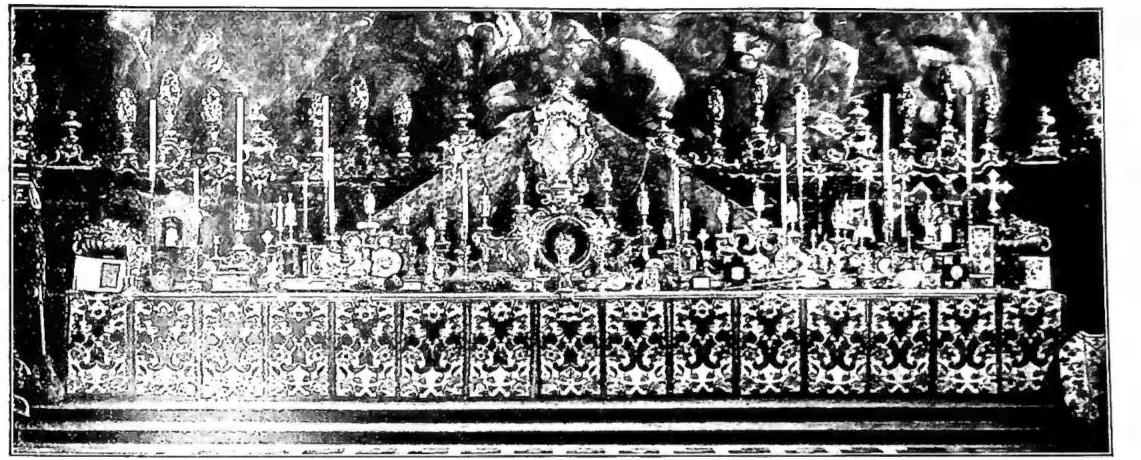
RELIQUES — Display of relics in the scuola di S. Rocco on the feast day of the Saint — Venice.
IV. RECOGNITION OF RELICS
The authentication of a relic always presupposes some form of recognition of its genuineness. Proper recognition, however, is that carried out in a juridical form by the competent ecclesiastical authority, which is the Ordinary, or, if it concerns the relics of a Servant of God or a Blessed whose cause of beatification or canonization is pending before the Sacred Congregation of Rites, the Holy See.Such recognition may be conducted on the occasion of the renovation of a tomb, the transfer or extraction of relics, or when the body of a saint, whose trace had been lost, is rediscovered. During the apostolic process on the virtues of a Servant of God, the recognition of his relics is also prescribed (can. 2096), which is the responsibility of the Apostolic Tribunal and is carried out under letters rogatory from the Sacred Congregation of Rites and according to a specific instruction from the Promoter General of the Faith. At this recognition, besides the members of the Tribunal, two physicians act as experts, along with the necessary personnel for opening the tomb (mason, blacksmith, tinsmith). It is at this moment that the relics are extracted, which are usually then distributed on the occasion of beatification.
V. LEGITIMACY OF THE CULT OF RELICS
The cult by which relics are honored is called relative cult, inasmuch as the object is honored for its relation to the person of the saint. A similar cult is found also in the civil, profane sphere, directed toward the memories and remains of illustrious men and heroes, and is as ancient and widespread as humanity itself; and thus legitimate in its principle and part of the laws of humanity.It presents no difficulty that these objects are material things and therefore, in themselves and by their nature, inferior to us, living beings endowed, beyond matter, with spirit. The object of worship is not, as it may be in fetishism or idolatry, the *res* in itself; but if relics are the term of worship or, if one prefers, the direct object, they are such only because of the contact they have had with the person, and thus they recall the excellence of the person himself, to whom, in the final analysis, our worship is directed.
VI. CURRENT DISCIPLINE CONCERNING THE CULT OF RELICS — The current discipline is gathered in the *Codex Iuris Canonici* and in the decrees of the Sacred Congregation of Rites.
In regulating the relative cult of *dulia*, owed to the relics of the saints, the Church, as is natural, concerns itself with public worship, and for this purpose the jurisprudence of the Sacred Congregations of Indulgences and Relics and of Rites, enshrined and collected in can. 1281 § 2, distinguishes between notable and non-notable relics.
Notable relics of the saints or the blessed are the body, the head, the hand, the knee, or that part of the body in which the martyr suffered, provided it is whole and not small (can. 1281 § 2). If these relics are notable, those of the Passion and Redemption of Our Lord Jesus Christ are all the more so, as are those of the Most Holy Virgin.
Given this premise, here are the norms established for the discipline of the cult of relics:
1) Any non-notable relic, whether ancient or recent, may be venerated with private worship, not only if it concerns canonized or beatified saints, but also those who died in a reputation for holiness, even if the relic is not officially recognized or approved. It suffices that those who practice this cult are morally certain both of the holiness of the person to whom the relic is connected and of the authenticity of the relic itself. Therefore, non-notable relics may be kept with due honor even in private homes or carried by the faithful (can. 1282 § 2). This is not the case for notable relics of saints and the blessed, which may not be kept without the permission of the local Ordinary (can. 1282 § 1).
2) For the admission of relics to public worship, the prior intervention of ecclesiastical authority is always necessary, which must pronounce on the authenticity of the relic to be exposed to public veneration. Therefore:
a) In public churches and oratories, even exempt ones, only those relics may be venerated which are known to be authentic either by an authentic document of a cardinal, the local Ordinary (excluding, however, the vicar general without special mandate), or some ecclesiastical person who has, by apostolic indult, the faculty to authenticate (e.g., general postulators; can. 1283 § 1-2).
b) The approval of the local Ordinary must be given in accordance with the mind of the Council of Trent, that is, the Ordinary must make his decision after consulting theologians and prudent men, and always inspired by criteria of truth and piety. In doubtful cases, before resolving the controversy, the Ordinary must await the judgment of the metropolitan and the provincial bishops at the provincial council. Where this is not possible, recourse must be had to the Holy See (Council of Trent, sess. XXV; AAS, 18 [1926], p. 262).
c) When relics already approved for worship are transferred to another diocese, they must be verified by the local Ordinary not for a new approval but to ascertain the approval already given; and after this, he shall grant permission for their exposition to worship.
d) Local Ordinaries shall prudently remove from worship any relic which they know with certainty is not authentic (can. 1284).
e) Relics whose authentic documents have been lost shall not be exposed to public veneration except after the judgment of the local Ordinary, excluding the vicar general without special mandate (can. 1285 § 1).
f) Nevertheless, ancient relics shall be maintained in worship, as in the past, unless certain arguments prove them to be false or counterfeit (can. 1285 § 2).
g) Those who knowingly manufacture, sell, distribute, or expose to the public veneration of the faithful false relics incur ipso facto the excommunication reserved to the Ordinary (can. 2326). The reason for this severity on the part of the Church is to be found in its intent to preclude the way for abuses which ignorance, self-interest, or superstitious faith might foster in this matter so delicate. But if the Church shows such great prudence and wisdom on the one hand in the selection of relics, it cannot but condemn on the other exaggerated and unseemly criticisms against their authenticity, especially when made in books or periodicals intended to foster Christian piety (can. 1286). This in no way intends to forbid the discussions of scholars animated by a spirit of sound, constructive, and prudent criticism.
3) The Church further determines the acts of worship permitted in accordance with circumstances toward the relics of the saints:
a) The principal acts of worship are: exposing the relics to veneration, showing them to the people, giving them to be kissed, carrying them in procession, and blessing the people with them (can. 1287). Regarding exposition, however, it must be noted that for it to be licit, relics must be enclosed in sealed cases or caskets to avoid the danger of theft or fraud. They may not be placed above the tabernacle where the Most Holy Sacrament is reserved (S. Congr. of Rites, 31 March 1826 ad 6, *Decreta authentica*, n. 2613), nor above the altar where the Blessed Sacrament is exposed (id., 2 Sept. 1741 ad 1, ibid., n. 2365), even if only with the ciborium (id., 19 May 1838, ibid., n. 2779), nor even before the closed tabernacle door (id., 6 Sept. 1845, ibid., n. 2066). To proceed with the exposition and procession of the relics of the blessed outside the places where Mass and the Divine Office are celebrated for them by concession of the Holy See, a special apostolic indult is required.
b) Other norms regulate the custody and translation of relics. Thus, the bodies of saints may not be preserved above the altar, but beneath the ground or beneath the mensa of the altar, and they may not be clothed in new vestments without the permission of the Sacred Congregation of Rites (Benedict XIV, *De servorum Dei beatificatione et beatorum canonizatione*, IV, part 2, cap. 26).
The translation of the bodies or notable relics of saints from one place to another within the same church may be done with the permission of the bishop; for translations from one church to another, the license of the Holy See is required (can. 1281 § 1). The same applies to the alienation of notable relics. The relics of the blessed may not be carried in procession nor exposed except in the place where the Holy See has granted permission to celebrate Mass and the Divine Office for them (can. 1287 § 3).
c) Any trafficking or fraud in matters concerning relics is contrary to the cult; the transfer of relics, even authentic ones, for simoniacal sale, theft, or robbery is forbidden (can. 1289). To such acts is attached the excommunication reserved to the Ordinary (can. 1289). To prevent such acts, the vigilance of Ordinaries, deans, and parish priests is encouraged, and they are also exhorted to prevent relics from falling into the hands of non-Catholics in cases of alienation or inheritance (can. 1289). Thus, for example, with the relic of the Cross, which is found in the bishop’s ring at the time of his death (can. 1288). This is one of the ways in which relics may be profaned, but not the only one. Other ways of profanation may be the carelessness in their custody, which may even lead to their loss. Avoiding these things is the responsibility of the rector of the church and of others to whom their custody is entrusted (can. 1289 § 2).
With special care, the Church, through the Vicariate of Rome, watches over the relics that are extracted from the Roman catacombs (cf. *motu proprio* of 11 Dec. 1925 with the attached Regulations: AAS, 17 [1925], p. 619). On the use of relics in the consecration of the altar V. *Altare*.
VII. THE CULT OF RELICS IN NON-CHRISTIAN RELIGIONS
Even in non-Christian religions, anything belonging to a real person (the whole body or a part of it, clothing, utensils, weapons) is the object of veneration and worship. Sometimes the attribution of such objects may also refer to a mythical being, a god or hero, considered real by the popular imagination and immortalized by myth. The veneration and use of relics is based on the principle that the contiguous affects the contiguous; and therefore contact with or use of things that belonged to or were connected with a person particularly rich in supernatural power will produce the same effects of strength, intelligence, and protection from evil influences of which the person to whom they belonged was capable.Among primitives, it is believed that carrying on one’s person, on the arm, around the neck, or on weapons, hair, teeth, or bones of a powerful figure, or ingesting the heart, liver, kidney, or eye, will help to assimilate those qualities and ensure protection against sorcery and aid in various enterprises such as hunting, war, or preservation from illness. Even places made sacred by the memory of mythical ancestors who left imprints of their hands, feet, etc., are venerated to the point of becoming pilgrimage destinations, as occurs among the Arunta (Central Australia) with the rocks and stones where mythical ancestors left traces of their passage.
**Egypt.** — The veneration of the ancient Egyptians for the fourteen parts of the body of Osiris, scattered by the evil Seth throughout Egypt, is well known. Shrines were erected at the places where they were found; particularly famous is that of Abydos, where the head was kept. The Serapeum of Alexandria contained the mummy of the bull Apis, considered a relic of the otherworldly Osiris (= Serapis).
**Greece.** — In Greece, the cult of heroes essentially consists in the cult of their tomb (ἡρῶον), which is the most effective protection for the city that possesses II. The exaltation of the tomb-relic is evident in the closing scene of Sophocles’ *Oedipus at Colonus*, where Theseus, king of Athens, declares in the name of Oedipus that if the tomb of the latter is respected by human footsteps and voices, perpetual safety will come to the land.
Besides the heroa, famous relics in Greece included the head of Orpheus at Lesbos and Smyrna, his lyre in various places, the bones of Theseus in Athens, of Orestes in Sparta, and so on; the spear of Achilles at Phaselis, the scepter of Agamemnon at Chaeronea; and then the sandals of Helen, the eggs of Leda, the clay with which Prometheus escaped Deucalion and Pyrrha, etc.
**Rome.** — In Rome, notable relics included the Palladium of Aeneas, the tomb of Romulus in the Forum and his house on the Germalus, the tomb of Acca Larentia, the Horatian pile with the armor of the three Curiatii, the sororium tigillum, the sandals and distaff of Tanaquil, etc.
Universal religions that have had a historical founder, such as Buddhism and Islam, have greatly accentuated the cult of relics associated with the founder.
**Buddhism.** — The places sanctified by the relics of the Buddha are those where his cult is particularly practiced. After his death at Kusinara, his ashes, divided into eight parts, were distributed to the people who attended the funeral, who then preserved them in special shrines (v. STUPRO). Three have been found: at Pitharwa in Nepal, at Bimaran near Kabul, and at Peshawar; in Ceylon a tooth of his is venerated; in Burma and northern India there are localities where relics of the Buddha are venerated.
**Islam.** — Among Muslims, although the religion is opposed to the veneration of relics, these are still venerated in those countries where tradition has allowed II. Thus, a hair from the beard of Muhammad is venerated at Bijapur in the Deccan, a hair at Rohri in Sind, and the imprints of his feet at Ahmadabad, Gaur, and Delhi; in North Africa, relics of famous Muslim saints are venerated in special shrines (marabouts).