
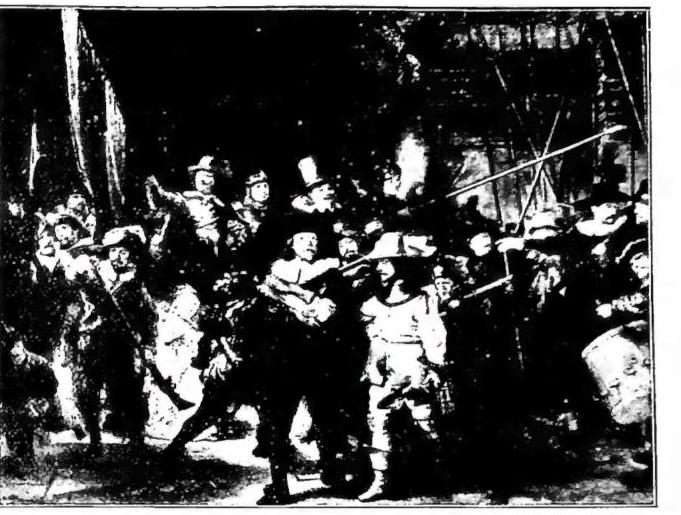
REMBRANDT (REMBRANDT HARMENSZON VAN RIJN or VAN RIJN) — *The Night Watch* (after the 1930 restoration) — Amsterdam, State Museum.
Where Lievens was strongly influenced by R. even subsequently, though in an external sense. The first dated works date from 1626: the *Tobias* in Moscow, the *Prophet Balaam* from the Cognac-Lay Museum in Paris, small panels executed with a minute, smooth, and delicate technique; in the *St. Paul in Prison* (1627) from the Stuttgart Museum, in the *Uranius* in Berlin, in the *Old Man Sleeping* (1629) in Turin, in the *Jeremiah Lamenting the Destruction of Jerusalem* (1630) from the Stroganoff Collection in Leningrad, in the *Ermit Reading* in the Louvre, in the *St. Anastasius* in Stockholm, in the *Presentation in the Temple* (1631) from The Hague Museum, the typical manner of violent illumination is already present, which later will be transfigured into magical, ghostly light; on the brown tonality of the background, vibrations of light are evoked by small brushstrokes. In 1631 R. left Leiden and settled in Amsterdam. From the following year is the painting that immediately became famous: *The Anatomy Lesson of Dr. Tulp* (The Hague, Mauritshuis), a subject not new in Dutch painting (it was in 1619 *The Anatomy Lesson of Dr. Sebastian Egbertsz* around a skeleton by T. Keyser, and in 1617 *Theatrum Anatomicum* by Miereveld). In this work by R., the images of the seven doctors are as many strong portraits that, while showing the influence of Rubens’ manner, are of such immediate sincerity as to place the young R. at once in the forefront among the portraitists of his country, which boasted great masters in this genre such as Thomas de Keyser; the composition as a whole, in the arrangement of the figures, shows an undoubted knowledge of Caravaggio, justified by the proximity of Honthorst, Baburen, and Terbruggen, the latter having returned from Rome in 1614.
A pupil in Leiden of Jacob van Swanenburgh, a mediocre local master who, however, had traveled in Italy (1617), and of Jan Lievens, his near contemporary, R. in 1623 was for the first time in Amsterdam for a period of six months, under the guidance of Pieter Lastman, a master also of Lievens and one who had adopted an Italianate style after his Roman sojourn (1604–1607), and of Jan Pynas, a good connoisseur of Italian painting as well, from which he had brought back especially Bolognese and Caravaggesque memories. The first known works of R. were executed in collaboration with Lievens: they bear the double signature, the *Head of a Child* in the Amsterdam Museum and the *Head of an Old Man* in the Schwerin Museum. Some paintings from these years are of uncertain attribution, certainly from this period, where it is difficult to distinguish between the hands of R., Lievens, and a third local painter, Gerard Dou, slightly younger, who worked in the same studio.
Of the same period as *The Anatomy Lesson* are the *Portrait of a Scholar* in Leningrad and the *Portrait of Coppenol* in Kassel, as well as many other portraits that approach the more refined manner of Keyser, while those from the earlier Leiden period have a vigorous and dramatic chiaroscuro and subtle effects of vibrant light that are distinctly Rembrandtesque (*Self-Portrait* in Kassel, Totha, Lemberg, Byfleet, Boston, Budapest, Braunschweig, The Hague). Many are the portraits of his father and mother, and from 1632 onward those of his wife Saskia, whom the artist loved to portray in sumptuous garments, just as sometimes in his self-portraits he adorned himself in strange and pompous attire (*Self-Portrait* in The Hague, Kassel, Vienna, Lichtenstein collection, etc.). Among the best-known portraits of his wife are those in the Musée Jacquemart-André in Paris, the Dresden Museum, Kassel, Pittsburgh, and the double portrait *The Artist and His Wife* in Dresden and London. Often his figures become theatrical, as in Saskia in *Bathsheba* (Madrid, 1634), in *Flora* and *Danaë* (Leningrad, 1634–36). There are portraits that depict figures who might be biblical or other dignitaries whom R. represents in brocade garments, with Eastern turbans and dark cloaks; these are commonly called *Rabbis*. Biblical subjects are the artist’s favorite themes, which, while remaining faithful to the texts, he transfigured into his own poetic and pictorial vision that transcends the narrative: *Rest on the Flight into Egypt* (The Hague, 1634–35), *Stories of the Cross* (Munich and Leningrad), *The Sacrifice of Manoah* (ibid., 1635), *Samson and the Philistines* (Frankfurt), *Tobias and the Angel* (Louvre, 1637). Notable is the treatment of landscape, a subject in its own right in about fifteen paintings completed between 1638 and 1648; in the overall vision, which is fantastic, precise annotations of details from life are encountered. Undoubted in these is the influence of Hercules Seghers, who left beautiful landscapes in numerous etchings of great power.
The year 1642, when the famous painting *The Night Watch* (Amsterdam, Rijksmuseum) was created—a vast composition in which a group of militiamen is captured in movement under strong contrasts of light—marks, with the death of his beloved Saskia, the beginning of a new period in R.’s life and art; years of sorrow and misfortune in which the artist reduced himself to a solitary and modest life with his faithful housekeeper Hendrickje Stoppels, who later became his wife, and his only surviving son by Saskia, Titus, who appear in many portraits of the following years (an inventory from 1656 reveals the immense collection of art objects that R. had amassed in his home during his prosperous years, followed by total financial ruin). But his activity continued; among many other works are the *Self-Portrait* in the Uffizi and the Louvre from 1660, and the masterpiece *The Syndics of the Drapers’ Guild* (Amsterdam, Museum) from 1661. Among the artist’s final works are the tragic *Jewish Bride* in Amsterdam, the *Family* in the Braunschweig Museum, and *The Return of the Prodigal Son* in Leningrad; the color is pasty, plastic, with flashes of unreal light. More than three hundred etchings and 1,500 drawings represent, moreover, the no less vital part of R.’s activity. Famous are the etchings of *The Virgin*, *The Father*, *The Death of the Virgin* (1639), *The Raising of Lazarus*, *Christ before Pilate*, *The Three Crosses*, etc., the landscapes including *The Little Bridge of Six* (1645) and the famous *Three Trees*, where the line is always powerful and personal; here too R. transforms familiar scenes into evocations of grand biblical events. Among his pupils, Karel Fabritius stands out; and among others, Govert Flinck, Ferdinand Bol, Jan Victors, Barent Fabritius, Samuel van Hoogstraten, and Nicolaes Maes. — See pl. XXXIX.