
RESTA URO. —
I. IN ARCHITECTURE
This term designates the direct interventions on the structures and essential decorative elements of a building aimed at their preservation or, as far as possible, restoring them to their original condition. The concept of architectural restoration, particularly regarding its limits, has evolved over time alongside the very concept of the architectural work of art. However, as early as 1893, Camillo Boito, a distinguished scholar of architectural history and criticism, codified useful norms for restoration in two dialogues, stating: "Better to consolidate than to repair, better to repair than to restore," implying that the term "restoration" is here confined to its etymological sense of reinstatement.Boito’s maxim is based on very clear principles:
a) An architectural work of art, like any other work of painting or sculpture, cannot tolerate additions, integrations, completions, modifications, or any alterations by anyone without losing or compromising its original value.
b) Any restoration always involves a critical process, namely the intuitive understanding of the work of art itself and knowledge of its individual values. Therefore, restoration primarily means conservation.
Nevertheless, considering that, even due to the destruction caused by the recent war, the aforementioned fundamental principles of restoration had to be applied with various adjustments—determined by the fact that the buildings requiring care were still living and functioning within complex civil life and thus could not be left as more or less picturesque ruins—a classification of different types of restoration has emerged. However, this classification is presented only after clarifying that, in most cases, different working criteria have often had to be simultaneously adopted even within a single restoration. Rarely have there been cases of monuments needing only consolidation without reintegration or recomposition, or without requiring new adaptations or arrangements in some of their parts. In any case, when executing architectural restoration, the following operations are distinguished: consolidation, reintegration, recomposition, and adaptation or arrangement.
1. **Consolidation restoration** consists solely in strengthening the structures of a building. This can be achieved by gradually replacing or reinforcing the masonry or load-bearing elements of the structure. A characteristic example is the 13th-century church of S. Lorenzo in Naples, where all the ancient pillars threatening collapse were patiently hollowed out one by one, and reinforced concrete supports were inserted inside them, anchored at the base to strengthened foundations and at the top to a reinforced concrete ring beam supporting the roof. In this way, the entire architectural structure of the church of S. Lorenzo is now as if encased and supported by an invisible framework that guarantees its absolute stability.
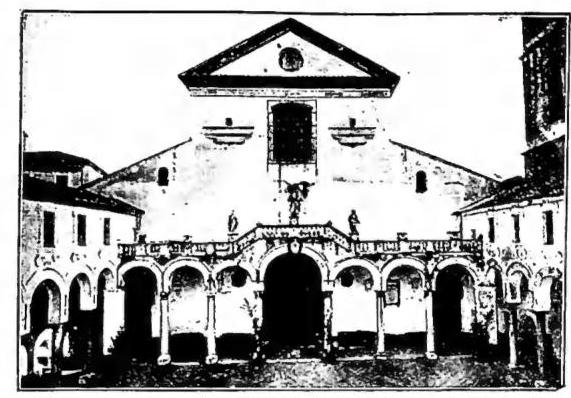
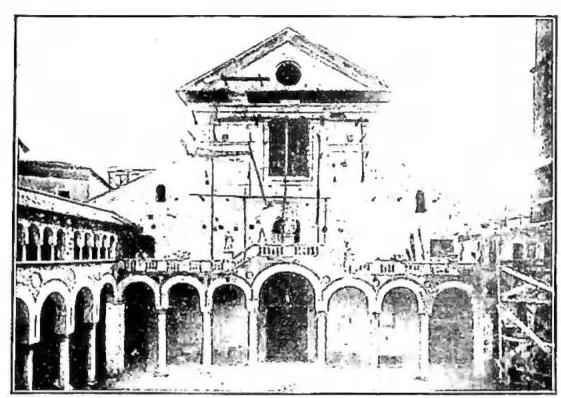
2. **Reintegration restoration**. These have been the most frequent type imposed by wartime events. Generally, these involve buildings that have been partially demolished or damaged but remain intact or nearly so in other parts. In such cases, the indispensable principle of not creating falsifications and not disturbing the whole with discordant modern works has often severely tested the intelligence and sensitivity of the restorer. The task is to harmonize the new parts with the old while clearly differentiating them. This can be achieved through various methods, ranging from the use of different materials to employing a different technique, or even inscribing the date on newly inserted elements. Restorations conducted, for example, at the Palazzo Vitelleschi in Tarquinia, S. Domenico in Bologna, the Eremitani in Padua, the church of S. Maria delle Grazie in Viterbo, and the minor basilica of the Osservanza in Siena, are characteristic examples. Another example is the restoration of the basilica of S. Lorenzo fuori le Mura in Rome, where the portico indeed provides a characteristic example of recomposition restoration.
3. **Recomposition restoration** is defined as the restoration determined by the opportunity and possibility of reassembling a building with the same elements, the same ancient stones, repositioned in their original locations. This has been possible especially in certain isolated structures of small size or those almost detached within larger buildings. Thus, for example, in the portico of S. Lorenzo in Rome, in many buildings of Pompeii, on the left flank of the church of S. Maria della Catena and in the porticoed courtyard of the Palazzo Abbattelli in Palermo, in the Mastrogiglio and Piccolomini chapels of the church of Monteoliveto in Naples, in the Bramantesque portico near S. Ambrogio in Milan, and in the Temple of Augustus in Pola.
However, recomposition restoration can also be defined in the case of the enormous structures of the façade and sides of the Tempio Malatestiano in Rimini. The dislodged but not demolished stones of these structures were patiently, systematically numbered, surveyed, photographed, and then dismantled one by one, like the components of a machine, and reassembled so that they returned to the positions they occupied before the disaster. Despite the immense scale of the work, this was accomplished with a method and technical perfection that, given the scope and delicacy of the task, borders on the prodigious. A similar operation had already been carried out 130 years earlier by Valadier for the restoration of the Arch of Titus in the Roman Forum.
4. **Adaptation and arrangement restoration** refers to those restorations conducted on buildings or parts of buildings that, for various reasons, have lost their original character and for which it would be illogical to attempt to recover their former appearance. Who today would think of restoring Castel S. Angelo in Rome to give it the appearance it had when it was erected as the mausoleum of Emperor Hadrian? Similarly, no one today would think of restoring the beautiful S. Chiara in Naples to return it to the admirable appearance it had been given by Neapolitans over centuries of work, art, love, and devotion. Of the ancient S. Chiara, devastated by flames from an incendiary shell on 4 June 1943, today only the 14th-century structures are consolidated and covered with a large trussed roof. The restored building will have an appearance quite different from the ancient one, when it was resplendent with gold and vivid colors. From it will emanate a wholly new sense, not devoid, however, of a certain tragic beauty.
II. IN PAINTING
Far removed from the pernicious so-called completion restoration, which was so prevalent in past centuries, today we have finally come to consider pictorial restoration primarily in a preservative and consolidating sense, without alterations or additions. Therefore, for painted works, the aim is always, as far as possible, to return the work to be restored to its original state.The first task in the restoration of paintings is cleaning, which is dangerous and difficult even when it does not involve the removal of added parts. Certainly, great assistance in this work is provided by new scientific discoveries, foremost among them radiography, which allows one to determine the use of cleaning agents—of which there are many—and to select those that appear most suitable based on the chemical and physical examination of the painting. Without enumerating them, it suffices to note that the most commonly used substances are those based on turpentine, which evaporate quickly and thus avoid the subsequent slow corrosive action that inevitably accompanies the use of alkaline substances (soda and potash).
Once cleaning is completed, a new problem arises: that of consolidating the surfaces and "filling" the lacunae that have become evident. Excluding any completion that could only falsify the artist’s work (since a work of art is, by its very nature, an individual creation and thus does not permit substitutions), the methods now in use are either to outline the contours of the damaged areas with neutral lines to preserve only the original rhythm of the composition (e.g., the *Polyptych of St. Gregory* by Antonello in the National Museum of Messina), or the method employed at the Central Institute in Rome, which involves filling the missing parts with a color that matches the surrounding area, using a hatching technique that satisfies the eye while remaining easily removable should a different aesthetic preference dictate a different approach.
But another problem often requires subtle skill and considerable effort: that of reinforcing, straightening, or even reconstructing ancient painted panels. One of the most common operations in the restoration of ancient panel paintings—which are prone to warping—is parquetry, which involves permanently restoring the panel to a flat state. This is a recent and ingenious solution, contrasting with the fixed crossbars that were previously glued to the reverse of the panel, often causing distortions and cracks. The new system, which allows the crossbars perpendicular to the wood grain to slide, permits the wood to move (as it naturally does in that direction) and "breathe," without compromising the stability of the panel.
For paintings on canvas, however, relining is often necessary—that is, the lining of the original canvas with a new one using special techniques and adhesives that permeate the original fabric while also reinforcing the painting’s adhesion between the ground layer and the paint. It is not uncommon, moreover, to transfer a painting from panel to canvas—a delicate operation performed in a manner similar to the transfer of frescoes, by gradually removing the old panel from behind after attaching canvases to the painted surface to ensure the painting’s stability during the process.
As for frescoes, it is well known that while in antiquity entire frescoed walls were sometimes moved, this was done by transporting the fresco along with the wall itself. Today, however, the process involves either detaching the painting and only the plaster layer using long blades to cut it from the wall, or by "stripping." In the latter method, canvases are glued to the painted surface and then "stripped" from the wall; the painted surface adheres to the canvases, allowing work to be done on the reverse to prepare it for mounting on a frame, after which the canvases applied to the front of the fresco—which served for the stripping—can be removed.
### III. IN SCULPTURE
The restoration and consolidation of sculpted works consists in eliminating the causes of their deterioration. Among these, the primary concerns are those arising from atmospheric agents. For marble statues that are crumbling, measures such as silica-based baths can be used to halt the disintegration of the material. For wooden statues, it is often necessary to eliminate woodworm (a concern also for panel paintings). Beyond these operations aimed at removing the causes of deterioration, the sculptor also faces the problem of freeing the work from later additions—for example, Renaissance "completions" or, worse, Baroque "alterations" of ancient statues. Today, however, we must unfortunately tolerate additions that, if removed, would leave only stumps perfectly trimmed and polished by old restorers to accommodate the additions in question. Pure and simple conservation of the work of art is therefore the goal, even for sculpture, though the need for some integration may occasionally be felt within the limits imposed by respect for the work of art.
A recent experiment by the Restoration Institute may be cited: the completion of a bronze *transenna* using different materials, with the restored areas marked by thin vertical and parallel incisions. "These do not alter the continuity of the work’s surface while clearly delineating the restored zones" (Cagiano de Azevedo). Thus, the hatching system used for paintings has been adapted for sculpture. In any case, it is always advisable to entrust necessary restorations to competent technical bodies, whose work generally offers every guarantee.
In conclusion, it can be affirmed that the restorer’s activity must always be judged by a critical evaluation of the work of art. The restorer must ensure that what is new in the restored work is distinguishable from the original. They must never attempt falsification. In this regard, too, what is false is condemnable.
— See pls. XLI–XLII.
**