
ROBERTO DI GINEVRA (CLEMENTE VII), anti-pope — Coat of arms of R. di G. and of the Duke of Berry. Miniature from the late 14th century, from the second volume of the Bible belonging to the Duke of Berry, as evidenced by the following note on folio 437: "Cette bible est au duc de Berry et d'auvergne conte de Poitou" — Vatican Library, cod. Vat. lat. 51, f. 1.
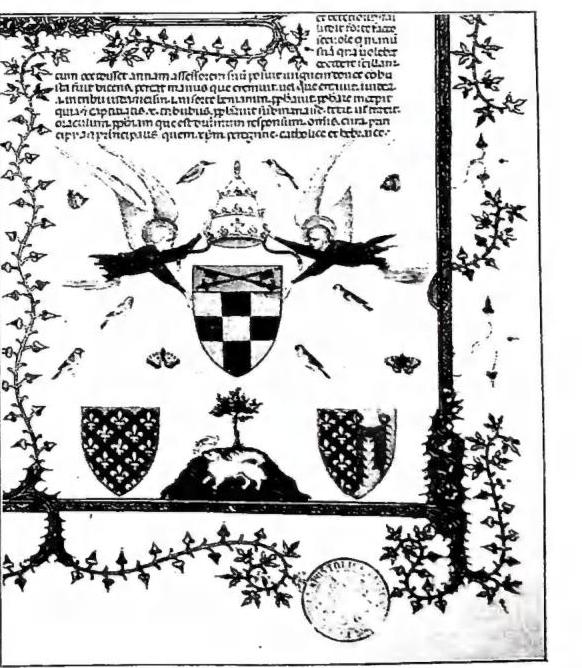
ROBERTO DI GINEVRA (CLEMENTE VII), anti-pope — Coat of arms of R. di G. and of the Duke of Berry. Miniature from the late 14th century, from the second volume of the Bible belonging to the Duke of Berry, as evidenced by the following note on folio 427: "Cette bible est au duc de Berry et d'Auvergne conte de Poitou".
Sent as legate to Italy (1376–78), he commanded the Breton bands that carried out the massacre of Cesena (19 February 1377). He participated in the election of Urban VI but later separated from him, together with the French cardinals who elected him pope at Fondi on 20 September 1378 under the name of Clement VII, thus initiating the calamitous Western Schism. After failing to seize Rome (Battle of Marino, 30 April 1379) and finding it impossible to remain under the protection of Queen Joanna, he left Italy and on 20 June established his see in Avignon. The kinship and influence of Robert, particularly that of Charles V, King of France, who had supported the rebellion of the cardinals, and later that of his son Charles VI, were the strongest supports of the obedience at Avignon. This obedience included, besides France, the Spanish kingdoms, Scotland, and intermittently some German princes and bishops, but never the majority of Christendom. In Italy, only the Kingdom of Naples, according to dynastic vicissitudes, at times adhered to Clement VII. He excommunicated his adversary, as the latter had excommunicated him, but was continually forced to resort to expedients to retain the loyalty of his adherents, who chafed under the heavy impositions necessitated by lack of funds, continuous strife, and the expenses of a lavish court. As early as 1379, Robert created Louis of Anjou, brother of Charles V, vassal of the Holy See and assigned him the “Kingdom of Adria,” formed from the possessions of the Holy See. In 1382, he appointed him Captain of the Church for the conquest of the Kingdom of Naples. Upon his death in 1384, he bequeathed that kingdom to his son Louis II and aided his vain attempts at conquest. In France, pressure mounted on Robert to end the schism, first at the death of Urban VI (1389), then from the University of Paris, which in 1394 virtually imposed its will upon him. He died suddenly of apoplexy on 16 September 1394.