
RUFINUS TURANNIUS. — Ecclesiastical writer, born at Concordia in eastern Venetia about 345 from the Turannia family, of which local memories survive; he studied in Rome where he was a companion of St. Jerome (q.v.), then went to Aquileia when St. Valerian was bishop (he was bishop before 371), where he was instructed by Chromatius, then a priest and later bishop of Aquileia (q.v.), and by the deacons Jovinus and Eusebius; there he was baptized and made profession of the monastic life. Here he renewed his friendship with Jerome who had come there from Trier.
About 373, as Jerome himself expressed it, “a sudden storm, an impious separation,” broke up the group that had formed around them. Rufinus then went back to Rome and in 374 accompanied Melania the Elder (q.v.), the great Christian lady, to Egypt and remained among the monks while Melania went to Palestine. At Alexandria, Rufinus listened to Didymus the Blind (q.v.), studied the works of Origen and the Greek Fathers, made the acquaintance of John, the future bishop of Jerusalem, of Theophilus, the future patriarch of Alexandria, and suffered violence at the hands of the Arians. In 378-79, Rufinus reached Melania at Jerusalem, took up residence in the monastery on the Mount of Olives and was ordained priest in 390. For Easter 393, Epiphanius, bishop of Salamis, came to Jerusalem to combat Origenism against the bishop John, supported by Rufinus and Melania, and found a hearing with Jerome, who was staying at Bethlehem with Paula: hence the first rupture between Jerome and Rufinus, which was however composed in 397. In that year Rufinus returned to the West, fully intent on making the Eastern Fathers known there, and in Lent 398 he published his translation of Origen’s *De principiis* (Περὶ ἀρχῶν), which did not fail to cause a scandal. The fact that in the preface he mentioned the admiration Jerome had once had for Origen provoked the second rupture between the two, which was the cause of a disagreeable controversy between them.
In 398-99, Rufinus, on the occasion of his mother’s death, returned to Aquileia and there met Paulinian, Jerome’s brother, already ordained priest. Chromatius (bishop from 388) intervened to restore peace between Rufinus and Jerome (Jerome, *Contra Rufin.*, III, n. 2), but without success, and urged Rufinus to translate Eusebius of Caesarea’s *Ecclesiastical History*. The disturbances caused by barbarian invasions, particularly dangerous in eastern Venetia, induced Rufinus to leave Aquileia and join Melania again in Rome; with her and other relatives he went about 408 to a villa on the Straits of Messina and there died in 411.
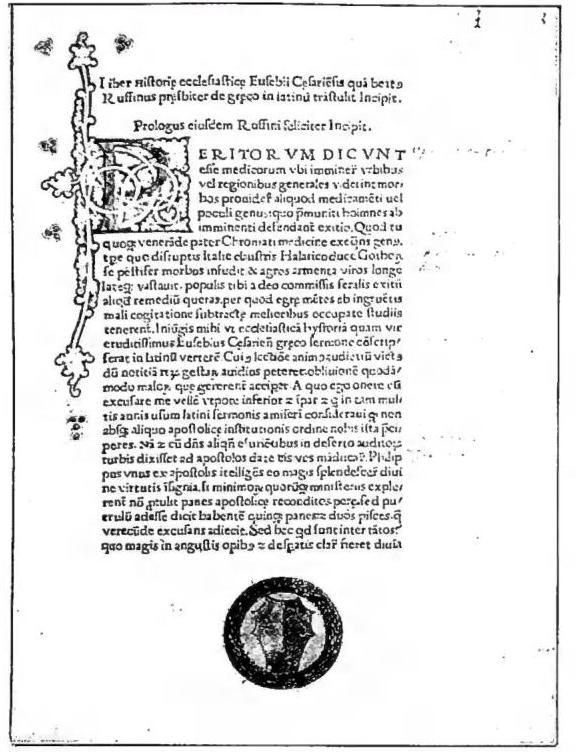
Rufinus’ importance in Western Christian literature consists above all in his translations from the Greek. He translated with exactitude and scrupulous care, but often proceeded with great freedom, going so far as to omit, add and modify the text. He gives ample proof of this method in his translation of Eusebius’ *Ecclesiastical History*, in which he reduced the ten books of the author to nine, transferring what he considered important from the tenth to the ninth; then he added two books of his own to bring the narrative down to 395 (the death of Theodosius). But certainly history was not Rufinus’ strong point.
Rufinus’ preferences went to Origen, whose works he came to esteem during his stay in Alexandria and never abandoned thereafter. In his short work, *De adulteratione librorum Origenis* (PG 17, 615-32), he went so far as to maintain that the passages of Origen that conflicted with orthodoxy had been misinterpreted or corrupted by heretics; it is not surprising, therefore, that in translating Origen’s *Homilies on Numbers* (PG 12, 115-414, where the fragments of the original Greek text are intercalated), Rufinus was led to attenuate and modify the text of Origen in many places. He added two prefaces, one to Book I and the other to Book III. Of his translations of Origen, 17 homilies on Genesis, 13 on Exodus, 16 on Leviticus, 28 on Numbers, 26 on Joshua, 9 on Judges (PG 12, 145-990) are known; also 5 homilies on Psalm 36; 2 on Psalm 37 and 2 on Psalm 38 (PG 13, 1319-1410). He also translated the prologue to the *Song of Songs*, 3 books and part of the fourth (PG 13, 61-198); and also the 10 books of the commentary on the *Epistle to the Romans* (PG 14, 833-1294). His admiration for Origen led Rufinus to translate the first of the five books of the *Apology* that the martyr Pamphilus had written about him (PG 17, 541-610), and this is all that survives of that work. Rufinus also considered the *De recta in Deum fidem* (PG 11, 1715-1884) of Adamantius to be the work of Origen and hastened to translate it in order to demonstrate Origen’s orthodoxy with II. Rufinus himself attests to having translated 10 orations of St. Basil and as many of St. Gregory Nazianzen. Eight survive under the name of St. Basil (PG 31, 1723-95) on various subjects, but the seventh is not by St. Basil; nine by St. Gregory. Of Basil, Rufinus also translated the two *Instituta monachorum*, forming a kind of catechism in 203 questions and answers. It is also known that he translated from Evagrius, and there survives his translation of the *Sententiae* (cf. A. Wilmart, in *Rev. bénédict.*, 28 [1911], p. 143). Rufinus also translated that religious novel which bears the title *Recognitiones Clementinae*, of which the original text is not extant (PG 1, 1205-1454); so too he translated the *Epistle of Peter to James* which precedes the apocryphal homilies of Clement (PG 2, 31-56). It is now known that the collection *Vitae Patrum* (*Historia eremitica*, *Historia monachorum*: PL 21, 387-462), a collection of lives of monks in which, taking occasion from a journey in Egypt, he makes known persons and monastic customs, is also a translation from the Greek (cf. C. Butler, *The Lausiac History of Palladius* [Cambridge 1898, 1904], against A. Preuschen, *Palladius und Rufinus* [Giessen 1898] who publishes the Greek text). Very doubtful is the attribution to Rufinus of the translation of Josephus’ *De bello Iudaico*. His, however, is the translation of the *Sentences of Sextus*, a work of a Pythagorean philosopher reworked by a Christian, which comprises 451 proverbs; Rufinus believed it to have been written by Pope Sixtus II and was corrected on this point by St. Jerome.
Rufinus’ original production is much more limited; besides the aforementioned *De adulteratione* and the two books of the *History*, it comprises the two books *De benedictionibus Patriarcharum*, a commentary on the blessings of Jacob to his sons (Gen. 49, 11 ff.), written at the request of Bishop Paulinus, in which he shows his preference for Origenist exegesis (PL 21, 295-336). Of greater importance is the *Commentarius in symbolum Apostolorum*, written about 404 at the request of an unknown bishop Laurence (ibid., 335-86), the first to survive on this subject, in which the author sets out to explain the baptismal Symbol of Aquileia which he himself had professed at his baptism and which differed somewhat from that of Rome. His source is the catecheses of St. Cyril of Jerusalem. The *Apology to Anastasius, Bishop of the Roman City* (PL 21, 623-28, written in 400) refers to the Origenist controversies with St. Jerome, in which he professes his orthodoxy regarding the rumors spread against him on account of his translation of Origen’s *De principiis*. Finally, the *Apology against Jerome* in two books dedicated to Armentarius (PL 21, 541-624), in which he again explains his doctrinal position, refuting the accusations against him and imputing to Jerome his own passion for the classics. Other works have been lost and others falsely attributed (cf. ibid., 633 ff.).
BIBL.:
Jerome, *Epist.* 57, 71, 81, 82, 120; *Contra Rufin.* I-III; Palladius, *Historia Lausiaca*; Socrates, *Hist. eccl.* VI, 14; Sozomen, *Hist. eccl.* VII, 15; Gennadius, *De viris illustr.* 11; *PL* 21, 541-634; A. Wilmart, *Les traductions de Rufin*, in *Revue Bénédictine* 25 (1908) 321-351; id., *Les écrits de Rufin*, ibid. 26 (1910) 321-351; id., *Les homélies de Rufin sur les Psaumes*, ibid. 28 (1911) 137-143; C. H. Turner, *The Study of the Bible in the fourth and fifth centuries*, in *Journal of Theological Studies* 10 (1909) 332-349; A. Vaccari, *Rufino di Concordia*, in *Enciclopedia Italiana* 30 (1936) 656-657.