
SALMANASAR (Sulmānu-ašarid [u]). — The name (Sulmān [warrior god of the type of Ninurta] predominates); Heb. Salman’éser) belongs to five Assyrian kings between 1200 and 700 B.C. Of these, S. III (858–824) and S. V (727–722, mentioned in 2 Kings 17:3ff., 18:9ff.) are important for the history of Israel.
S. III, an able politician and tenacious warrior, is numbered among the great kings who “laid the foundations of Assyrian imperial power” (Sidney Smith).
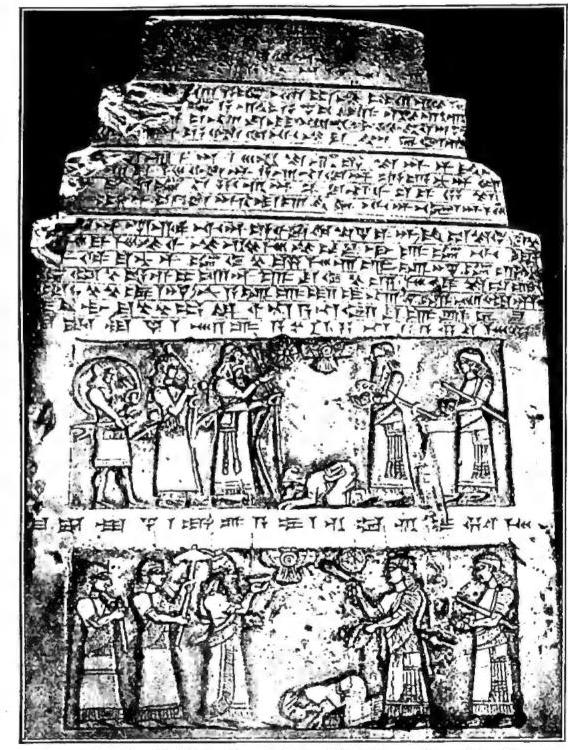
Numerous cuneiform inscriptions, especially the “Annals” (regarding the literary genre and different Assyrian editions cf. studies by J. M. Peñuela and R. Follet), inform us of his deeds. S. consolidated and extended the conquests of his father Aššur-nāṣir-apal (883–859). He subdued in five campaigns the Abuni of Bit-Adini, the most powerful Aramean state between the two rivers (859–855), taking possession of the caravan route on the Euphrates. More demanding was the struggle for the submission of the Neo-Hittite states on the lower Orontes, on the Amanus and in Cilicia, to secure free access to the cedars and mines of the Taurus and to the caravan route on the Mediterranean coast. In this he already triumphed in 853 (he ritually washed his hands of his army). But this economic success came to him only after sustaining several battles (final fall of Que and Tarsus in 732). S. was opposed by a strong coalition led by Irhuleni of Hamath and Hadad-idri (Hadad-ezer) of Damascus. In the very protracted war he gained the upper hand; yet he could not destroy the enemy, not even with the general mobilization of all men capable of bearing arms that he carried out in the spring of almost every third year. A reverse was probably the famous battle of Qarqar (853 B.C.): the “monolith” of S. gives of it a “war communiqué,” which insists on the “enormous losses” of the enemy and the immediate return from the “spectacular victory”; the battle is of great importance for biblical chronology: even to Ahabbu mat Sir’ilāyā, to be identified with the king of Israel Ahab (v.), S. is said to have annihilated 2,000 chariots and 10,000 infantry. The invasions of 848 and 845 also failed. The situation changed, however, in 841, after Hazael (v.) IEHU (v.), abandoning the coalition: Hazael was defeated despite having fortified himself on Mount Senir (Hermon) and had to retreat to Damascus, whose walls S., however, could not breach; then he devastated the country, especially the orchards around Damascus, as far as the mountains of Hauran. Yet he reaped political advantages: not only did Jehu (scene of the Black Obelisk) pay tribute, but also Tyre and Sidon; and Assyria then had undisputed control of the Mediterranean coast from Byblos to the Taurus.
To the east, S. is perhaps the MEDINA (v.); to the southeast of Lake Urmia and in Parsua his successes were fleeting. The same must be said of the expeditions to the sources of the Euphrates and Tigris, to Lake Van, on whose shores in the capital of Tušpa reigned Sarduris I, Urartu (v.): he exerted strong pressure there, but did not achieve decisive success.
Yet S.’s political skill shines in his relations with Babylonia, where he asserted Assyrian influence. A good neighbor and friend of Nabū-apla-iddin (d. 851), he continued the same policy with the legitimate heir Marduk-zākir-šum. The latter called S. to his aid at the outbreak of the rebellion of his brother Marduk-bēl-ušāte, who, aided by a large part of the Babylonian people, had established himself east of the Tigris. In two campaigns S. reduced the rebel and also punished the Chaldean and Sutean tribes of Babylonia. The liberator then returned, visiting as a pious king the most notable sanctuaries of ancient Sumer and offering, especially in Babylon, spectacular sacrifices (and feasts), with rich gifts to the citizens.
S. was a shrewd administrator of his own lands and those he had conquered. He knew how to choose excellent collaborators and advisors. Hence, during the rebellion of his son Aššur-dan-apal (826), who was aided by 27 cities, and the civil war between him and Shamshi-Adad V (823–811), the empire did not suffer: this seems to be explained by the well-fortified garrisons and colonies and by the rigid administration of the Assyrian provinces.
Of S. V (727–722), because of the brevity of his reign (and perhaps through the action of Sargon II, who deposed him), almost no cuneiform inscriptions are found. Thus his reign unfolds in the darkness of history. According to Menander of Tyre, he once besieged Tyre. The Babylonian Chronicle attributes to him a sack of Šabara’in, identifiable with Si-birajim (Ezek. 46:16). On that occasion he must have begun the war against the king of Israel Hoshea (v.) SAMALIA (v.). He reigned in Babylonia under the name Ululai.