
SANCTI, CULT OF THE. — It is the demonstration of the religious veneration given to the blessed in heaven, on account of the excellent perfection of divine life which they have attained with the help of grace.

I. NOTIONS
The cult of the saints in Christianity is essentially different from and inferior to the supreme cult of adoration or latria (*ἀστέρια*) due only to the Most Holy Trinity and to its individual Persons, and also, by reason of the Hypostatic Union, to Jesus Christ, in whom, even under sacramental species, the humanity is adored together with the divinity in a single act of adoration. The religious excellence of the saints and of the angels consists entirely in their being faithful servants of God, and the cult paid to them is called the cult of dulia (*δουλία* = servitude); while Mary, privileged above all the servants of God, is the object of a cult which, although essentially different from and inferior to that of latria, is nevertheless superior to that of all other saints and angels, and is therefore called the cult of hyperdulia.Since they are creatures, every excellence they possess derives from God as their first source; nevertheless, the cult paid to them goes, not only to God, but also to their persons, as having, as servants of God and dependent on Him, a real excellence in themselves. In this sense, the cult which has as its object the person of the angels and of the saints is called absolute. On the other hand, the cult by which objects that have some relation to the persons of the saints (relics, images) are honoured is purely relative, since these objects have no religious excellence in themselves, but only by the mental relation which the one venerating them establishes between these objects and the persons of the saints, so that the cult paid to them goes entirely to the saints.
Public external cult, however, which is that paid on behalf of the Church as such, must be paid only to saints and blessed who have been legitimately recognized as such (v. BEATIFICATION; CANONIZATION) and is today subject to the juridical norms of the Church (v. can. 1255-1257; 1259; 1260-61; 1276-80; 1215-12; 2125-35). Its principal expressions are: their inscription in the martyrology; the celebration of their feasts; the dedication of places of worship, such as churches and altars, in their name; their public and liturgical invocation; the veneration of their relics and images; and, above all, the offering to God of the Sacrifice of the Mass in their honour, that is, to praise and thank God for the graces granted to the saints and to beg Him, through their intercession (v.) and subordinately to the mediation of Christ, to grant us His benefits, especially spiritual ones.
II. CATHOLIC DOCTRINE AND ITS DEVELOPMENT
That such a cult is lawful and useful for the spiritual good of the faithful, although not absolutely or for all necessary, is a dogma of Catholic faith, proposed by the ordinary magisterium of the Church, especially in the Council of Trent, against the denials of the Protestants (Denz-U, 984-88), particularly of Zwingli and Calvin, who asserted that it was a purely human invention, without foundation in Scripture and insulting to the unique mediation of Christ.The Catholic position harmonizes perfectly with the whole of Christian dogma. First, because the religious excellence of the angels and of the blessed in heaven is real, definitive, and recognized by God Himself, since they have, with the help of grace, truly attained in themselves an eminent degree of divine life. There is no reason why the recognition of this their excellence should not be lawful and useful. Moreover, if they know our needs and, subordinately to the supreme mediation of Christ, intercede for us, there is no reason why their invocation should be unlawful or useless. Finally, the saints are models of virtue for the faithful, and the cult paid to them proposes them for their imitation; this cult is therefore of great utility and pedagogical efficacy. That it, as proposed by the Catholic Church, is not detrimental to the cult due to Christ and to His supreme mediation is shown by the fact that its whole meaning lies in honouring the fruits of Christ’s Redemption and the efficacy of this His supreme mediation, since the religious excellence of the saints is clearly proposed as founded entirely on the Redemption of Christ and their intercession as ultimately founded on His supreme mediation. In reality, therefore: “We honour the servants, so that the honour of the servants may redound to the Lord” (St. Jerome, Ep., 109, 1).
This perfect, intrinsic coherence of Catholic doctrine on the cult of the saints with the great dogmas of Christianity and its perfect correspondence to the laws of religious psychology explain the ever clearer and more explicit development of this doctrine and of its consequent practice in the life of the Church. The principles underlying it are already seen in action in Scripture. The angels (v.), especially the Angel of the Lord, in the Old Testament, are the object of profound religious veneration, although in a general way (e.g., Exod. 23, 20-22; Num. 22, 31-35; Jos. 5, 13-16; cf. Gal. 1, 8; 4, 14; Apoc. 19, 10), because they are glorious beings, servants and messengers of God, His heavenly court, always in His presence (cf. Matt. 18, 10). And although strong warning is given against the misunderstanding of the cult of angels, to which, among others, some circles at Colossae seem to have been inclined (cf. Col. 1, 9-20; 2, 18-23), and although their subordination to Christ is strongly emphasized (e.g., Heb. 1, 5-2, 18), the general principle of the lawfulness and utility of their veneration is in no way impaired.
The same severe prohibition of the Old Testament against the use of images (e.g., Exod. 20, 4 sqq.; Lev. 26, 1; Deut. 4, 15; 27, 15; Jos. 24, 19) was not absolute, as is shown by the sculptures in the Temple of Solomon, but was evidently motivated only by the practical danger of idolatry in which the people found themselves in the midst of a pagan world, and not by the denial of the legitimacy and religious utility of images in themselves. With the change of circumstances, it was therefore natural that the ancient prohibition should be considered as superseded without thereby failing in the spirit of Scripture. Thus it is understood how, in the history of the Church, in conformity with the whole spirit of Revelation and with the principles already explicitly active in Scripture, there is to be seen an ever greater development of the practice of the cult of the saints, beginning with that of the martyrs (v. martyrdom and martyr), and an ever more explicit formulation of its doctrine (v. canonization, II. History). In the course of the fourth century, the cult of non-martyred saints began to be affirmed: just men of the Old Testament; ascetics, among whom was St. Hilarion; bishops, including St. Martin of Tours and Pope St. Sylvester.
It was the Protestants of the sixteenth century who, advancing
Pseudo-dogmatic motives were raised with greater or lesser intolerance against the intercession and veneration of the saints. A historical prejudice also began to take hold, namely that the so-called saint is nothing more than a Christian adaptation of the pagan cult of gods and divinized heroes. By this route, polytheistic elements would have infiltrated Western Catholicism and survived to this day even in the practice—substantially identical (cf., e.g.: M. Jugie, *Theologia dogmatica christianum orientalium dissidentium*, II, Paris 1933, pp. 710–17)—of the dissident Eastern Churches (see also *conventione* [confessor]). In fact, the cult of the saints began with that of the martyrs, and only after the period of persecutions had ended did the veneration of the most illustrious bishops—renowned for their merits and holiness—begin at their burial places, followed by monks and figures who had become famous in their country.
Should it happen, over time and quite exceptionally, that the veneration of a figure who never existed began, this does not mean that it occurred as a continuation of the cult of a pagan deity or hero; rather, the opposite sometimes occurred, namely that the cult of a saint was introduced to supplant a superstitious cult. And when error did occur, it arose from entirely different motives (mostly from mistaken interpretations of ancient names and documents).
It is true that legends arose in later ages in which the obscure lives of real saints were embellished, and in which traits derived from the legends of pagan gods and heroes can indeed be found. But an apocryphal legend about an authentic saint does not create the person of the saint; it presupposes him.
Conversely, the external forms in which the cult of the saints manifested itself in Christian religion—such as certain rites and ceremonies like the use of incense, candles, the manner in which invocations are expressed, festivals are celebrated, pilgrimages are made, relics and images are venerated, etc.—all of this in the Christian cult of the saints can be analogous to parallel pagan usages accepted insofar as they contain nothing repugnant or superstitious. This is also widely attested and acknowledged by the Fathers themselves, and it cannot be held against Christianity, since these things are in themselves perfectly honorable and capable of being permeated by a higher form of religious spirit. St. Jerome’s words are apt: “Because we once honored idols, must we now not honor God for fear that the same honors paid to idols seem to be rendered to Him?” In the first case, veneration was directed toward idols and must therefore be abhorred; in the other, it is directed toward martyrs and thus deserves approval (*Contra Vigilantium*, 7). The spirit animating the Christian cult of the saints from its earliest days is vastly different from the spirit of polytheistic worship, for every Christian knows that the saints are not gods, that their excellence and power derive from God, and that every honor paid to them redounds to God. It cannot therefore be asserted that the cult of the saints is an unconscious return to paganism.
For a complete bibliography, consult: J. B. Walz, *Die Fürbitte der Heiligen*, Freiburg im Br. 1927, pp. ix–xxv; P. Séjourné, *Saints (culte des)*, in *DThC*, XIV, cols. 870–978. Among the monographs to be noted are: I. C. Trombelli, *De cultu Sanctorum*, 5 vols., Bologna 1740–43; F. A. V. LEONE, *Die Marienwerdung in den ersten Jahrh.*, Stuttgart 1881; G. Rabeau, *Le culte des saints dans l'Afrique chrétienne d’après les inscriptions et les monuments*, Paris 1903; E. Lucius–G. Anrich, *Die Anfänge des Heiligenkults in der christ. Kirche*, Tübingen 1904 (protestant rationalist); H. Delehaye, *Les origines du culte des martyrs*, 2nd ed., Brussels 1933; id., *Sanctus. Essai sur le culte des Saints dans l’antiquité*, 1927; A. Mollien, *La liturgie des saints; leur culte en général*, Avignon 1932.
---
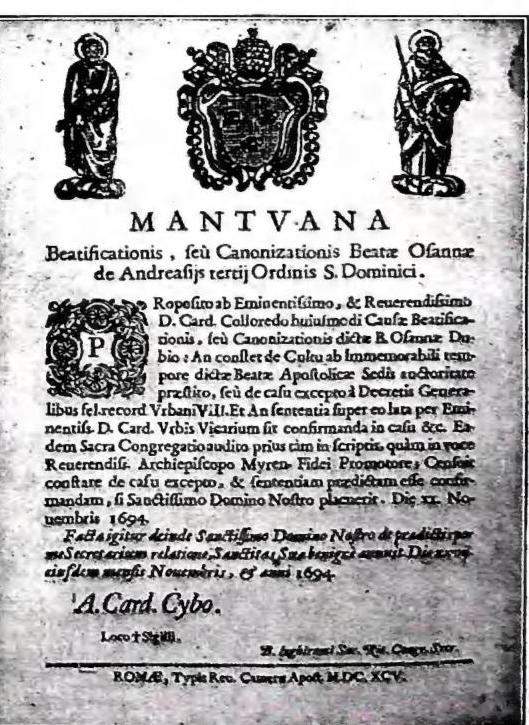
**MANTVA NA**
**Beatification, Feigned Canonization of the Blessed Ofanaz de Andrefaj of the Order of St. Dominic.**
**Ropelino ab Eminenti, & Recuerdafim D. Card. Calloredo in such a Cause of Beatification, &c. feigned Canonization of the said Cardinal Blessed Ofanaz de Andrefaj of the Order of St. Dominic.**
**J. A. Card. Cybo.**
**Lore, Tyrer R. C. Card. A. M. D. C. X. G. V.**
**J. A. Card. Cybo.**
---
It may be analogous to parallel pagan usages accepted insofar as they contain nothing repugnant or superstitious. This is also widely attested and acknowledged by the Fathers themselves, and it cannot be held against Christianity, since these things are in themselves perfectly honorable and capable of being permeated by a higher form of religious spirit. St. Jerome’s words are apt: “Because we once honored idols, must we now not honor God for fear that the same honors paid to idols seem to be rendered to Him?” In the first case, veneration was directed toward idols and must therefore be abhorred; in the other, it is directed toward martyrs and thus deserves approval (*Contra Vigilantium*, 7). The spirit animating the Christian cult of the saints from its earliest days is vastly different from the spirit of polytheistic worship, for every Christian knows that the saints are not gods, that their excellence and power derive from God, and that every honor paid to them redounds to God. It cannot therefore be asserted that the cult of the saints is an unconscious return to paganism.
III. CONFIRMATION OF THE CULT. — This is the juridical recognition by the Holy See of a cult that had legitimately developed during the period from the pontificate of Alexander III (1159–81) to 1534, i.e., within the years preceding the constitution *Caelestis Hierusalem cives* of Urban VIII (5 July 1634), with which the Holy See reserved exclusively to itself the approval of such cults (can. 2125).
For the history of the cult and the various modes of its approval in ancient Christianity and the Middle Ages, see the entries **BEATIFICATION**; **CANONIZATION**.
The practical effect of the approval of the cult is equal to that of a formal beatification, so that the juridical term “equivalent beatification” soon came into use.
1. **History of the procedure for the approval of the cult.** — Urban VIII first established the conduct of a special ordinary process in the diocese where the cult in question was practiced, which was to conclude with a juridical sentence by the Ordinary himself on the existence of the cult; the Congregation of Rites was to decide in three successive “congregations”: 1) on the introduction of the cause; 2) on the confirmation of the Ordinary’s sentence, i.e., the approval of the cult by the Holy See; 3) on the concession of Mass and Office in honor of the Servant of God.
However, by the time of Benedict XIV, a twofold form of cult approval had already been introduced: one with a view to canonization, in which case the full rigor of Urban’s procedure was required, and another with a view solely to the concession of Office and Mass, and in this second, more common case, while the three aforementioned congregations were still held, they were conducted without a prior canonical process: extrajudicial evidence sufficed. As a result, concessions of Mass and Office increased so greatly that the entire institution of cult approval lost its rationale. Indeed, by the end of the 18th century, the Holy See was content with the mere concession of Mass and Office without even pronouncing on the cult itself, and the evidence admitted for such concessions was sometimes quite flimsy.
Under Leo XII, the necessary reaction occurred. On 16 (20) December 1826, the Pope issued a decree by which the dual practice was reinstated: with regard to future canonization, the full rigor of Urban’s decrees was maintained; for the concession of Mass and Office, however, two congregations were established—one for judging the actual existence of the cult, the other for granting Mass and Office—while extrajudicial evidence remained admissible, as in the time of Benedict XIV.
Pius IX, however, felt compelled to require the Urbanian practice, i.e., the conduct of the ordinary process on the existence of a legitimate cult, both for the concession of Mass and Office and with a view to future canonization. Nevertheless, the processes were ordinarily limited to demonstrating that a certain cult had existed for at least a thousand years prior to 1634; little inquiry was made into its origin, authenticity, or the merits of the person (historical existence, life, virtues). The consequence was another inflation of cult approvals, particularly during the pontificate of Leo XIII.
Finally, Pius X established a new procedure without any distinction as to whether a canonization was envisaged or not, parallel in form to the ordinary procedure in all other causes. He maintained, as a basis, the ordinary process and the judgment on the existence of the cult, but added the regular procedure of the usual three congregations: ante-preparatory, preparatory, and general on the heroicity of the virtues or the martyrdom of the Servant of God. Only after obtaining the decree on the virtues or martyrdom may one proceed to the examination and approval of the cult. This new and rightly strict procedure was then incorporated into the CIC (can. 2125-35).
If, after this procedure, one wished to proceed, once the confirmation of the cult had been obtained, to formal canonization, three miracles are required that occurred after the confirmation of the cult (can. 2134, 2138).
2. Scope of the cult
The idea of Urban VIII was to ascertain not only the existence but also the scope of the existing cult concerning a particular Servant of God.And since formal beatification reached its complete canonical consistency (v. BEATIFICATION) only toward the end of the 17th century, from this time onward certain inequalities began to appear between certain confirmed cults and the limited cults of those formally beatified, so that it could happen that a Servant of God, whose cult had been approved within the limits actually attained, had enjoyed for centuries a cult as a saint, not universal but within a particular territory. According to current law, such a Servant of God, after confirmation of his cult, would be equivalently “beatified,” and thus would be entitled only to the honors and prerogatives of those formally beatified. To avoid such a diminution of cult, under Gregory XVI, in 1832, a new formula was introduced: when the cult of the Servant of God Gregory XVI was in question, the cause was titled: “Beatus, sanctus nuncupatus,” since it could be established that such a cult had been accorded to him, even in liturgical texts, since the Middle Ages. From then on, cases multiplied of confirmations of cult with the denomination *sanctus nuncupatus*, which, in comparison to simple confirmation, has a greater or more extensive meaning.